
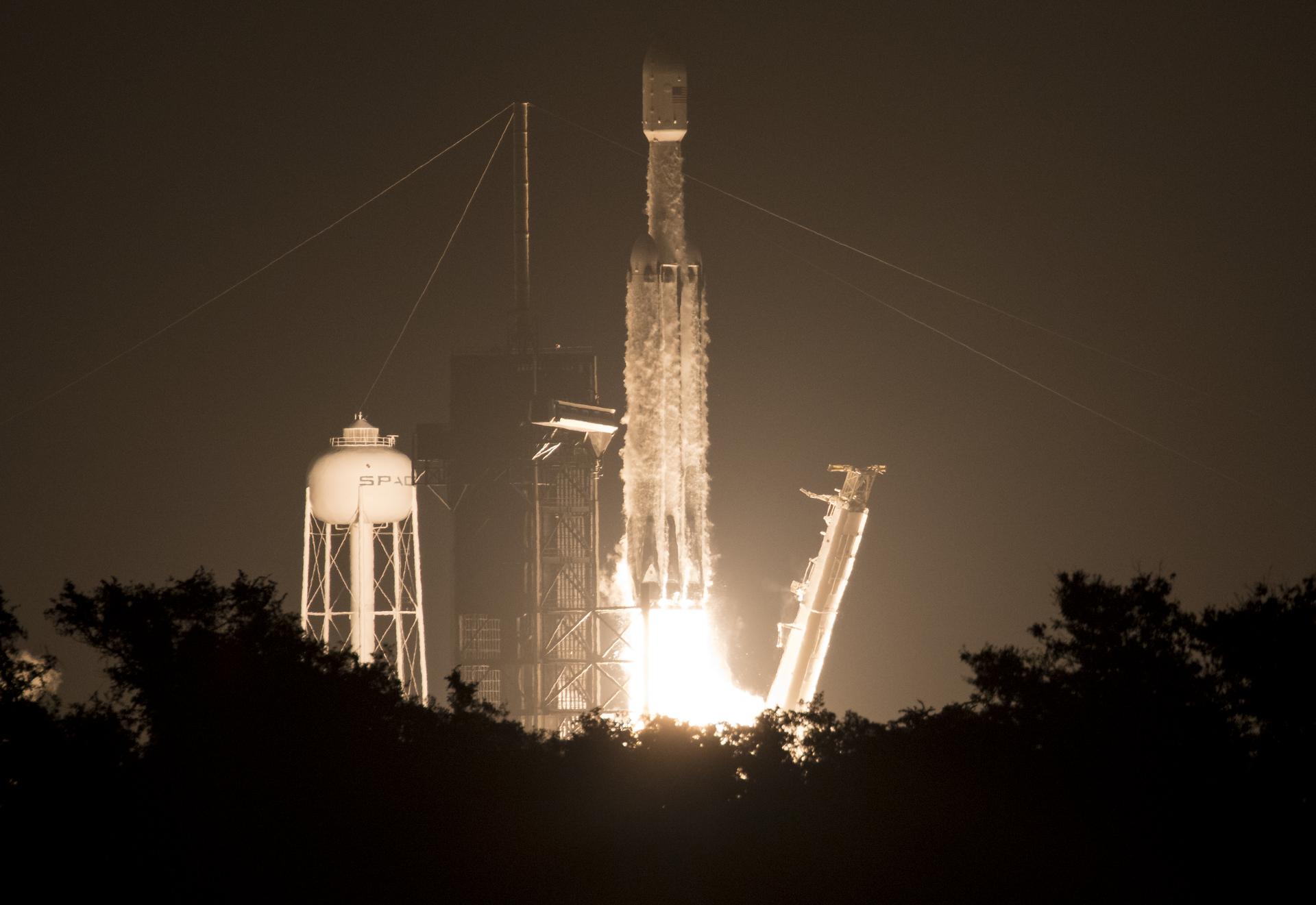
At 11:54 p.m. EDT on Oct. 1 (0354 UTC on Oct. 2), a SpaceX Falcon Heavy lifted off from Launch Complex 39A at NASA's Kennedy Space Center and headed out on a north-easterly trajectory carrying NROL-97 for the National Reconnaissance Office. The US spy-satellite agency has flown payloads on 22 Falcon 9 rockets, according to Spaceflight Now. This was its first time on the three-core Falcon Heavy, which was making its 14th flight.
The payload got the headline, but much of the rocket had flown before. Both side boosters had launched NASA's Nancy Grace Roman Space Telescope about a month earlier. The payload fairing had flown on another NRO mission in July. The launch was also SpaceX's third Falcon flight of the day.
A rocket built from recent missions
The two side boosters were B1104, on its second flight, and B1072, on its fourth. Both had last flown on NASA's Roman launch, a Falcon Heavy that lifted off from the same pad, LC-39A, at 7:26 a.m. EDT on Aug. 30. That makes 32 days between the two launch dates. After NROL-97, both boosters flew back to Cape Canaveral Space Force Station and landed at Landing Zones 1 and 2, with the usual sonic booms across the Space Coast.
Spaceflight Now reports that SpaceX returned LZ-1 to service for this mission after it had been replaced by LZ-40. The center core, B1106, was a new booster and was expended. It did not try to land. The payload fairing had flown before on NROL-95, which the NRO's release dates to July 30.
The NRO's own account of the launch, reproduced by Intelligence Community News, lists the reused hardware openly: fairings from NROL-95 and side boosters from Roman. Col. Ryan Hiserote, commander of System Delta 80 and the National Security Space Launch program manager, said the quick reuse of boosters that had supported a NASA mission only a month earlier was "a 30 percent faster improvement over the previous record." The release does not say which record he meant or how it was measured, so the figure is the agency's claim and not something we could check independently.
The mission involved several organizations. The NRO launched NROL-97 in partnership with Space Systems Command, System Delta 80, Space Launch Delta 45, and SpaceX.
The first Phase 3 Lane 2 payload
The contract history matters as much as the hardware. NROL-97 was the first NRO mission procured in 2025 through NSSL Phase 3 Lane 2, according to Spaceflight Now. The NRO release goes further and calls it the first national security payload launched from an NSSL Phase 3 Lane 2 contract.
The NRO release also quotes Col. Kathryn Cantu, director of the NRO Office of Space Launch and NROL-97 mission director. She said that flying under the Phase 3 Lane 2 framework shows the partnership with Space Systems Command is modernizing national security space operations, and that reusing the Roman side boosters enabled the NRO to eliminate schedule delays. That is the appeal of reusing flight-proven hardware: if boosters and fairings are already flown and ready, a payload is less likely to wait for new hardware.
Neither source describes what NROL-97 carries, where it was going, or what it will do. That is normal for NRO launches, and we will not guess.
Four landings in one day
NROL-97 was the last of three Falcon launches SpaceX flew on Oct. 1. Space.com's coverage of the day describes it as a spaceflight tripleheader:
- Morning: Crew-13 launched on a Falcon 9.
- 11:32 a.m. PDT (2:32 p.m. EDT): Transporter-18 lifted off from Vandenberg on a Falcon 9, whose first stage was completing its 25th flight. It carried 130 payloads on the rideshare.
- 11:54 p.m. EDT: NROL-97 launched on Falcon Heavy from Florida.
Spaceflight Now reports that the day was the first time SpaceX has landed four boosters in a single day. Two of those landings were the Falcon Heavy side boosters coming back to LZ-1 and LZ-2; the others were the Crew-13 and Transporter-18 boosters.
Why It Matters
NROL-97 pairs a national security payload with hardware that had flown a NASA flagship telescope 32 days earlier, plus a fairing from one of the NRO's own July missions, and the agency highlighted the reuse in its press release.
Three points stand out:
- Reuse is part of the plan. The NRO release lists the flight-proven hardware openly, and Hiserote's comments present fast booster turnaround as an achievement.
- Phase 3 Lane 2 is producing launches. NROL-97 is the first national security payload launched from that contract lane, which ties the contracting framework to an actual flight.
- Falcon Heavy flew twice in about a month. The rocket flew Roman on Aug. 30 and NROL-97 on Oct. 1 from the same pad, with its side boosters landing back at the Cape after both flights.
There are open questions. The NRO has not given the baseline behind the "30 percent faster" figure, and as usual there are no details about the payload. Still, one Falcon Heavy configuration flew for NASA's Roman telescope and then for a classified NRO mission about a month apart, with the side boosters reused in between.
Sources
- Falcon Heavy flies its first mission for U.S. spy satellite agency (Spaceflight Now, Oct. 1, 2026)
- NRO launches NROL-97 (NRO release via mirror, Intelligence Community News, Oct. 2, 2026)
- Roman Launch (NASA Science)
- SpaceX launches Google AI satellite, 129 other payloads on 2nd leg of spaceflight tripleheader (Space.com, Oct. 1, 2026)
