
Every so often, cosmic rays slam into Earth's atmosphere carrying energies that dwarf anything humans have built a collider to produce — up to a petaelectronvolt (PeV), or a quadrillion electronvolts. Astronomers have long wanted to know where these particles come from. A new theoretical paper submitted September 3, 2026, argues that the answer might be sitting at the center of our own galaxy: Sagittarius A*, the supermassive black hole around which the Milky Way turns.
The study, titled "Sgr A* as a Galactic PeVatron" (arXiv:2609.04051), is the work of eight researchers, including Marina Cermeño, Pedro De la Torre Luque, Viviana Gammaldi and Miguel Á. Sánchez-Conde. Rather than pointing a telescope at the galactic center, the team built a model of a decades-old idea from general relativity — the Penrose process — and asked whether it could turn Sgr A* into a "PeVatron," a natural accelerator capable of boosting particles to PeV energies.
What Is the Magnetic Penrose Process, and Why Neutrons?
The original Penrose process, proposed in 1969, describes how a rotating black hole's ergosphere — the region just outside the event horizon where spacetime itself is dragged around by the hole's spin — can, in principle, extract energy from that rotation. A particle falling into the ergosphere can split into two; if one fragment falls into the black hole with negative energy, the other emerges having gained energy at the black hole's expense.
The "magnetic" variant modeled in this paper adds the black hole's magnetic field to that mechanism, which the authors argue dramatically boosts the efficiency of the energy extraction. Their model works through the chain step by step: neutrons near Sgr A*, being electrically neutral, travel undeflected by the black hole's magnetic field into the ergosphere, where they undergo beta decay into protons, electrons and antineutrinos. Because the resulting protons are now charged, the magnetic Penrose process can act on them — and the paper's calculation shows those protons can be accelerated up to PeV energies, strengthening the case for Sgr A* as a candidate Galactic PeVatron.
Crucially, the authors don't stop at the acceleration mechanism itself. They calculate what such a process should produce as a byproduct: gamma rays and neutrinos, generated as the accelerated protons interact in the Central Molecular Zone, at energies that current and next-generation observatories are built to catch. The paper finds the predicted gamma-ray signal falls within the sensitivity of the Southern Wide-field Gamma-ray Observatory (SWGO) and, in some scenarios, approaches the reach of the Cherenkov Telescope Array Observatory (CTAO), while the predicted neutrino signal — though below current IceCube sensitivity — could be picked up by the neutrino detector KM3NeT/ARCA or the planned IceCube-Gen2. That's the difference between a purely theoretical proposal and a testable one: if Sgr A* really is behaving as described, these facilities should eventually see the signature.
A Companion Paper Pins Down How Sgr A* Itself Moves
Submitted the same day, a second paper takes a very different approach to studying the same object — not by modeling exotic physics near the event horizon, but by measuring, with unprecedented precision, exactly how Sgr A*'s infrared counterpart moves across the sky.
"Absolute Motion of Sgr A*'s Infrared Counterpart" (arXiv:2609.04077) is led by Rebecca A. Lewis-Merrill of UCLA, working with Andrea Ghez — the Nobel laureate whose Galactic Center group has spent 23 years tracking stellar orbits around Sgr A* to test general relativity — along with Tuan Do and collaborators from UCLA, UC Berkeley and Caltech. The team combined the Gaia-CRF3 celestial reference frame with Hubble Space Telescope data and Keck Observatory adaptive-optics imaging, the same adaptive-optics technique that underpins the Galactic Center group's long-running orbital studies.
The result is the first measurement of both the proper motion and the acceleration of Sgr A*'s infrared counterpart in an absolute reference frame — essentially, a precise account of where the black hole's radio/infrared signal is and how it's drifting. One notable outcome: the measurement sets a 2-sigma upper limit that excludes an intermediate-mass black hole companion more massive than roughly 4×10^4 solar masses within 0.01 parsecs of Sgr A*. In plain terms, if such a companion existed at that mass and that close, its gravitational tug would show up in the motion data — and it doesn't.
Setting the Scene: What Chandra Already Found Nearby
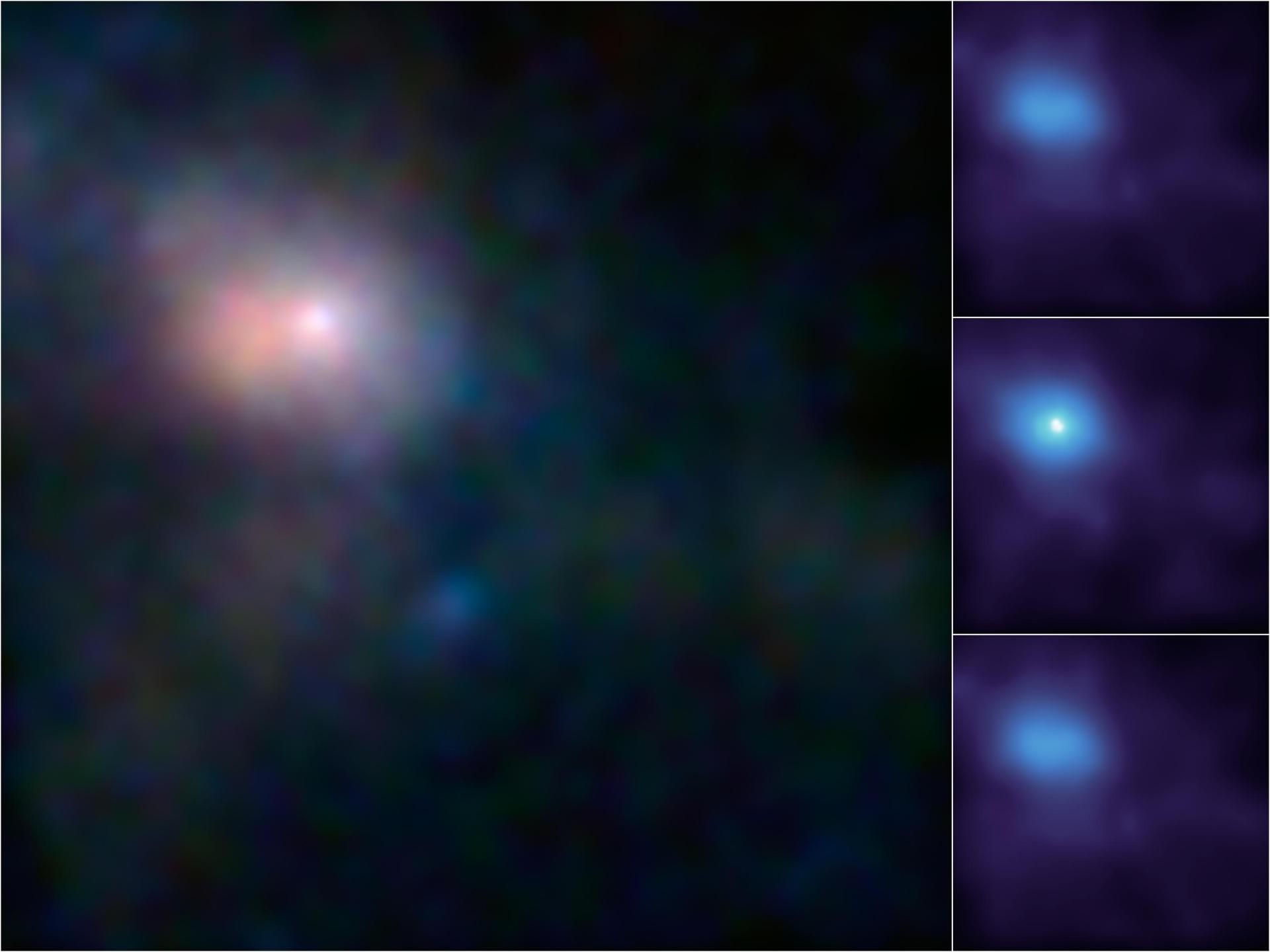
These two papers land against a backdrop of other recent findings about Sgr A*'s immediate environment. A 2026 release from the Smithsonian/NASA Chandra X-ray Observatory describes the detection, using both ALMA and Chandra, of a cone-shaped "hot cosmic wind" outflow streaming from the black hole's vicinity — an outflow the researchers, credited to M. Gorski of Northwestern University, say has been active for at least 20,000 years. The finding resolved a long-standing puzzle about missing wind expected from the region. Together with the astrometry and PeVatron papers, it's a reminder that Sgr A* is currently the subject of converging observational and theoretical scrutiny from multiple, largely independent angles.
Why It Matters
The origin of the highest-energy cosmic rays observed at Earth remains one of astrophysics' open questions, and supernova remnants — the traditional suspects — struggle to explain particles at the very top of the energy range. A supermassive black hole at the center of our own galaxy, close enough to study in detail, would be a uniquely well-placed PeVatron candidate if the magnetic Penrose mechanism holds up. That's still a big "if": the arXiv:2609.04051 paper is a theoretical model, not a detection, and its authors are explicit that confirmation depends on facilities like SWGO, CTAO and KM3NeT/ARCA actually observing the predicted gamma-ray and neutrino signatures.
The Lewis-Merrill/Ghez astrometry paper matters for a different reason: it's a direct, data-driven constraint on Sgr A*'s immediate surroundings, built from real telescope measurements rather than models. Ruling out a hefty intermediate-mass black hole companion nearby narrows the field for anyone trying to explain oddities in the galactic center's dynamics, and it demonstrates that decades of adaptive-optics work on the Galactic Center are now precise enough to measure the black hole's own motion, not just the stars orbiting it. Neither paper alone proves Sgr A* is flinging particles across the galaxy at near-light speed — but together they show how many independent lines of evidence, from X-ray winds to stellar astrometry to particle-physics modeling, are now converging on the same supermassive black hole at the heart of the Milky Way.
