
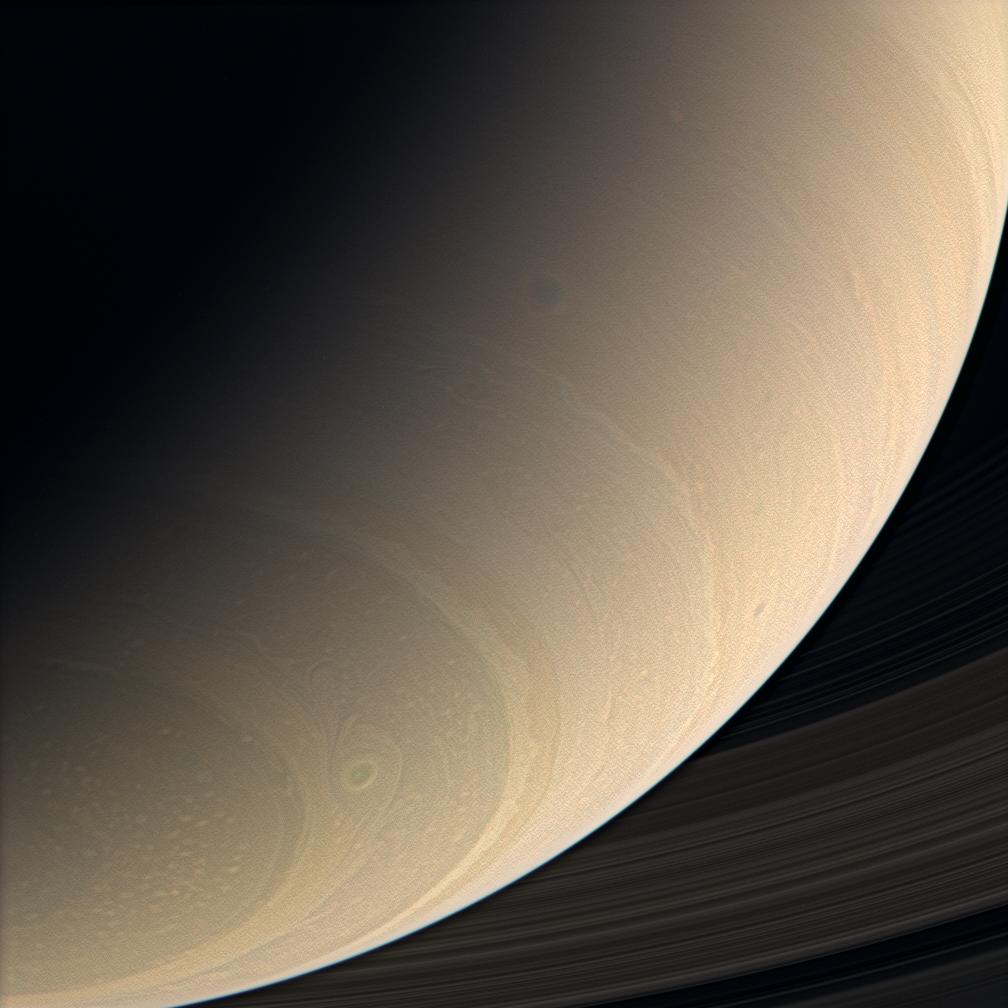
Saturn's north pole has spent four decades hosting one of the solar system's most inexplicably tidy features: a hexagonal jet stream, its six straight sides wrapping the pole like something drafted with a ruler rather than sculpted by turbulent gas. It showed up in Voyager images in the early 1980s and simply never left. Now Saturn's south pole has apparently decided to answer back — with ten sides instead of six.
A paper published September 2 in Science Advances, led by Agustín Sánchez-Lavega of the University of the Basque Country, documents a persistent decagonal wave encircling Saturn's south pole. The team traced the pattern using Hubble Space Telescope archival data back to 2023, after ground-based observers first flagged something unusual there in 2024. Two amateur astronomers, Trevor Barry and Jean-Paul Oger, are credited in the paper with contributing to the early identification — a reminder that backyard-scale telescopes still occasionally beat space agencies to a discovery, provided someone happens to be looking in the right place at the right time.
Co-authors Amy Simon of NASA's Goddard Space Flight Center, who leads Hubble's long-running OPAL (Outer Planet Atmospheres Legacy) program, and Michael Wong of UC Berkeley worked with Sánchez-Lavega to confirm the feature and pin down its timeline. Berkeley's Space Sciences Laboratory, Wong's home institution, published imagery in September comparing the newly seen ten-sided wave against Saturn's rings, helping visualize just how oddly geometric the pattern is for something made of moving gas.
A Hexagon's Estranged Twin
The most immediate comparison is obvious, and the researchers make it explicitly: NASA describes the decagon as "remarkably similar" to the northern hexagon in basic character — both are standing polygonal wave patterns locked to a planetary pole, both look almost engineered. But the resemblance stops at the family portrait. The northern hexagon has held its six-sided shape for more than 40 years, effectively unchanged since Voyager 1 and 2 first captured it. The southern decagon, by contrast, appears to be young and still gaining strength — a feature actively sharpening rather than one that settled into a stable configuration decades ago.
That difference matters because Saturn's two poles have not exactly been symmetric in what they show off. Cassini spent 13 years, from 2004 to 2017, orbiting Saturn and staring at both ends of the planet in extraordinary detail. It never found a long-lived polygonal feature at the south pole. Whatever is generating the decagon either wasn't there during the Cassini era, wasn't strong enough to notice, or has changed since — and Hubble's archival record, stretched back to 2023, is the only reason anyone can now say the feature predates its 2024 discovery by ground-based imaging at all.
How You Miss a 10-Sided Pattern for a Decade
It's worth sitting with how the discovery actually happened, because it says something about how planetary science works in practice. Nobody sent a mission to look for this. Ground-based astronomers — amateurs among them — noticed something odd at Saturn's south pole in 2024. That prompted a search through existing data, and Hubble's OPAL program, which has photographed the outer planets on a repeating schedule for more than a decade, had the south pole in frame going back further than anyone had thought to check. Reprocessing those archival frames pushed the confirmed presence of the decagon back to 2023.
That is a fairly ordinary pattern in outer-planet science: a mission built for routine cataloging quietly banks years of images, and years later those images turn out to contain the first record of something nobody knew to look for. It also means the actual birth of the decagon remains an open question. 2023 is when it's confirmed in the data Hubble happened to have — not necessarily when it formed.
Why It Matters
Saturn's northern hexagon has been a genuine puzzle in atmospheric physics for 40 years: a jet stream that organizes itself into flat-sided polygonal shapes doesn't have an obvious analog in Earth's atmosphere, and explaining why has been an ongoing challenge for atmospheric modelers. A single persistent hexagon could always be written off as some quirk specific to Saturn's north — a one-off boundary condition, an accident of that pole's particular vortex strength or rotation. A second polygonal wave at the opposite pole, with a different number of sides and a different age, is much harder to shrug off as a fluke. It suggests polygonal polar jets might be a more general behavior of Saturn's atmosphere — or of giant-planet atmospheres generally — that simply hasn't always been visible, rather than a singular oddity tied to one location. Because the decagon appears to be actively strengthening rather than settled, it also hands atmospheric scientists something the static hexagon never offered: a polygonal wave caught in the act of forming, which is a much better dataset for testing theories about why these shapes appear at all than a pattern that has already been stable for half a human lifetime.
What Comes Next
With no active Saturn orbiter — Cassini's mission ended in 2017 — Hubble and ground-based telescopes are the only tools currently tracking the decagon's evolution. The research team's plan going forward is straightforward: keep watching. Whether the shape hardens into something as durable as its northern counterpart, drifts toward some other number of sides, or dissolves entirely once whatever is driving it changes are all live questions the paper doesn't resolve. For now, Saturn has two poles, two polygons, and one very useful excuse for astronomers — professional and amateur alike — to keep pointing telescopes at the ringed planet's most geometrically improbable weather.
