
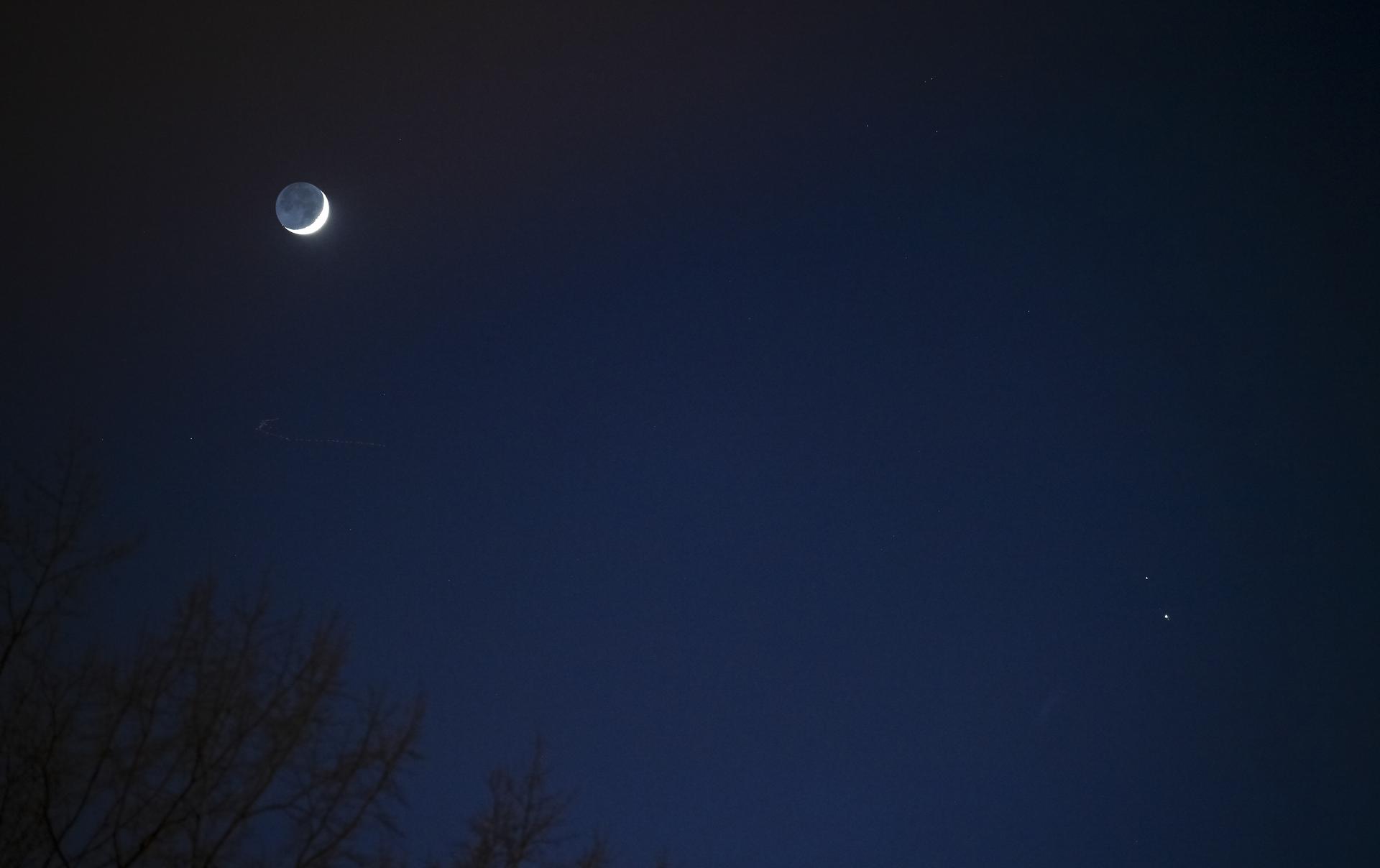
Early October hands sky-watchers two events in two days, and they suit different hours of the night. On Oct. 4, Saturn reaches opposition and sits in the sky from dusk to dawn. On the morning of Oct. 6, the waning crescent Moon slides in front of Jupiter, hiding it from view for observers across eastern North America. One is an evening-and-all-night target. The other asks for an alarm clock.
Saturn: opposition on Oct. 4
Opposition is the moment a planet lies opposite the Sun as seen from Earth. According to EarthSky, Saturn's opposition falls at 12 UTC (7 a.m. CDT) on Oct. 4. The planet shines at magnitude 0.3 and is about 784 million miles (1.26 billion km, or 8.43 astronomical units) away. Its disk spans up to 19.7 arcseconds. Saturn sits in front of the constellation Cetus, and Universe Today describes it as lying in a corner of that constellation.
Because Saturn is opposite the Sun, it rises at sunset and is visible all night, per NASA's JPL Night Sky Network. The same listing says it stays easily visible in the evening sky for the rest of 2026 before vanishing into the sunset glare in March 2027. EarthSky likewise puts its evening visibility at until March 2027. The JPL page is an event listing for a Salt Lake Astronomical Society public observing night on Oct. 4, from 7 to 10 p.m. Mountain time, so local clubs may be a good way to get a first look through a telescope.
Why it is a little brighter than the numbers suggest
Universe Today notes that Saturn gets a further lift near opposition from the opposition surge, also called the Seeliger effect, which it puts at a brightness gain of about 0.3 magnitude. Universe Today gives the ring tilt as 12 degrees in late 2026, widening from edge-on in 2025, and says the rings will be widest again in 2031. EarthSky, by contrast, lists the tilt as -7.5 degrees relative to Earth in October 2026, so the exact figure depends on how it is measured. Either way, the rings are open and easy to see in a small telescope.
The Moon meets Jupiter: Oct. 6
Two mornings later the show shifts to Jupiter. Universe Today gives the occultation as centered at 10:16 UT, or 6:16 a.m. EDT on Oct. 6. The Moon will be a waning crescent about 20 percent lit. Jupiter, at magnitude -1.9 and 34 arcseconds across, takes about a minute to disappear or reappear, which Universe Today calls a leisurely affair well suited to video. The nighttime side of the Moon, lit by Earthshine, should add to the scene.
When the Curves Line Up reports that the event is visible across eastern North America, the northern Caribbean and western Africa. Western locations see only the end of the event. Its times were computed with the U.S. Naval Observatory's MICA program, and its table of disappearance times for eastern cities runs from about 4:15 a.m. in Atlanta to 4:26 a.m. in Boston, with reappearance roughly an hour later. That is earlier than the 6:16 a.m. EDT figure Universe Today gives, so the two sources do not agree on the clock time, and you should confirm your own local times before setting an alarm. Universe Today notes the event occurs under predawn skies for the eastern contiguous United States and Canada, unlike last month's daytime occultation.
Which edge to watch
The geometry matters. Jupiter disappears behind the Moon's bright limb, which When the Curves Line Up says makes the disappearance harder to see than the reappearance. It reappears at the dark limb, the easier moment to catch. That source says the event can be viewed without optical aid or at low powers through a binocular or spotting scope, and warns that higher telescope powers greatly reduce the field of view, so a modest setup is enough. Since the planet fades out over about a minute, it helps to be watching a few minutes early rather than trying to time the exact second.
Why It Matters
Occultations are not rare in the abstract, but a well-placed one of a bright planet is. Universe Today calls this one of the best-placed and top skywatching events for 2026, and says the next good lunar occultation of Jupiter for the contiguous United States is Sept. 28, 2034. Saturn's opposition, meanwhile, is the planet's brightest showing for 2026 according to EarthSky, and it comes with months of comfortable evening viewing afterward. With the rings open and not at their widest until 2031, according to Universe Today, this is a good season to get a feel for how the ring tilt changes the view.
Practical advice: for Saturn, any clear night from Oct. 4 onward works, and nothing about the planet is time-critical. For Jupiter, check your local times against a tool such as MICA or a planetarium app, find a clear eastern horizon line of sight, and be outside well before the earliest time listed for your city, since the sources differ by a couple of hours.
Sources
- Catch a Rare Lunar Occultation Jupiter Plus Saturn at Opposition in Early October (Universe Today)
- Saturn at opposition, brightest for 2026, on October 4 (EarthSky)
- Saturn at Opposition event listing (NASA JPL Night Sky Network)
- 2026, October 6: Crescent Moon Occults Bright Jupiter in Predawn Sky (When the Curves Line Up)
