
For most of its existence, the hardware now climbing toward the Sun-Earth L2 point had no name the public was allowed to know. It lived inside a classified Boeing contract called Future Imagery Architecture, a National Reconnaissance Office program to build a new generation of optical and radar imaging reconnaissance satellites. It never flew. By 2005, after years of schedule slips and cost overruns that the New York Times would later describe as "perhaps the most spectacular and expensive failure" in fifty years of U.S. reconnaissance history, the program was cancelled outright. Two finished telescope assemblies — mirrors, structures, optics on the scale of the Hubble Space Telescope — were left with no mission and no clearance to talk about what they were for.
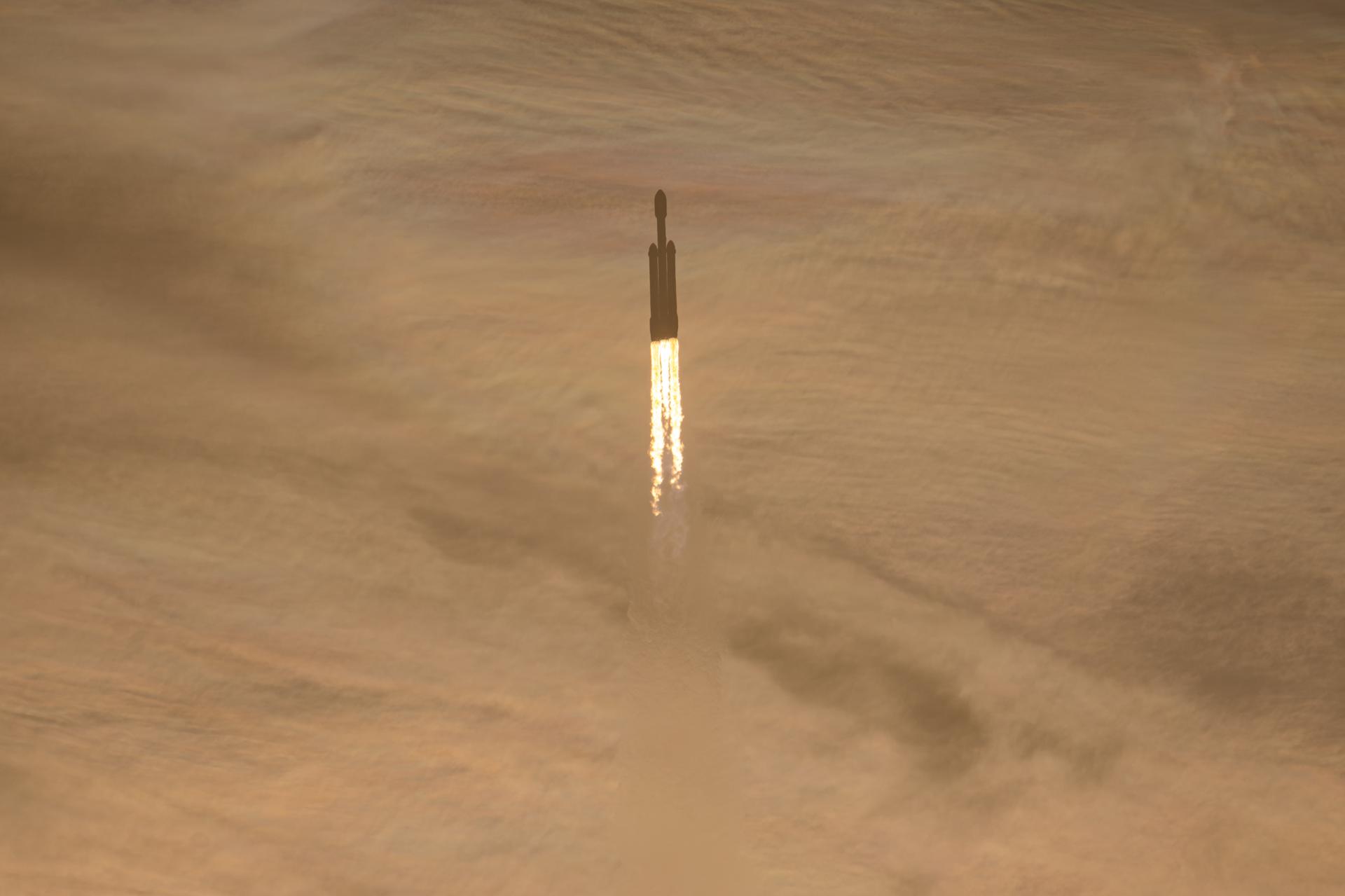
On August 30, 2026, at 7:26 a.m. EDT, one of those telescopes left Earth again, this time on a SpaceX Falcon Heavy lifting off from Kennedy Space Center's Launch Complex 39A, in full public view, streamed live, its purpose printed on NASA's own press materials. It is now the Nancy Grace Roman Space Telescope, and its job for the next several years is not to watch anyone. It is to look outward, at roughly a billion galaxies, and try to answer what dark energy actually is.
NASA Administrator Jared Isaacman called the mission's arrival at the pad, after more than a decade of development, a project "delivered ahead of schedule and on budget." That framing — a rare one in American spaceflight — sits oddly next to the instrument's own history. The optics inside Roman were not built ahead of schedule or on budget. They were built inside a program so far over budget on cost and schedule that its own overruns helped sink it in 2005, and they sat unused for seven years after cancellation before anyone found a second purpose for them.
From a Warehouse to a Decadal Priority
The path from cancelled spy program to flagship observatory ran through an unusual coincidence of timing. In 2010, the National Academy of Sciences released its decadal survey of astrophysics priorities — the document that effectively sets the field's research agenda for the following ten years — and named what would become the Roman Space Telescope, then called WFIRST, as its top-ranked large space mission. Two years later, in 2012, the NRO donated two surplus Future Imagery Architecture telescope assemblies to NASA, each independently valued at at least $250 million. One became the core of Roman. The donation was not a plug-and-play gift. The telescopes arrived stripped of their electronics, which the NRO removed before transfer, meaning NASA engineers had to design and build an entirely new instrument suite around optics they had not designed themselves. Some of the original technical documentation remained redacted under lingering classification, forcing engineers to work around gaps in records for hardware built for a mission that was never meant to be examined by outsiders at all. What NASA inherited was a telescope the same general size as Hubble but with a shorter focal length — a difference that happened to translate almost perfectly into a wide field of view for cosmology, whatever the original reasoning behind it.
That inherited geometry is the reason Roman exists as a distinct kind of observatory rather than a second Hubble. Its Wide Field Instrument, an 300-megapixel array built from eighteen 4K detectors, achieves image sharpness comparable to Hubble's across a field of view at least 100 times larger — about 0.28 square degrees of sky in a single exposure, where Hubble captures a sliver. The practical result is a survey speed roughly 1,000 times faster than Hubble's, and a data downlink of 1.4 terabytes per day. A telescope built to look outward with a wide field of view for one purpose turns out to be extremely good at a different one: the same shorter focal length that gave the NRO's optics their broad view is what gives Roman its broad view of the sky. Nothing about the optics changed. Only the direction they point, and who is allowed to see the results.
The Name Attached to the Instrument
Roman's three science objectives are dark energy, exoplanets, and general infrared astrophysics. On dark energy, it will measure the universe's expansion history through baryon acoustic oscillations, distant supernovae, and weak gravitational lensing — the subtle bending of galaxy shapes by intervening mass — across a survey volume no prior instrument has covered fast enough to sample at this scale. On exoplanets, it will run a gravitational microlensing survey capable of detecting free-floating planets with no host star at all, alongside a coronagraph for direct imaging of planets around nearby stars. Both approaches lean on the same trait: the wide field lets Roman watch enormous numbers of stars simultaneously, catching the rare lensing events and faint planetary signals that a narrower telescope would need to get lucky to find one at a time.
The mission carries the name of Nancy Grace Roman, NASA's first chief astronomer and the person credited as the central organizing force behind the creation of the Hubble Space Telescope program — a role that earned her the nickname "Mother of Hubble." She held that title, and helped build that program, at a time when very few women reached senior leadership positions in American astronomy at all. She spent her career pushing an institution toward space telescopes it had not yet committed to building. The telescope now carrying her name was built for an institution — American intelligence — that had no interest in her field whatsoever. The Future Imagery Architecture program was never going to produce a scientific instrument; its designers were solving a surveillance problem, not an astrophysics one, and the fact that the resulting optics turned out to suit cosmology was accidental, not planned. Roman herself had no connection to the hardware that would eventually bear her name. What connects them is a structural parallel rather than a direct one: an instrument kept out of public science for years by classification, named for a scientist who spent her career in a field that, for most of her working life, offered few women any senior leadership role at all. Neither the telescope nor the astronomer got into the room by the front door.
Why It Matters
Roman's launch is a genuine milestone for astrophysics on its own terms — a survey instrument fast enough to build 3D maps of cosmic structure at a scale earlier telescopes could only sample in small patches, arriving at a moment when the nature of dark energy remains one of the most open questions in physics. But the instrument's backstory is worth resisting the urge to over-read. The transformation from spy satellite to space telescope is not evidence that secrecy inevitably serves science, or that classified programs are quietly subsidizing basic research. It is closer to the opposite: a half-billion-dollar asset sat idle for seven years because no institutional mechanism existed to redirect failed defense hardware toward public science, and it only found a second life because a scientific priorities process happened to align with a donation nobody had planned for. That is a story about a fortunate exception, not a functioning pipeline. What it does illustrate clearly is a distinction between how classified and public science operate once the hardware is actually pointed at something. The Future Imagery Architecture program collapsed partly under the weight of its own opacity — contracts, costs, and technical decisions shielded from the kind of outside scrutiny that might have caught problems earlier. Roman's mission, funded through NASA's public budget process and reviewed through the open decadal survey system, will publish its billion-galaxy catalog for astronomers to use. The same optics that were once too sensitive to describe in an unclassified document will spend the next several years producing data explicitly designed for public release. That is not a redemption arc so much as a demonstration of what the same physical capability looks like under two entirely different sets of institutional incentives — one built to restrict information, the other built to distribute it. The telescope's commissioning period will run for roughly three months after it settles into orbit near L2, with first images expected in early 2027. Whatever it finds about the nature of dark energy or the population of free-floating planets in the galaxy will stand on its own scientific merit. But the fact that the tool doing the finding began its existence as a monument to a defense program too secretive to survive its own management, now flying under the name of a woman who spent a career arguing that she and her field deserved a serious hearing, is the kind of detail that does not resolve into a tidy moral. It sits there instead, a reminder that the line between watching an adversary and watching the origin of the universe can, mechanically, be a matter of degrees of a mirror's tilt — and that who gets to point the instrument, and who gets to see what it finds, was never a technical question at all.
Sources
- NASA's Dark Universe-Seeking Nancy Grace Roman Space Telescope Launches (NASA press release)
- Nancy Grace Roman Space Telescope mission page (NASA Science)
- From spy satellite to space telescope: The unlikely origins of NASA's Roman Space Telescope (Space.com, via Yahoo News)
- Nancy Grace Roman Space Telescope (Wikipedia)
