
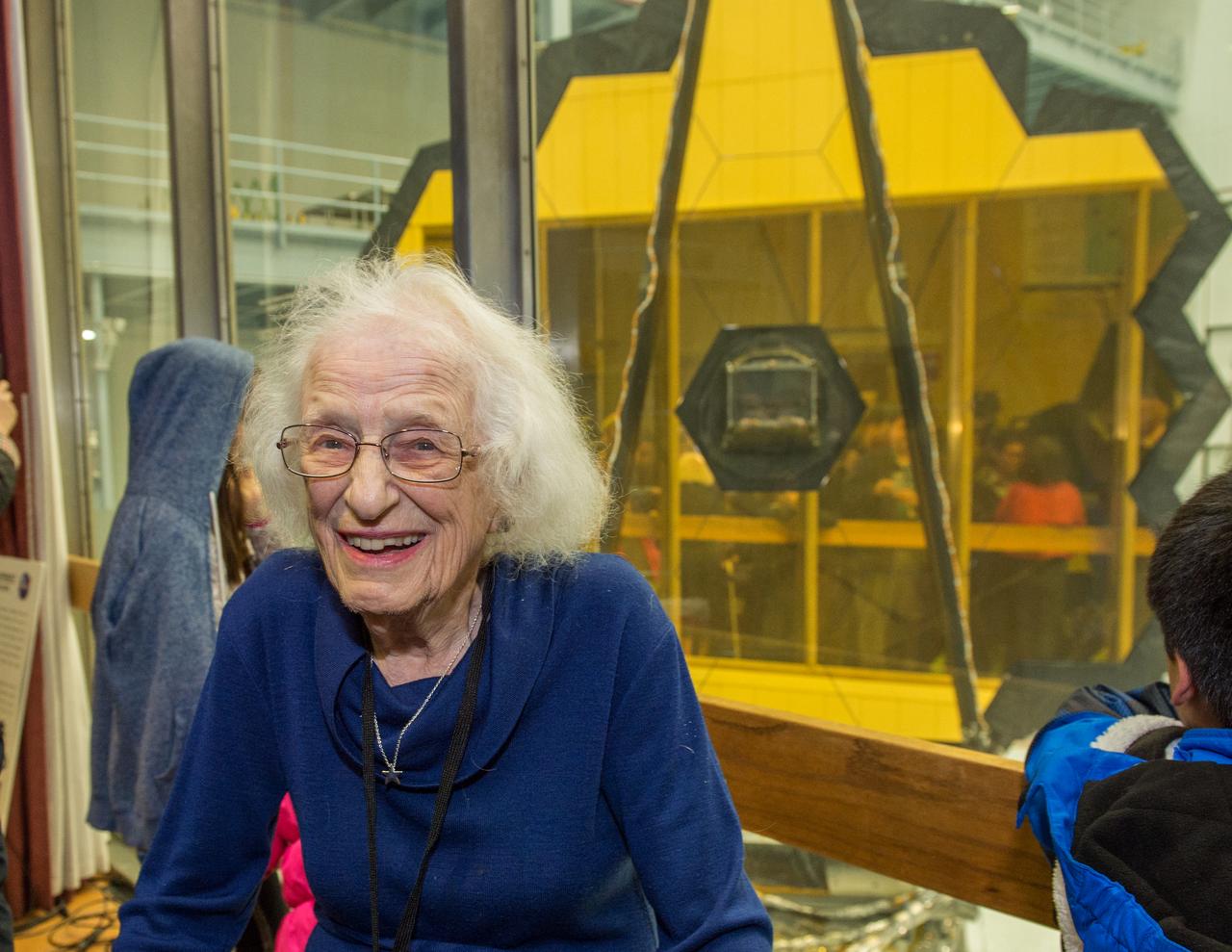
Large space telescopes run late. It is essentially a law of the field: JWST slipped by years; Hubble had its mirror problem; every generation of flagship observatory arrives with a story attached about schedules that didn't hold. NASA's Nancy Grace Roman Space Telescope is doing something unusual. It is ahead of schedule. On June 6, NASA confirmed the launch date as August 30, 2026 — eight months earlier than the original target — with liftoff on a SpaceX Falcon Heavy from Kennedy Space Center. If the date holds, Roman will be operating before the end of the year.
The telescope is named for Nancy Grace Roman, NASA's first Chief of Astronomy, who in the 1960s laid the institutional groundwork that eventually produced Hubble. The mission Roman carries her name into orbit has a science program that in some ways dwarfs anything that has come before it in exoplanet detection: 100,000 new worlds in five years, plus a first-ever statistical census of the free-floating rogue planets drifting through the galaxy without a star.
Two ways to find planets
Roman will hunt exoplanets by two techniques simultaneously. The first is transit photometry — the same method used by Kepler and TESS, watching for the brief dimming of a star's light as a planet crosses its face. Roman's wide field of view, roughly 100 times larger than Hubble's, means it can monitor an enormous number of stars at once. Over five years, that cadence is expected to yield approximately 100,000 transiting exoplanet detections — more than all previous transit surveys combined.
The second method is gravitational microlensing, and it does something transit photometry fundamentally cannot. When a foreground star passes between Earth and a more distant background star, the foreground star's gravity briefly bends and magnifies the background star's light — a predictable brightening that lasts days to weeks. If the foreground star has planets, they add their own gravitational contribution, producing characteristic deviations in the magnification curve that reveal the planet's mass and orbital separation.
Microlensing's advantages over transit detection are significant. It doesn't require the planet to orbit at an angle where it transits from Earth's perspective. It works on planets in wide orbits, far from their stars, where transits become too rare to catch. And crucially, it works on planets that have no star at all.
The rogue planet census
Free-floating planets — worlds ejected from their birth systems during the chaotic early dynamics of planetary formation — are one of the least-characterized populations of objects in the galaxy. Current estimates suggest they may be common, but the observational basis for those estimates is thin: a small number of directly imaged objects at the high-mass end, and hints from statistical analysis of microlensing surveys that the number of low-mass rogue planets could be enormous. Roman is designed to settle the question.
Over its Galactic Bulge Time-Domain Survey, running for 15 months across the mission lifetime, Roman will repeatedly scan the densely packed stellar fields toward the galactic center — the region where the optical depth for microlensing events is highest. Any compact object passing through the line of sight creates a lensing signal: not just planets, but stellar-mass black holes, brown dwarfs, neutron stars, and anything else massive enough to deflect light measurably. For the first time, it will be possible to count these populations across mass ranges where they've been essentially invisible.
Hubble's contribution
Preparation for Roman's microlensing survey has already begun — from Hubble. The older telescope has been conducting preparatory observations of the galactic bulge fields that Roman will study, building a foundational catalog of 20 to 30 million point sources. The catalog serves multiple purposes: it helps astronomers identify which stars are likely to participate in future lensing events before they happen, it establishes baseline brightness measurements to detect variability, and it maps the dust extinction zones where interstellar material obscures the view in ways that vary with wavelength.
The preparatory work also allows more precise mass measurements during microlensing events. Knowing a foreground star's mass from Hubble photometry — for example, determining that it is 0.8 solar masses — allows the gravitational contribution of any planet it hosts to be calculated more precisely when the lensing signal arrives. Without that prior data, the mass estimates carry larger uncertainties.
Beyond exoplanets
Roman's science program extends well past planet-hunting. Its High Latitude Wide Area Survey will image hundreds of millions of galaxies in the near-infrared, building a dataset designed to constrain the equation of state of dark energy — how its density changes with cosmic time, which determines whether the accelerating expansion of the universe will continue at its current rate or change. Weak gravitational lensing of those galaxy shapes maps the distribution of dark matter between us and them. The resulting 3D map will be the most precise measurement of the large-scale structure of matter in the universe available from a single instrument.
The instrument has also been designed to conduct a Supernova Type Ia survey, using the standard-candle brightness of exploding white dwarfs across cosmic distance to extend the distance-redshift relation — the same measurement that first revealed dark energy in 1998 — to higher precision and farther distances than ground-based surveys can achieve.
Roman arrives at a moment when the cosmological questions it is designed to answer are genuinely unresolved. The Hubble tension — the discrepancy between expansion rate measurements from the early and late universe — has not been explained. The nature of dark energy is unknown. The population of rogue planets is unmeasured. If the August 30 launch date holds, Roman will be returning science before the year is out.
Why It Matters
Roman's microlensing survey will conduct the first statistical census of planetary populations across all orbital separations — including the rogue planets and wide-orbit worlds that transit surveys systematically miss. That census is foundational: you cannot understand how planetary systems form and evolve without knowing how common these populations are. The telescope's dark energy and weak lensing surveys address a different but equally unresolved question: what is driving the accelerating expansion of the universe, and is its density constant or changing? If Roman launches on August 30 and returns data before year-end, it will be the most scientifically significant new observatory since Webb.
