
A telescope is only as useful as the pipe that gets its data home. For the Nancy Grace Roman Space Telescope, that pipe just got a full-throttle test — and passed.
NASA announced that all three ground stations assigned to track Roman have successfully received data from the spacecraft at its maximum downlink rate of 500 megabits per second, the fastest of any NASA astrophysics mission. The milestone, confirmed in a September 25 post from the Roman team, clears one of the last major operational hurdles before the observatory begins early science operations in early 2027.
Roman launched August 30, 2026, atop a SpaceX Falcon Heavy rocket from Kennedy Space Center, according to Spaceflight Now. Since then, the observatory has settled into its working position roughly one million miles from Earth, near the Sun-Earth L2 Lagrange point, where it will spend years surveying the sky in infrared light to study dark energy, exoplanets, and the structure of the universe.
Three Stations, Three Continents, One Deadline
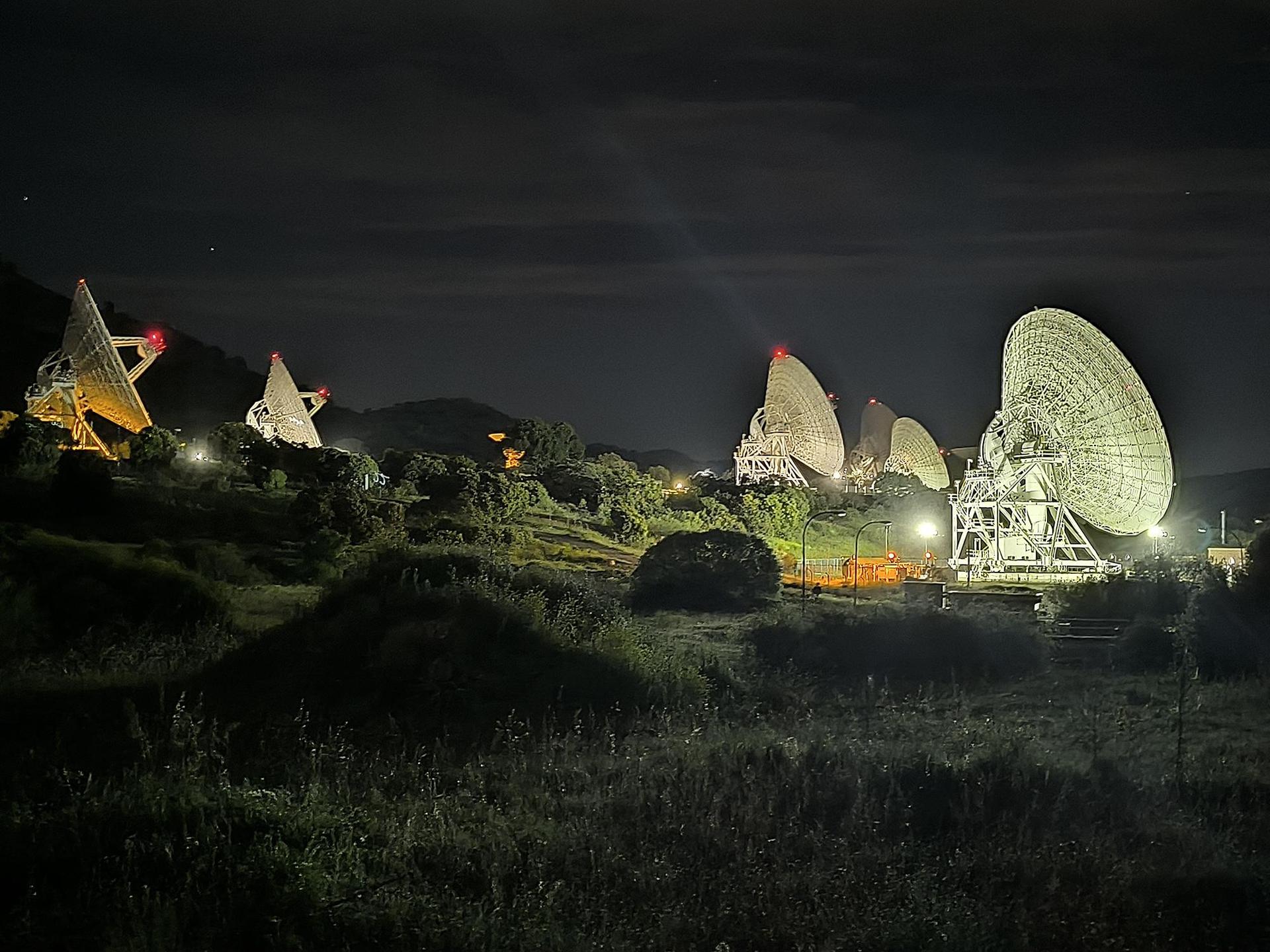
Getting Roman's torrent of data to the ground isn't a job for a single antenna. The mission relies on a trio of stations spread across the globe, each operated by a different space agency: NASA's Near Space Network station at White Sands, New Mexico; the European Space Agency's antenna near New Norcia, Australia; and JAXA's Misasa Deep Space Station in Japan.
Testing ran through most of September. JAXA's Misasa station went first, completing its peak-rate reception test on September 7 — during typhoon conditions, according to NASA. White Sands followed with a multi-day test window from September 8 through 11, and ESA's New Norcia station closed out the campaign on September 17. All three demonstrated they could pull in Roman's signal at the full 500 Mbps rate without a hitch.
"This is real, operational data," said Bob Kalogerakos, an RF engineer at NASA's Goddard Space Flight Center, describing the significance of moving from simulated test signals to genuine spacecraft telemetry flowing through the network.
The numbers involved are substantial. At full rate, Roman is expected to generate roughly 1.4 terabytes of data every day once science operations are underway — a volume driven by the telescope's wide field of view, which will let it image large swaths of sky in a single exposure rather than the narrow postage-stamp fields typical of an observatory like Hubble or the James Webb Space Telescope.
Why It Matters
A space telescope's science output is gated by its downlink as much as by its optics. Roman's defining feature — a field of view far wider than Hubble's while matching Hubble's resolution, since the two telescopes share the same size mirror ground to a different prescription — means it will collect images far faster than previous infrared observatories. Without a ground network capable of keeping pace, that data would simply back up onboard, delaying delivery to scientists and risking bottlenecks as new observations pile on top of unsent ones.
By verifying all three stations independently at the mission's peak rate, NASA and its partner agencies have confirmed there's no single point of failure in the downlink chain. If one station is down for maintenance, weather, or a technical issue, the other two can carry the load without forcing Roman to throttle back its observing rate. That redundancy matters over a mission designed to run for years: Misasa's test itself proceeded successfully even with a typhoon bearing down on Japan, a reminder that rain and storms can scatter or weaken the radio signals Roman relies on, and that having stations spread across different climates — from Japan's subtropics to the Western Australian desert to monsoon-prone New Mexico — gives the network a way to route around any single station's bad weather.
The test also matters as a systems-engineering checkpoint. Roman's science teams have been counting down to an early 2027 start for its primary surveys, and a downlink failure discovered after that start would be far more disruptive — and costlier to fix — than one caught now, while the mission is still in its post-launch checkout phase.
A Longer Runway Than Planned
The ground-station milestone arrives alongside another piece of good news for the mission's long-term prospects. According to a September 15 report from Universe Today, Roman's post-launch trajectory correction burn used only a fraction of its budgeted fuel. Fuel is Roman's only consumable resource and its ultimate mission-limiting factor: even once it settles into its halo orbit at L2, it will still need periodic station-keeping burns roughly every 28 days to hold position, so fuel efficiency early in the mission has outsized effects on how long it can operate before running dry.
That efficiency reportedly extended Roman's projected operational lifetime from roughly 10 years to about 22 years — more than double the original estimate. Combined with a downlink network now proven at full rate, the extended fuel margin suggests a mission with room to run: more sky surveyed, more data returned, and more time for the observatory to fulfill its role as a wide-field complement to Webb's narrow, deep gaze.
What Comes Next
With the ground segment validated, Roman's team moves into the remaining checkout and calibration work ahead of early science operations in early 2027. That phase will put the observatory's instruments — including its 300-megapixel wide-field camera, the source of its enormous data rate — through the paces on real astronomical targets before the mission's formal survey programs begin in earnest.
For now, the September test campaign answers a basic but essential question: when Roman is ready to start returning science-quality data at full speed, the ground is ready to catch it — on three continents, in whatever weather shows up.
