
Most known exoplanets were found by starlight: a dip as a planet crosses its star, or a wobble in the star's spectrum. A pair of papers published Tuesday, Nov. 10, in The Astrophysical Journal describes a different approach. A planet's presence could be written into the gravitational waves given off by two dead stars orbiting each other, and a future space observatory could read it.
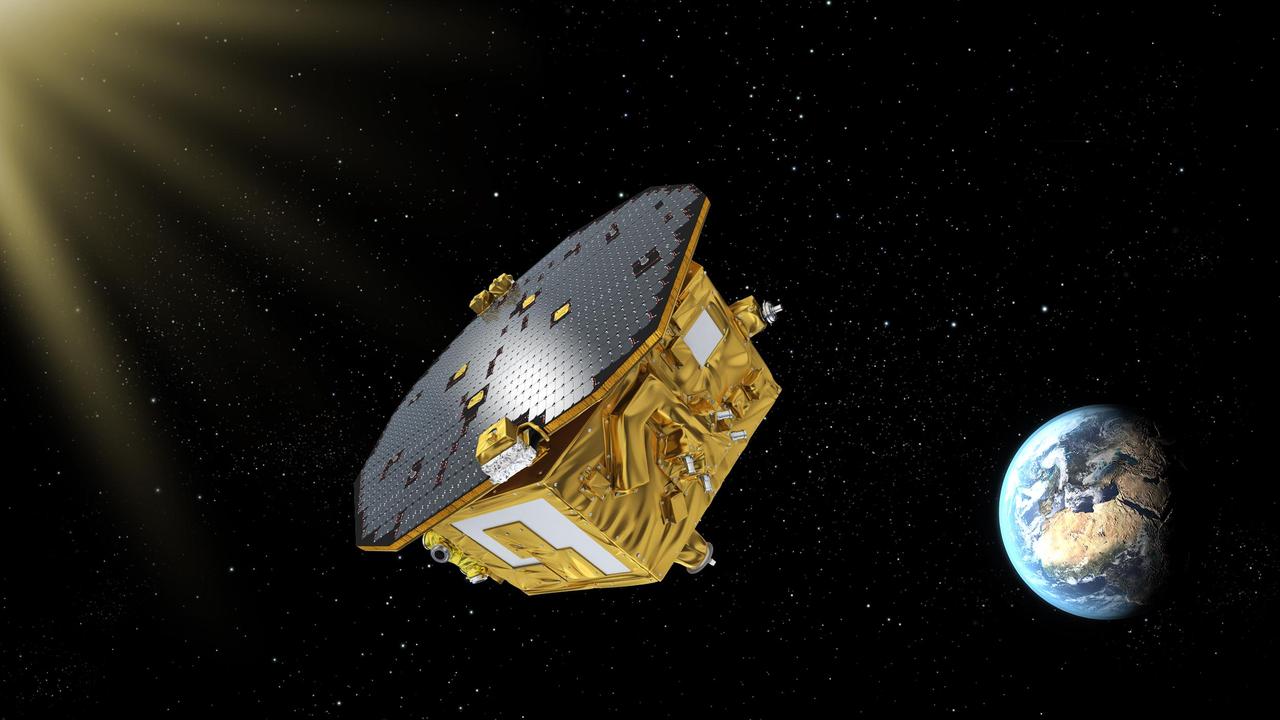
The work is led by Casey McGrath, a postdoctoral researcher at the University of Maryland, Baltimore County, and NASA's Goddard Space Flight Center. It targets a tight binary made of two white dwarfs, the dense leftover cores of dead stars. The instrument in question is LISA, the Laser Interferometer Space Antenna. LISA is led by the European Space Agency with NASA as a contributor, and it is scheduled to launch in the mid-2030s.
Listening for the wobble
Two white dwarfs circling each other closely give off a steady gravitational-wave signal at a well-defined frequency. McGrath's first paper, which she wrote alone, works out what happens when a planet orbits the pair. The planet's gravity adds a Doppler modulation to that signal. In the data it shows up as sidebands, which are weaker copies of the signal at frequencies a little above and a little below the main one.
The principle is the same Doppler effect behind radial-velocity planet hunting, which looks for periodic shifts in a star's light. Here the shifts appear in a gravitational-wave signal instead. The first paper also identifies which planet masses and orbital periods the method is best at finding. According to NASA's announcement, a Jupiter-mass planet could be detectable up to thousands of light-years away.
The idea itself isn't new. NASA notes that Naoki Seto first proposed it in 2008. Others have since built on it, including Tamanini and Danielski in 2019 and a 2021 study that estimated detection rates for both LISA and China's planned Taiji mission. That 2021 study simulated a four-year mission using the Mock LISA Data Challenge population of binaries and assumed, as a test, that half of them hosted planets. The new papers take the concept further. They pin down where LISA's sensitivity is best, and they work out how a gravitational-wave candidate could be checked with an ordinary telescope.
The numbers behind the opportunity
The scale of the possible sample explains the interest. The Milky Way is estimated to contain about 10 million double white dwarfs with orbital periods shorter than an hour. LISA won't separate all of them, but it is expected to resolve roughly 10,000 individual systems, plus around 100 mixed binaries. Each resolved source has a signal that can be searched for planetary sidebands.
That matters because white dwarfs are small and faint, and a tight pair of them is a difficult target for the transit and radial-velocity surveys that produced most of today's exoplanet catalog. A gravitational-wave search offers a way into a population those methods handle poorly.
Webb as the second witness
A wiggle in a gravitational-wave spectrum makes a candidate, not a discovery. The second paper, by McGrath with coauthors Scott Noble of NASA Goddard and Mary Anne Limbach of the University of Michigan, deals with confirmation. Their answer is the James Webb Space Telescope and a signature called infrared excess: more infrared light coming from the system than the two white dwarfs alone should produce, which can point to an orbiting planet.
According to the team, Webb can detect this excess out to at least 500 light-years. They also show where the two techniques differ in reach. For a test system at 500 light-years, Webb could detect a planet of about five Jupiter masses. Under ideal conditions, LISA could detect a planet smaller than Jupiter at that distance.
So the methods overlap only in part. In that test case LISA could reach lighter planets than Webb, and NASA says Webb should be able to confirm planets detected by gravitational waves in systems within a few hundred light-years. Where both apply, a sideband signal followed by an infrared excess from the same system would give two independent lines of evidence for a planet.
The instrument doing the listening
LISA is an ambitious machine. It will be the first space observatory dedicated to gravitational waves. Three spacecraft will fly in a triangle 2.5 million kilometers (1.6 million miles) on a side and measure changes in the distances between them smaller than the width of a helium atom.
That size lets LISA tune in to lower frequencies than ground-based detectors such as LIGO and Virgo. ESA's factsheet says it will cover signals with timescales from seconds to several hours, from sources such as interacting compact stars and merging supermassive black holes. NASA says double white dwarfs with orbital periods under an hour generate gravitational waves in the right range for LISA to find. ESA selected LISA as its third large-class mission (L3) on June 20, 2017, and formally adopted it on Jan. 25, 2024. Launch is currently planned for about 2035.
Why It Matters
Exoplanet science has a sampling problem. The planets we know are mostly the ones that current techniques find easiest: planets around ordinary, fairly bright stars. McGrath's papers suggest LISA could open a new population almost as a side effect. The double white dwarfs it was always going to observe would double as targets for a planet search.
Any planet found that way would raise questions of its own. Did it survive the late, violent stages of its host stars' lives, or did it form afterward? A count of how many of LISA's roughly 10,000 resolved binaries carry planets, even a rough one, could help test ideas about planetary survival.
Some caution is warranted. LISA is about a decade from launch, and these papers estimate what is possible. They don't report a detection. The best-case results, such as sub-Jupiter planets, depend on ideal circumstances. Still, the work shows how a gravitational-wave detector could serve as a planet finder, and how Webb could check its candidates.
