
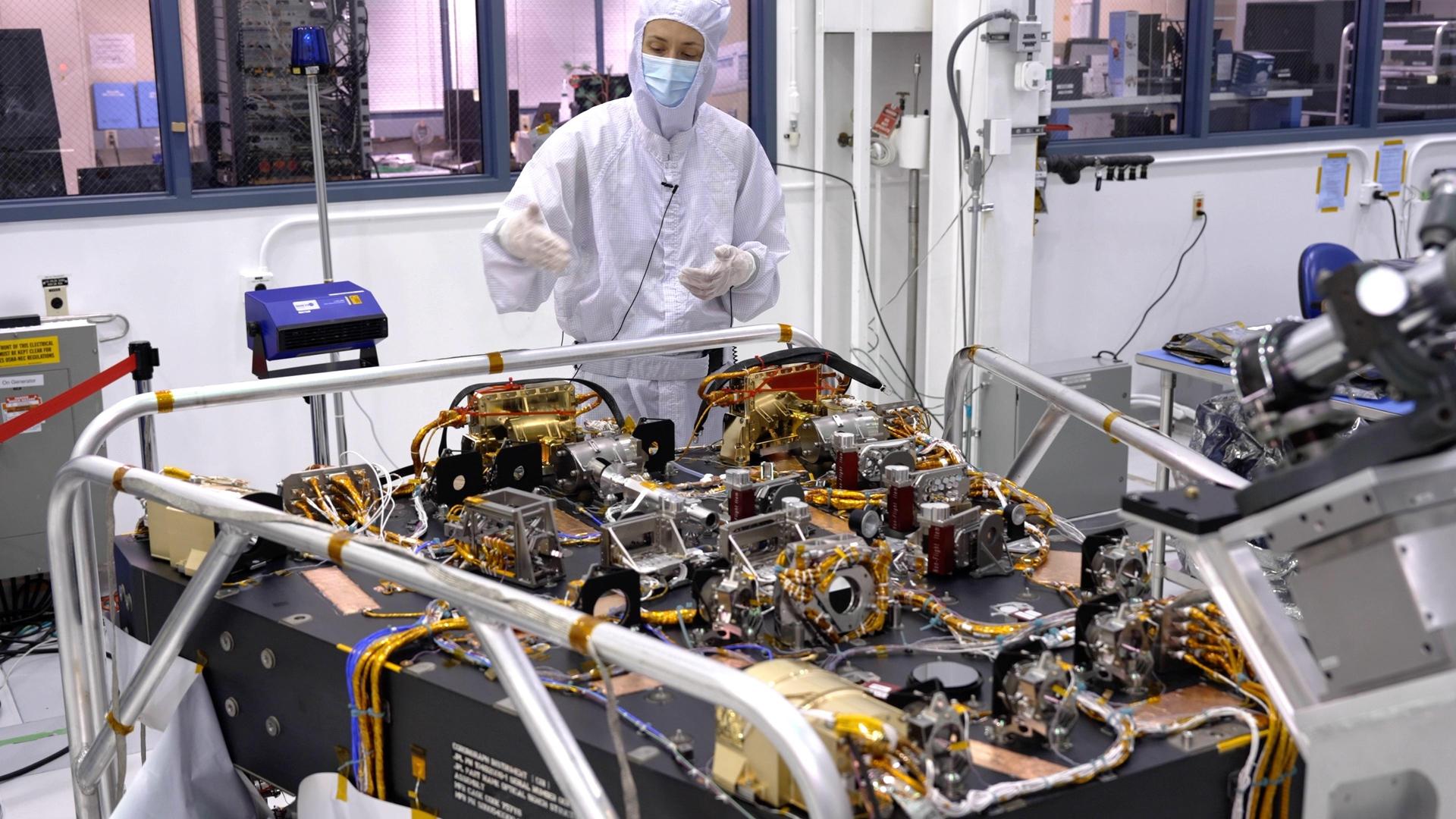
Two days after riding a SpaceX Falcon Heavy off the pad at Kennedy Space Center, NASA's Nancy Grace Roman Space Telescope hit its first major instrument milestone. On the morning of September 1, 2026, engineers sent the command to power on Roman's Coronagraph Instrument — a device built to do something few space telescopes have managed: block out the glare of a distant star cleanly enough to see the much fainter planets orbiting it.
The power-on sequence was brief. According to NASA's Roman blog, the process began at 7:27 a.m. EDT and wrapped up less than an hour later, at 8:22 a.m. That short window brought online a system NASA describes as the most advanced technology ever flown in space for directly imaging planets around other stars — years of design work condensed into a single quiet checkbox on a very long commissioning list.
What the Coronagraph Actually Does
A coronagraph's job sounds simple and is anything but: suppress a star's light enough that a planet a billion times fainter, sitting almost on top of it in the sky, becomes visible. Roman's instrument does this with a stack of optics, precision masks, sensors, and self-flexing deformable mirrors that can adjust their shape to cancel out stray light and imaging imperfections. That combination is what separates a technology demonstration like this from earlier planet-imaging attempts. Ground-based coronagraphs and even some space instruments have captured planets before, but almost always big, young, still-glowing worlds far from their stars. NASA says Roman's coronagraph is designed to help reveal giant planets that are older, colder, and in closer orbits than the hot, young super-Jupiters direct imaging has mainly turned up so far — a step toward the kind of imaging that will eventually be needed to photograph Earth-like planets around Sun-like stars.
Still Weeks of Checkout Ahead
Powering on is not the same as taking pictures. NASA says the coronagraph now enters a months-long series of calibrations and tests before it begins full science operations. Every mirror, mask, and sensor needs to be characterized and tuned before the instrument can be trusted to hunt for real planetary signals rather than instrumental artifacts.
The coronagraph activation didn't happen in isolation. It's one entry in a fast-moving commissioning sequence that Caltech/IPAC's Roman Science Support Center — which is coordinating science operations for the mission — has been tracking since launch, as the observatory unfolds and checks out its systems during its cruise toward L2.
From the Launch Pad to L2
Roman's road to this point started on August 30, 2026, when a Falcon Heavy lifted the observatory off Launch Complex 39A. As the Washington Times reported that day, the telescope had just begun a roughly one-million-mile, three-month journey to the Sun-Earth L2 point, the same gravitationally stable perch used by the James Webb Space Telescope, where it will settle into its final orbit. Roman's main mirror is a 2.4-meter instrument — the same aperture class as Hubble — but with an unusual pedigree: it was donated hardware, originally built for a U.S. national security satellite before being repurposed for astrophysics. Paired with it is a wide-field infrared camera whose field of view is at least 100 times larger than Hubble's, a combination intended to let Roman survey huge swaths of sky in the hunt for dark matter, dark energy, and exoplanets in a fraction of the time a narrower-field telescope would need.
The coronagraph is a smaller, more specialized piece of that overall mission — bolted onto a telescope whose primary science goals are cosmological. But if it performs as designed, it could prove out control-loop and starlight-suppression techniques that future, purpose-built exoplanet-imaging missions will depend on.
Why It Matters
Most known exoplanets have never actually been seen — they're inferred from a star's wobble or a periodic dip in its brightness as a planet transits in front of it. Direct imaging is different: it means collecting actual photons that bounced off or came from the planet itself, which opens the door to studying its atmosphere, colors, and orbit in ways indirect methods can't match. The catch is that stars are overwhelmingly brighter than the planets around them, which is why coronagraphs exist and why building one that works well in space, at low light levels, over months of operation, is such a hard engineering problem. Roman's coronagraph is explicitly billed as a technology demonstration rather than a guaranteed science instrument, and NASA has been careful to frame it that way. A successful checkout would still be significant: it would validate deformable-mirror wavefront control and high-contrast imaging techniques in space at a level beyond what's been previously demonstrated, feeding directly into the design of future missions — including concepts aimed at directly imaging Earth-sized, potentially habitable planets. A rocky start, on the other hand, would be an early data point on just how hard that goal remains. Either way, the months of calibration ahead will be the real test of whether Roman's planet-imaging ambitions can be matched by its hardware.
