
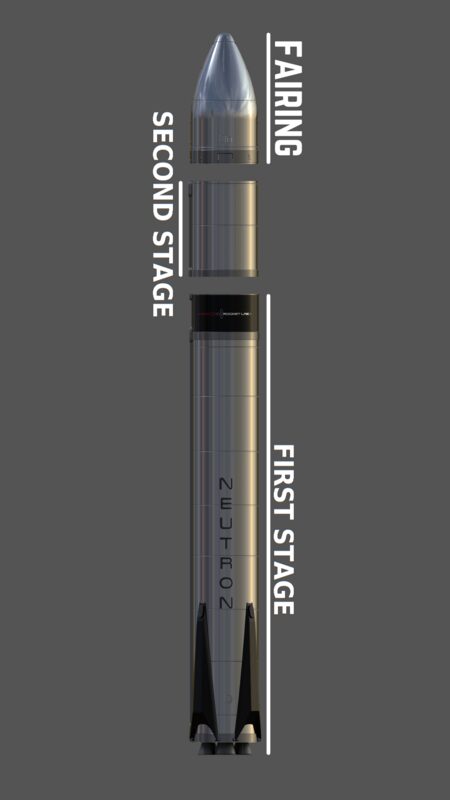
For a decade, Rocket Lab has made its name on the small end of the launch market with Electron, a light rocket that flies often and reliably. Neutron is the company's attempt to move up a weight class and into the most lucrative, most contested arena in spaceflight: medium-lift launch, the domain SpaceX's Falcon 9 has dominated. After a record year of Electron launches in 2025, Rocket Lab is now aiming to fly Neutron for the first time in the last quarter of 2026.
Built around reuse
Neutron is designed from the outset to be partially reusable, with a first stage meant to return and fly again — the feature that reordered launch economics once Falcon 9 proved it could be done routinely. An expendable medium-lift rocket now struggles to compete on price, so any serious new entrant has to bake in recovery from the start, and Neutron does. The company has also designed the vehicle with an eye toward the surging demand for launching satellite constellations, the high-cadence business that rewards a cheap, frequently flown rocket.
The vehicle itself is an unusual piece of engineering. Neutron is built largely from carbon composite rather than metal, stands about 43 metres tall, and is designed to loft roughly 13 tonnes to low Earth orbit when its first stage is recovered. It is powered by a new in-house engine called Archimedes, burning methane and liquid oxygen — the propellant combination favored by the newest generation of rockets for its performance and its friendliness to reuse. Most distinctively, the rocket's nose fairing stays attached to the first stage and opens like a hungry mouth to release the upper stage, then closes and rides the booster back, sparing the cost of discarding a fairing on every flight. It is, in short, a vehicle designed around the lessons of the last decade rather than retrofitted to them.
A setback, then a vote of confidence
The road to the pad has not been smooth. Earlier in 2026, a first-stage propellant tank ruptured during testing at Wallops Flight Facility in Virginia, the site Neutron will launch from. Rather than paper over it, Rocket Lab used the failure to revise the tank design, reporting improvements to both its structural margins and how easily it can be manufactured — a reminder that in rocketry, a test failure that teaches you something is doing its job. The company has since cleared stage-separation testing at full flight loads and is working through off-nominal separation cases, the unglamorous validation work that stands between a vehicle and its first flight. CEO Peter Beck has pointed investors to a concrete near-term marker of progress: hardware going onto test stands.
Customers, notably, are not waiting for the debut to commit. Rocket Lab announced a block deal for five Neutron launches to an undisclosed customer, at a value exceeding the company's previous record — a meaningful signal that the market wants a credible alternative to Falcon 9 badly enough to book flights on a rocket that hasn't flown. That demand is the real story behind Neutron. The launch market has been effectively single-supplier at the medium-lift tier for years, an uncomfortable dependence for satellite operators and governments alike. Whether Neutron's first flight slips, as first flights often do, matters less than whether Rocket Lab can turn it into a reliable, reusable workhorse. If it can, the medium-lift monopoly finally gets a competitor — and the whole market benefits from the pressure. For now, the milestones to watch are concrete and close: engines and stages moving onto test stands, and a first flight vehicle taking shape for shipment to the Virginia coast. First flights slip, and this one may too — but the distance between one dominant rocket and a real rival is finally measured in months rather than years, and that alone changes the conversation.
