
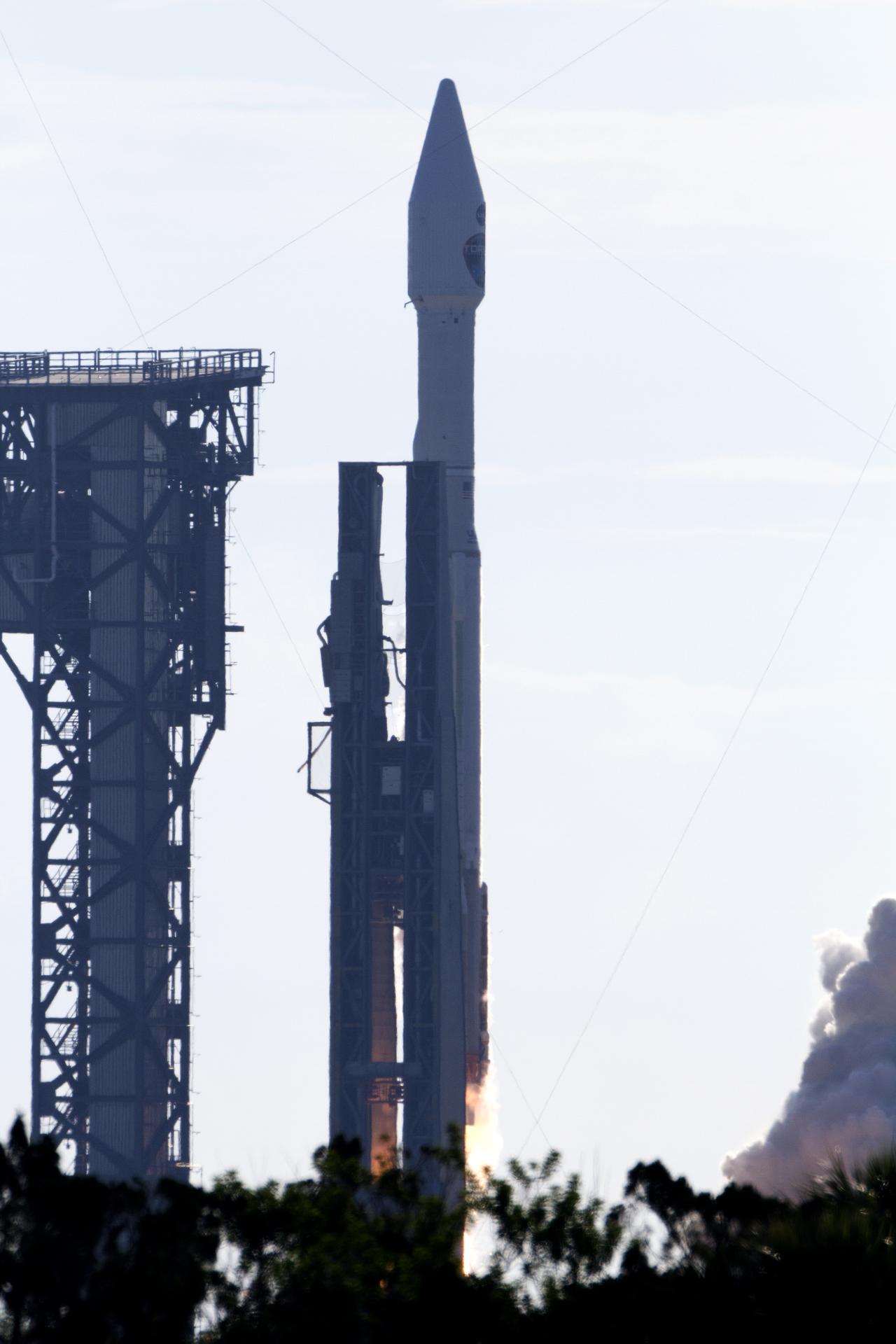
Most of the 32 payloads on SpaceX's Bandwagon-5 rideshare were headed for their own missions. Two of them were there to demonstrate something else: whether NASA can stop owning the satellites that relay its spacecraft data and rent that service from industry.
The Falcon 9 lifted off from Space Launch Complex 40 at Cape Canaveral on Oct. 20, 2026, according to Spaceflight Now, which listed a 7:04 a.m. EDT (1104 UTC) target time. It was a day late. The Oct. 19 attempt was scrubbed for poor weather in the booster recovery zone. The first stage, B1085, was flying for the 19th time. Spaceflight Now reported that the rocket carried 32 payloads, among them the Starfall reentry capsule, and that SpaceX had deployed all customer payloads by 1245 UTC.
Two of those payloads were NASA-funded commercial communications demonstrations, NASA said on its Small Satellites blog. One comes from Viasat and the other from SES Space and Defense. They take different routes to the same job.
The problem these satellites are meant to solve
For decades, NASA spacecraft in low Earth orbit have sent data home through the agency's Tracking and Data Relay Satellite (TDRS) system. NASA is now gradually retiring that fleet. Aerospace America reports that NASA stopped using TDRS for new missions in late 2024. Existing users, including the International Space Station and Hubble, are expected to keep relying on it until the mid-2030s.
NASA's plan for what comes next is to move future low Earth orbit missions to commercial alternatives. In 2022, NASA's Space Communications and Navigation (SCaN) division awarded $278.5 million to industry through its Communications Services Project (CSP) to develop satellite services for space missions. CSP is managed by NASA's Glenn Research Center, and NASA says testing will continue through 2027.
Two architectures, one test
Viasat and Maxwell
Viasat's demonstration is built around Maxwell, a spacecraft built by Rocket Lab. Aerospace America describes Rocket Lab as Maxwell's operator as well as its builder. According to NASA, Viasat will use Maxwell to test both high-rate and low-rate relay services. The demonstration will also use autonomous technology to route data among Maxwell, Viasat's geosynchronous satellites and its ground stations.
That routing piece is the main point of Viasat's pitch. Skylar Cox, chief technology officer of Viasat Space & Mission Systems, said during a Payload Space webinar, as reported by Aerospace America, that Maxwell will demonstrate end-to-end service, a move away from "rigid, constrained windows of communication opportunities" toward "always-on, persistent communication." Cox said the goal of CSP is to improve on TDRS, where mission controllers have experienced regular, if brief, dropouts as spacecraft antennas switch from one satellite to another. Aerospace America reports that Viasat received $53.3 million of the 2022 CSP awards.
SES Space and Defense
SES Space and Defense is leaning on its own existing fleet. NASA says the company will use its O3b mPOWER fleet in medium Earth orbit to transmit high-rate data and its satellites in geosynchronous orbit to transmit low-rate data, between the demonstration spacecraft and SES ground stations. That splits traffic across two orbital regimes according to how much bandwidth each job needs.
Both designs mix orbits. Neither is described as copying TDRS with a handful of dedicated government satellites; both rely on commercial operators' networks and ground stations.
Not the only bet
The Bandwagon-5 pair are not the only CSP efforts. Aerospace America reports that other companies with CSP contracts include Amazon's Kuiper, SES Satellite, SpaceX and Telesat, and that SpaceX's $69.95 million award is for connecting its Starlink constellation and ground system to spacecraft through optical links. NASA is equipping the Orion spacecraft for Artemis III with two SpaceX Starlink mini laser terminals to demonstrate that capability. So NASA is testing several commercial relay models at once: Viasat's autonomously routed hybrid network, SES's MEO-plus-GEO split, and SpaceX's laser links.
Greg Heckler, deputy program manager of capability development for NASA's SCaN Program, said during the same webinar that NASA made a decision several years ago not to build any more TDRS satellites, and so needed to maintain what he called Earth relay capability for science and human exploration missions. Aerospace America adds that NASA is applying the same approach of partnering with commercial providers to networks around the Moon and eventually Mars, with a larger goal of a unified "Solar System Internet."
Why It Matters
Relay networks rarely make headlines, but many science and exploration spacecraft depend on one. The data a mission can return is limited by how often and how fast it can reach the ground. Under TDRS, communication opportunities came with brief dropouts during handoffs between satellites. If the CSP demonstrations work, future missions could buy connectivity from commercial operators rather than from a fleet NASA must replace itself.
The timeline is tight. TDRS has been closed to new missions since late 2024, and its remaining users are expected to stay on it until the mid-2030s. With CSP testing continuing through 2027, the results from Maxwell and the SES demonstration will help NASA evaluate whether commercial relay can take over from a NASA-owned system. Viasat's promise of "always-on, persistent communication" now has to hold up in orbit.
