
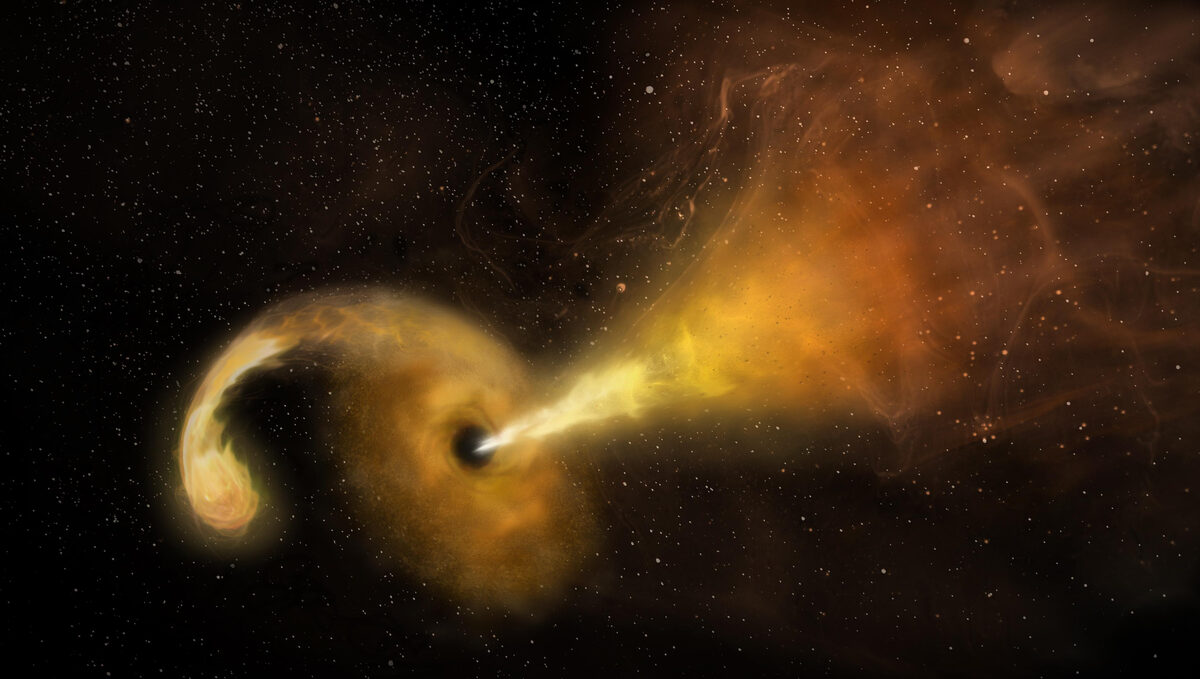
Most stars that wander too close to a supermassive black hole do not get a second chance. In a classic tidal disruption event, tidal forces overwhelm the star's own gravity in a single pass, ripping it apart and scattering its gas into a bright, short-lived flare as the debris falls back onto the black hole. The star does not survive to tell the story.
But over the past several years, astronomers have identified a stranger category of event: stars on tight, repeating orbits around supermassive black holes that get stripped of a little material on every close approach, flare each time, and then swing back out to do it again. About ten of these "repeating partial tidal disruption" systems have been identified so far. In four of them, something odd shows up in the data — each successive flare is dimmer than the last, even though the timing between flares stays remarkably steady, months to several years apart depending on the system.
That combination is the puzzle. If a black hole is stripping less mass from a star each pass, the star should be settling into a smaller, more tightly bound orbit — and the time between flares should shrink accordingly. Instead, observers were seeing the opposite: shrinking flares, but a fallback timescale that barely budges. A team led by Syracuse University doctoral student Ananya Bandopadhyay, with postdoctoral researcher Benjamin Amend and associate professor Eric Coughlin, thinks it has worked out why — and the answer comes down to how fast the star was already spinning before the black hole ever touched it.
The spin the star brought with it
The team's explanation, published in The Astrophysical Journal in August 2026, starts before capture. Many stars that end up on tight, repeating orbits around a supermassive black hole likely got there through what astronomers call the Hills mechanism: a binary pair of stars wanders near the black hole, and its tidal field tears the pair apart, ejecting one star at high speed while its former companion is captured onto a tight, bound orbit around the black hole.
That capture process leaves an imprint: stars that go through it tend to already be spinning rapidly by the time they settle into their new orbit around the black hole. And a star that is already spinning close to its own physical limit doesn't have much room left to spin up further.
That matters because spin governs how efficiently a tidal encounter can concentrate stripped material into a dense stream that falls back predictably. On each close passage, the black hole's gravity pulls at the star and would ordinarily torque up its rotation as it strips away gas. A slower-spinning star has plenty of room to be spun up pass after pass, changing how much mass is stripped and how tightly that debris streams toward the black hole. But a star that arrived already spinning fast can't be sped up much more — so the physical process that sets the fallback timescale stays roughly the same on every pass, even as progressively less material is available to be stripped away. Less mass loss means a dimmer flare; a near-constant spin state means a near-constant delay before that flare's peak. Put those two effects together, and you get exactly what observers have recorded: flares that fade while their timing holds steady.
Why It Matters
Repeating partial disruptions are a relatively new class of observed event, and until now the fading pattern seen in some of them had no clean explanation — models built around a single, one-off disruption did not anticipate stars that survive dozens of encounters while dimming on a fixed clock. Tying the behavior to pre-existing stellar spin gives astronomers a physical mechanism to test against future repeating flares, rather than treating each new dimming sequence as a fresh puzzle.
It also connects two outcomes of the same event. The Hills mechanism ejects one star from a disrupted binary at high speed while capturing the other — and this work suggests that captured companion may be hiding in plain sight, in orbit around supermassive black holes, producing exactly the kind of repeating, fading tidal flares now being catalogued. Coughlin notes that the mechanism may help explain the origins of some of the stars already known to be orbiting the Milky Way's own central black hole, Sagittarius A*. If so, repeating partial disruptions become more than a distant curiosity: they become a possible window into the population of tightly bound, fast-spinning stars circling our own galaxy's supermassive black hole, and a clue to how they got there in the first place.
What's still open
The study explains the pattern seen in four of the roughly ten known repeating systems; the fading effect is not universal even within this new class, and the framework does not yet cover the full diversity of what's been observed. As more repeating tidal disruption events are found — and as existing ones are watched through additional passes — the spin-based model suggests a testable prediction: systems built from fast-spinning, Hills-mechanism stars should keep showing fading flares on steady clocks, while stars captured by other routes, with slower initial spins, should behave differently. That's a prediction future surveys can check directly, pass after pass.
