
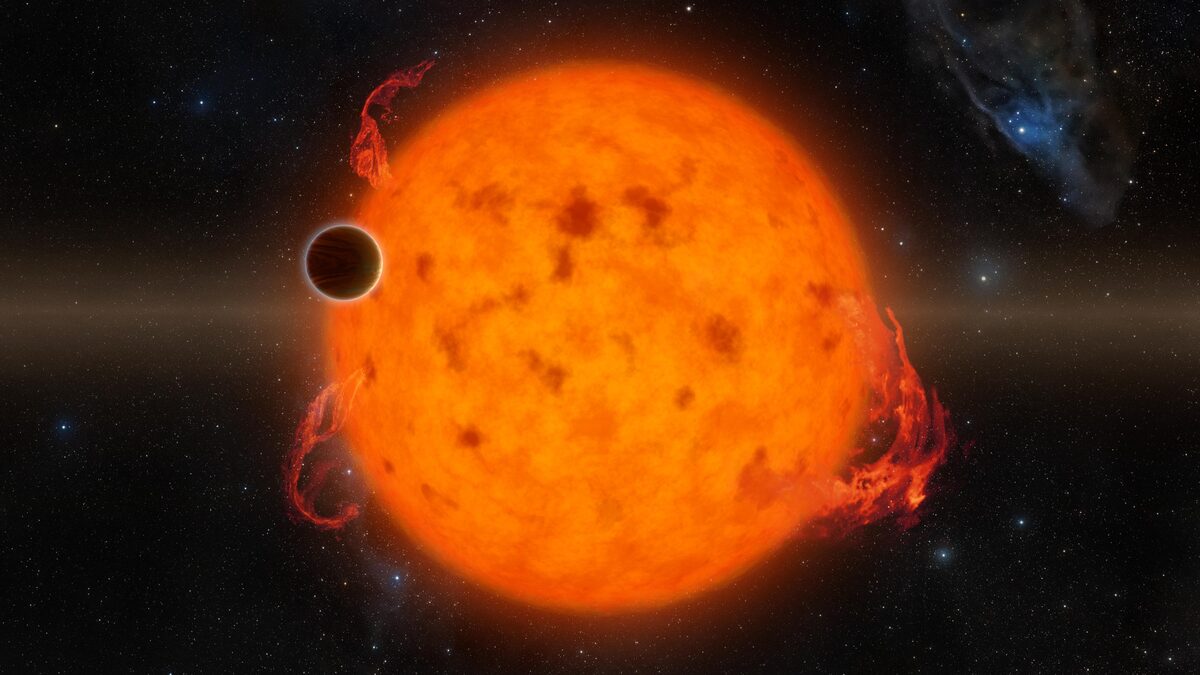
Most planets orbit in roughly the same plane their star spins in, and in the same direction. It's a leftover habit from the flattened disc of gas and dust every planetary system is born from. GJ 3090 b never got the memo. An international team led by the University of Geneva has confirmed that this sub-Neptune, orbiting a red dwarf 73 light-years from Earth, travels backward relative to its star's rotation — and, unusually, there's no obvious culprit forcing it into that path.
The result, published in Astronomy & Astrophysics on Sept. 21, 2026, turns a modestly interesting exoplanet into one of the more puzzling misalignment cases astronomers have on the books.
What the measurement actually shows
GJ 3090 b was already known before this study. First identified via the transit method in 2022, it's a sub-Neptune about 2.2 times Earth's radius and roughly 4.5 times Earth's mass, circling a red dwarf star with about half the sun's radius. The NASA Exoplanet Archive, maintained by Caltech/IPAC, lists the system's distance at 22.475 parsecs — about 73 light-years — and also credits a second planet, GJ 3090 c, detected via radial velocity measurements earlier this year.
What's new is the planet's orbital geometry relative to its star's spin axis. Using the NIRPS infrared spectrograph at La Silla Observatory — an instrument partly built in Geneva — the team, whose first author is UNIGE doctoral student Yann Carteret, measured what's known as the Psi angle: the three-dimensional tilt between a planet's orbital plane and the rotation axis of its host star. For reference, Earth's Psi angle is only about 7 degrees; our solar system's planets are all nearly coplanar with the sun's equator.
GJ 3090 b's Psi angle came out to 136 degrees. That's not just misaligned — it's retrograde, meaning the planet swings around its star in the opposite direction to the star's own spin. According to the Space.com report on the findings, by science journalist Robert Lea, this makes GJ 3090 b one of only five known systems with a Psi angle above 70 degrees, a threshold that marks genuinely extreme tilts rather than modest wobbles.
The missing suspect
Extreme misalignments like this usually have an explanation, and it's typically a big one: a massive companion — another planet, a brown dwarf, or even a second star — whose gravity has spent millions or billions of years tugging the inner planet's orbit out of alignment, or a violent early scattering event that flung the planet onto a tilted path in the first place.
GJ 3090 b doesn't have one. Of the five known systems with Psi > 70 degrees, it's reportedly the only one where researchers have not found a massive companion capable of doing the tilting. That absence is the real headline here: it's not just that the planet orbits backward, it's that astronomers can't point to the thing that should have made it do that.
A star with a split personality?
In the University of Geneva's own announcement of the findings, Carteret and UNIGE's Vincent Bourrier lay out a more exotic possibility: rather than something happening to the planet after formation, something may have happened to the star's protoplanetary disc during formation. Their proposal is that GJ 3090 may have accreted a second disc of material — one misaligned with, and rotating opposite to, the original disc the star and its planets formed from. If GJ 3090 b coalesced out of that second, retrograde disc, its backward orbit would be baked in from birth rather than imposed later by a companion's gravity.
It's a testable idea in principle, but a hard one to confirm after the fact — there's no leftover disc to observe billions of years later, only the orbital fingerprint it would have left behind. UNIGE's Léna Parc is also credited as part of the team pursuing the analysis.
Why It Matters
Spin-orbit misalignment measurements are one of the few tools astronomers have for reconstructing a planetary system's violent (or not-so-violent) youth, long after the evidence of formation itself has vanished. Most exoplanets that transit their stars show close alignment, consistent with calm, disc-driven formation. The rare exceptions — hot Jupiters flung into retrograde orbits by companion stars, for instance — have generally come with a suspect already in the frame.
GJ 3090 b breaks that pattern. If its tilt really does trace back to a second, counter-rotating accretion disc rather than a gravitational bully, it suggests protoplanetary discs can be messier and more layered than the tidy single-disc picture most formation models assume. That has implications well beyond this one system: it would mean misalignment alone can't be used as a reliable signature of a hidden massive companion, and that some fraction of "unexplained" misaligned systems may simply reflect chaotic, multi-generational disc formation rather than post-formation violence. Confirming or ruling out the two-disc idea will likely require finding more systems like GJ 3090 — tilted, but conspicuously alone.
