
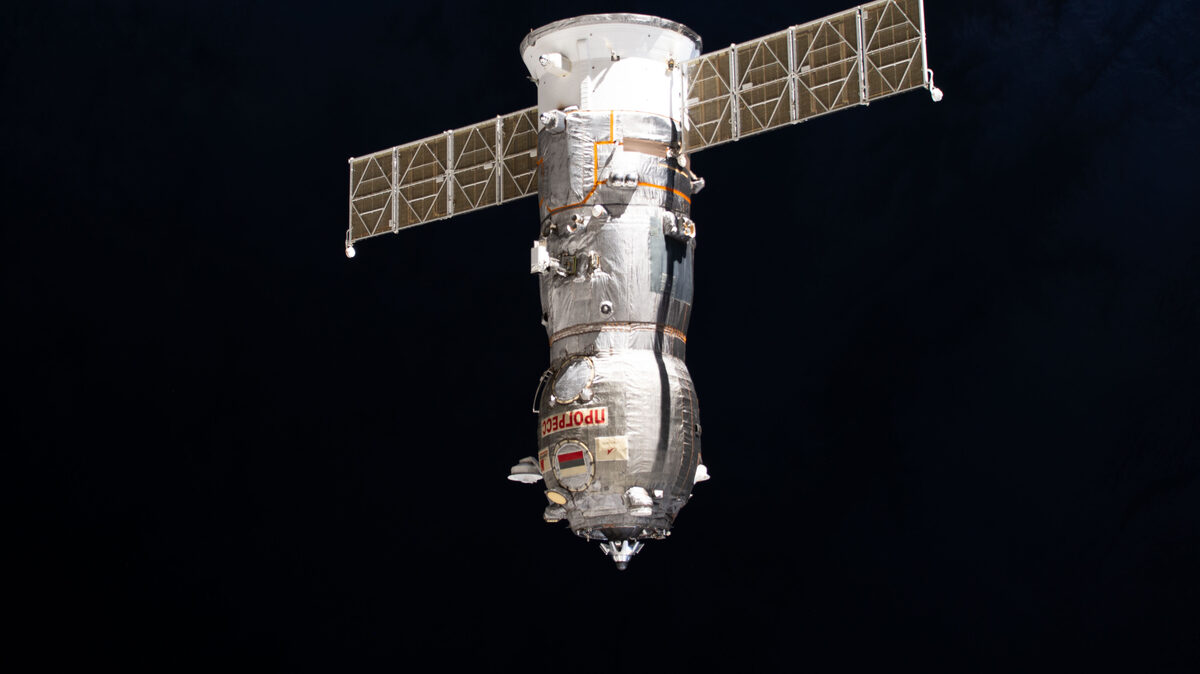
There's nothing glamorous about a cargo run. No crew waves from a hatch, no countdown gets a network primetime slot, and the payload manifest reads like a grocery list rather than a mission patch. But the International Space Station has run on exactly this kind of unremarkable logistics for more than a quarter century, and this week it's Russia's turn to keep the supply chain moving.
On Wednesday, Sept. 9, an uncrewed Progress 96 spacecraft — known to Roscosmos as Progress MS-35 — is scheduled to lift off from the Baikonur Cosmodrome in Kazakhstan atop a Soyuz-2.1a rocket. Liftoff is targeted for 12:15 p.m. EDT (9:15 p.m. local Baikonur time, or 16:15 UTC), according to NASA, with spacepolicyonline.com independently tracking the mission under its Roscosmos designation, Progress MS-35. That schedule carries some real uncertainty: as of Sept. 7, spacepolicyonline.com reported that unconfirmed social-media accounts were describing a possible postponement tied to a problem with the Soyuz rocket's third stage, though neither NASA nor Roscosmos had issued an official update at that time.
Aboard is roughly three tons of cargo — NASA rounds it to "about 3 tons," and spaceflight tracker Starlust independently describes it the same way, as roughly three tons of food, fuel, and general supplies bound for the station's seven-person crew. It's the kind of unglamorous inventory that keeps a laboratory the size of a football field running: propellant to maintain the station's orbit, water and provisions for the crew, and spare hardware to keep experiments and systems humming.
An Automated Two-Day Trip
Unlike a crewed Soyuz, which typically takes a fast-track rendezvous of just a few hours, Progress vehicles often fly a more measured approach to docking — and this one is no exception. Progress 96 isn't expected to reach the station until Friday, Sept. 11, with autonomous docking to the space-facing Poisk module scheduled for 2:37 p.m. EDT, per NASA. Starlust's coverage translates that to roughly 18:37 UTC. As with virtually all Progress missions, the docking will be fully automated, guided by the Kurs rendezvous system rather than a joystick in anyone's hand.
Getting a fresh freighter to the port required clearing space first. The outgoing Progress 94 spacecraft, which had been occupying a docking slot, undocked from the station on Monday, Sept. 7, at approximately 11:18 a.m. EDT — freeing up the berth Progress 96 will eventually use. That kind of choreography, one vehicle leaving so another can arrive days later, is standard practice for a station that typically hosts multiple Russian and American resupply craft in rotation.
Once Progress 96 docks, it won't be going anywhere fast. NASA says the freighter is expected to remain attached to the ISS for about five months before its eventual disposal — a fiery, deliberate reentry over the Pacific Ocean, the standard graveyard for Progress vehicles once their cargo is unloaded and their holds are filled with the station's trash and unneeded equipment.
Why It Matters
It's easy to read a Progress cargo mission as pure routine — because that's precisely the point. Progress spacecraft have been resupplying Russian and international space stations for decades, and that kind of steady cadence is what has allowed the ISS to sustain continuous human occupation for more than 25 years, a streak NASA highlighted in its own announcement of the mission.
That continuity isn't just a historical footnote. NASA frames the ISS's ongoing operation as directly supportive of the agency's next steps outward — research conducted aboard the station feeds into planning for Artemis missions to the Moon and eventual human trips to Mars. None of that research happens without a steady supply of consumables, spare parts, and propellant to keep the orbiting laboratory functional, which is exactly what missions like Progress 96 exist to deliver.
It's also a reminder that station logistics remain a genuinely international, and interdependent, undertaking. Even amid broader geopolitical friction between Russia and the West, NASA and Roscosmos continue to coordinate closely on ISS operations — this launch will get NASA television and web coverage despite being an entirely Russian vehicle launched from a Russian-leased pad in Kazakhstan. The docking port being vacated by Progress 94 and filled by Progress 96 is one small, mechanical illustration of how the partnership still functions on a practical, week-to-week basis.
How to Watch
Coverage of both the Wednesday launch and Friday's docking is expected to be available through NASA+, with additional carriage on Discovery+ and Amazon Prime Video, according to Starlust's mission preview. Given the unconfirmed postponement reports circulating as of Sept. 7 around the Soyuz rocket's third stage, viewers should check NASA's own channels for the latest schedule update before tuning in — the launch and docking times above reflect the plan as of this writing, not a guarantee the countdown holds.
Barring a scrub, Progress 96 will spend the next several months as a quiet, orbiting storage locker attached to the ISS — present but unremarked upon, exactly as cargo missions are designed to be.
Sources
- NASA to Cover Progress 96 Spacecraft Launch, Docking
- PROGRESS MS-35 CARGO MISSION TO ISS, Sept 9, 2026, Kazakhstan, 12:15 pm ET
- Progress 96 mission to bring supplies to the ISS on September 9: How to watch the resupply live
- Launch Preview: Soyuz, CZ-8A, and Falcon 9 to launch from sites around the world
