
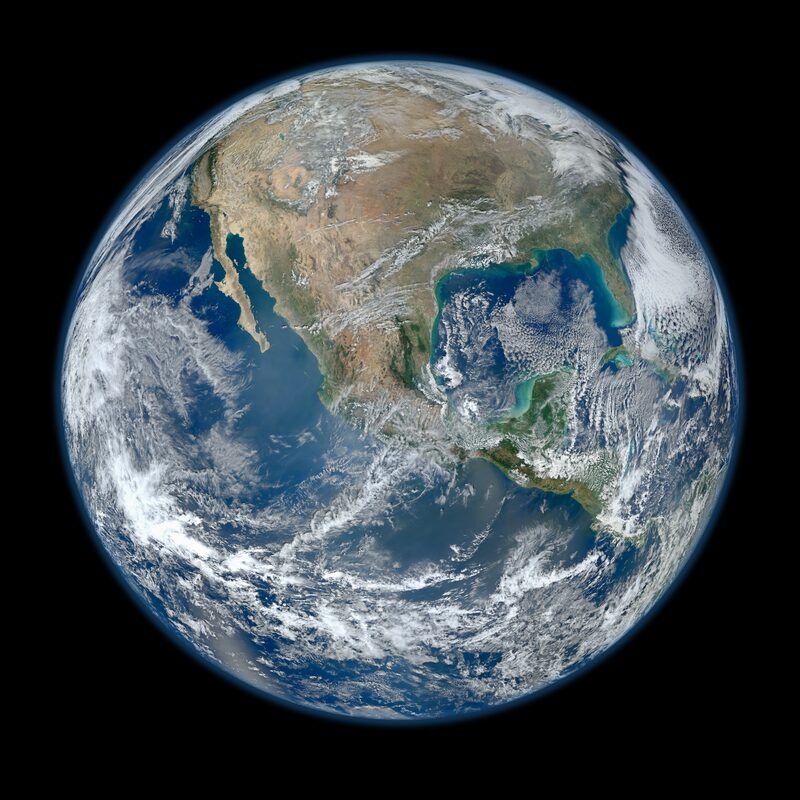
Traditional Earth observation satellites were large, expensive, and infrequent. Landsat — the U.S. Geological Survey's flagship Earth observation program, in continuous operation since 1972 — revisits any given point on Earth roughly every 16 days. SPOT, the French commercial observation system, offered 2.5-meter resolution imagery on a similar revisit cycle. These systems produced science of enormous value; Landsat's archives are one of the most important datasets in environmental science, covering five decades of land cover change globally. But their revisit rates made them tools for measuring change over seasons and years, not over days.
Planet Labs changed this model by applying the economics of consumer electronics — small components, rapid iteration, mass production — to satellite manufacturing. Planet's Dove satellites are 3U cubesats (10 × 10 × 34 centimeters) that cost a fraction of traditional satellites to build and launch. By operating a constellation of over 200 Doves in multiple complementary orbital planes, Planet achieves daily global coverage: every point on Earth is imaged at 3-meter resolution at least once per day, and the coverage density increases at higher latitudes. The resulting time series is qualitatively different from anything available before — not a snapshot of the Earth but a continuous record, enabling the detection of changes that would be invisible in traditional imagery.
What dense time series enables
Agriculture is one of the clearest applications. A 16-day revisit is too slow to track crop development, detect pest damage early, or predict yield with useful accuracy. Daily imagery captures the evolution of crop health through the growing season, enabling precision interventions that reduce inputs and increase yields. Planet's data feeds agricultural analytics platforms used by commodity traders, insurance underwriters, and governments managing food security in developing countries. The same temporal density enables deforestation monitoring: a single annual or seasonal mosaic may miss logging events that begin and end between overpasses; daily coverage captures them in near-real-time. Global Forest Watch, a partnership between Planet and the World Resources Institute, uses this data to generate weekly deforestation alerts for tropical forests worldwide.
Disaster response is another domain where revisit rate is the critical parameter. After an earthquake, flood, or hurricane, responders need updated imagery of affected areas within hours to days, not weeks. Planet's daily global coverage provides that. During the 2023 Turkey-Syria earthquake and the 2024 flooding events in West Africa and Brazil, Planet's imagery was shared with humanitarian organizations within 24 hours of acquisition. The coverage is not exclusive to Planet — other commercial constellations (Maxar, Airbus, ICEYE, Capella) offer complementary capabilities — but Planet's combination of global daily coverage and open data sharing with research institutions has made it a foundational layer of modern Earth observation.
Surveillance and dual-use concerns
Daily global imaging of Earth creates obvious dual-use concerns. Military installations, port movements, industrial activity, and agricultural output are all continuously monitored by a system that sells its data commercially. Governments track each other's infrastructure more precisely than was possible in the satellite reconnaissance era, when imagery was classified and access was limited. The same data that detects illegal deforestation in the Amazon also tracks vehicle movements at military bases in contested regions. Planet has a data policy that limits the use of its imagery for applications violating human rights or international law, but enforcement is imperfect and the technology's dual-use nature is inherent rather than incidental. The geopolitical implications of cheap, continuous, high-resolution Earth observation are still being worked out by governments, militaries, and international bodies that were not designed to regulate this kind of commercial capability.
The scientific community has embraced Planet's data for applications far beyond the company's original commercial markets. Archaeologists use time series imagery to track looting at archaeological sites in conflict zones, where illegal excavation damages irreplaceable heritage. Economists use it to nowcast GDP growth by tracking construction activity, parking lot occupancy, and shipping container movements in ports. Epidemiologists have used satellite imagery to track the expansion of informal settlements in regions with poor health infrastructure, providing proxy indicators for disease exposure risk. The democratization of Earth observation has produced a sprawling secondary research ecosystem that Planet's founders did not specifically anticipate but that has become one of the most compelling scientific justifications for their business model.
Sources
- USGS — Landsat missions: Earth observation heritage, data archive, and comparison with modern constellations
- Planet Labs — Wikipedia (Dove constellation, daily coverage, agricultural and disaster response applications)
- Earth observation satellite — Wikipedia (history, commercial constellations, dual-use concerns, and resolution comparisons)
