
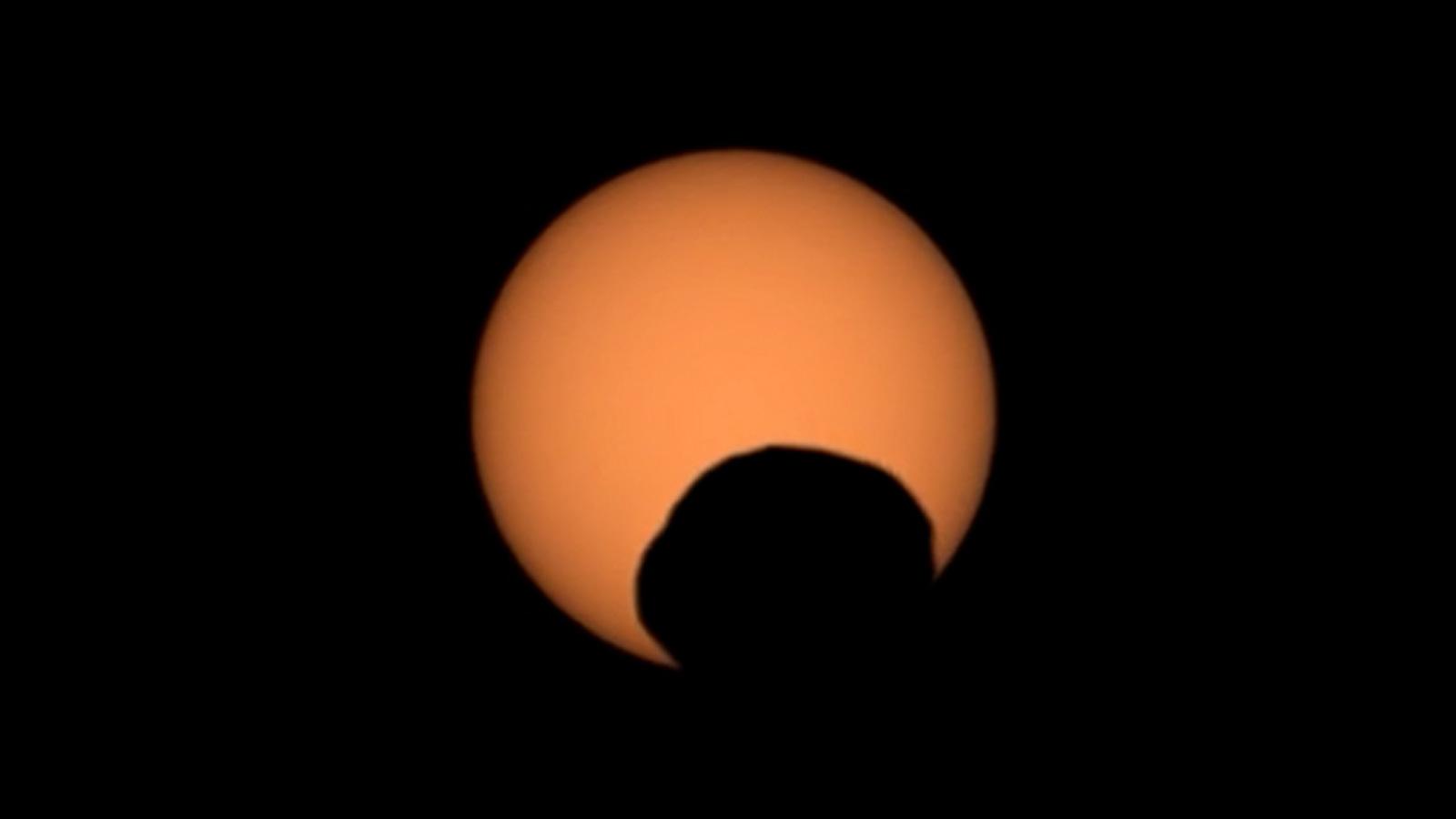
Forty minutes after sunset on Mars, with the sky still glowing that particular Martian twilight blue-gray fading to reddish-gray, NASA's Perseverance rover pointed its Mastcam-Z camera at a faint point of light in the sky and watched it disappear. That point of light was Earth, roughly 195 million miles (314 million km) away. The thing it disappeared behind was Phobos, the larger and closer of Mars's two small moons. It happened on July 2, 2026 — Sol 1,907 of the mission — and it is the first time any spacecraft has photographed one planetary body passing in front of another as seen from the surface of a world that isn't Earth.
NASA released the imagery as a composite built from nine Mastcam-Z frames, stacked to pull the dim Earth-Moon pairing out of the dark. A companion release from the agency's science imaging team describes a slightly different assembly — seven images — used to construct the sequence showing Earth's approach toward, and disappearance behind, Phobos's near-black, cratered limb. Either way, the underlying data tells the same story: Perseverance's camera, cooling in the evening air on the floor of Jezero Crater, caught Earth blink out.
"A Phobos photobomb," is how Justin Maki, deputy principal investigator for Mastcam-Z, put it — an irreverent way of describing a genuinely rare celestial alignment. Mission scientists didn't stumble into this shot. According to Mark Lemmon, a Mastcam-Z co-investigator, the geometry required real planning: "Phobos crosses the Martian sky three times a day, and Earth is visible for months," he said, meaning the operations team had to work out exactly when the moon's rapid orbit would put it directly between the rover and the pale blue dot.
What Perseverance Actually Saw
Phobos is not a large object. It measures about 17 miles (27 km) across and orbits just 4,850 miles (7,800 km) above the Martian surface. That proximity is exactly why the alignment was possible at all: a small, nearby moon sweeps across a large patch of sky relatively quickly, and on July 2 its path happened to cross directly over Earth's position as seen from Jezero Crater.
The black background in the released images isn't a fluke of deep space — it's a processing choice. Mars's twilight sky was still faintly lit at the time of the observation, and the imaging team stripped that glow to make the faint Earth-Moon system and Phobos's silhouette stand out clearly. What's left is a stark, almost diagrammatic view: a small dark disc sliding across the frame, and a pinprick of light winking out behind its edge.
Occultation, Not Eclipse
It's worth being precise about the vocabulary here, because the terms get used loosely. An eclipse happens when one body blocks the light source illuminating another. A transit is when a smaller body passes across the face of a larger, more distant one, staying visible against it the whole time — think Mercury crossing the Sun's disc. What Perseverance recorded was neither. It was a true occultation: Phobos, an opaque body, moved directly along the line of sight between the rover and Earth and physically hid it from view, the same basic geometry as the Moon blocking a star during a lunar occultation back home. The distinction matters because it tells you what was actually demonstrated. This wasn't a brightness dip caused by shadowing — it was one solid object stepping in front of another and blocking it outright, captured from a vantage point no human has ever occupied: the surface of another planet, watching our own world get swallowed by a moon that isn't even ours.
Why It Matters
On its own, this is a striking image and nothing more — Perseverance's job is Martian geology and sample caching, not orbital photography, and this observation didn't advance either. But it's a useful marker of how mature Mars surface operations have become. Pulling off a shot like this requires precise, pre-planned knowledge of two independent orbital paths — Phobos circling Mars roughly three times a day, and Earth moving along its own orbit around the Sun — intersected with a rover's exact position, camera pointing, and the local time of day when the sky is dark enough to see a faint point of light but not so dark that Mastcam-Z has nothing to work with. That kind of choreography, executed successfully on the first attempt described, says as much about the operations teams at JPL, Arizona State University, Malin Space Science Systems, and the Space Science Institute as it does about the moons and planets involved.
There's also a quieter, less technical payoff. An image of Earth taken from another planet's surface collapses the scale of the solar system into something a human eye can process. Watching your home planet vanish behind a moon 195 million miles away doesn't change any trajectory or any dataset. It's simply a reminder, recorded by a robot on another world, of how small and how far.
