
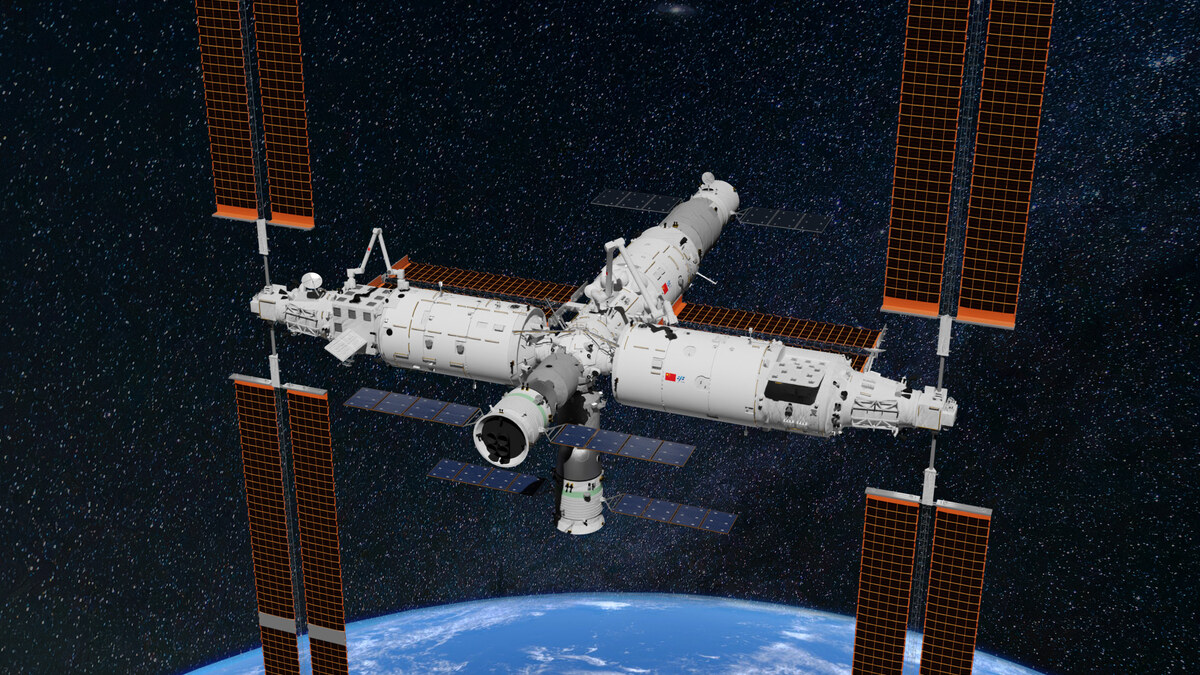
For its entire operational life so far, China's Tiangong space station has hosted only Chinese crews. That is about to change. On November 7, the China Manned Space Agency (CMSE) announced that the upcoming Shenzhou-24 mission will carry a Pakistani astronaut as a payload specialist. CMSE describes it as the first flight in the program's history with a joint Chinese-foreign crew.
The visit will be short. The Pakistani astronaut will fly up on Shenzhou-24, stay on the station for a brief period, and return to Earth with the departing Shenzhou-23 crew. Space.com reports that the stay should last roughly a week, with launch expected before the end of November, although China has not announced a launch date.
How the mission is meant to work
The flight plan is built around a crew rotation that is already underway. According to Space.com, the Shenzhou-23 crew arrived at Tiangong on May 24 and is nearing 180 days in orbit. One of the three Shenzhou-23 astronauts is staying aboard to complete what would be China's first year-long stay in space, so a seat on the Shenzhou-23 capsule is free for the return trip, and the Pakistani visitor takes it. The arrangement changes China's usual "three in, three out" rotation, and the two other Shenzhou-23 astronauts will come home alongside the visitor.
Shenzhou-24 is due to launch on a Long March 2F rocket from the Jiuquan Satellite Launch Center in the Gobi Desert. As usual for China's crewed missions, the crew will be revealed in a press conference the day before launch, so the identity of the Pakistani flyer has not been officially confirmed. Al Jazeera's reporting at the time of the announcement did not name the astronaut, gave no departure date, and said only that the mission was expected by the end of the year. Space.com's later reporting narrowed that to before the end of November.
Who is going
The selection process started with a government-to-government agreement. CMSE says China and Pakistan signed the cooperation agreement in Islamabad in February 2025. A three-stage selection then produced two candidates: after completing training in China, one will fly, and the other will serve as backup.
Space.com reports that the two candidates, named in Pakistani press reports as Muhammad Zeeshan Ali and Khurram Daud, are both pilots from the country's military forces, chosen from a wider pool of around 20 finalists. China has not said which of them will fly. Al Jazeera notes that the candidates trained in Beijing, and that their training included intensive Chinese language lessons, a sensible preparation for flying on a Chinese spacecraft.
A week is not long, but the time is planned out. According to Space.com, citing Pakistan's space agency, SUPARCO, the Pakistani astronaut will be responsible for four research payloads selected from more than 300 proposals. Meanwhile, the Chinese astronauts on Shenzhou-24 will be starting a six-month stay in space, so the visitor's short flight fits inside a standard crew rotation period.
Why It Matters
The obvious headline is a first for Pakistan. The bigger story is what the flight means for Tiangong. Until now the station has had no foreign visitors, and both CMSE and Al Jazeera frame this flight as the first foreign astronaut to reach it. It is a foreign astronaut selected under a bilateral agreement, trained in Beijing and launched on a Chinese vehicle, and it shows how China is willing to work with partners on its station.
The format is also worth noting. A short-duration payload specialist arrives on one crewed vehicle and leaves on another, and China is using the overlap between Shenzhou-23 and Shenzhou-24 to make that seat available. Whether the approach is repeated with other partners is not something the sources address, but the design shows how a spare seat on a return flight can be put to use without changing the long-duration crews' work.
For Pakistan, the flight is one part of a broader space relationship with China. Al Jazeera notes that Pakistan's Jinnah-1, a 35-kilogram lunar rover, will be deployed by the China National Space Administration, and Space.com says the rover is due to fly on the Chang'e-8 lunar landing mission. The partnership has also already produced Chinese-launched Pakistani satellites, including a lunar cubesat. A human spaceflight seat and a lunar payload both depend on Chinese launch and mission support.
The diplomatic angle is clear too. Space.com reports that Chinese Foreign Ministry spokesperson Guo Jiakun called China and Pakistan "all-weather strategic cooperative partners" on November 9 and said the Pakistani astronaut's flight will mark the first-ever joint mission of Chinese and foreign astronauts in the history of China's manned space program. Al Jazeera adds that Chinese state media described the flight as part of bilateral cooperation under Beijing's Belt and Road Initiative.
What to watch
Two things are still unknown: the launch date and the identity of the flyer. The crew announcement on the eve of launch should settle the identity, and the rollout of the Long March 2F to the pad, which Space.com says happens around a week ahead of launch, will be an early sign that liftoff is near. After that, the main thing to watch is the handover. The Shenzhou-24 crew arrives, the Pakistani payload specialist works through roughly a week of experiments, and then the Shenzhou-23 capsule departs with its returning Chinese astronauts and one guest, while one Chinese astronaut stays behind to continue a year in orbit.
