
The regulatory part is settled. In an order released this week, the Federal Communications Commission approved SpaceX's petition to launch up to one million "Starmind" data-center satellites. The deadlines are long: the first deployment must happen by November 25, 2033, half the constellation must be up by November 25, 2038, and the full system by November 25, 2040. According to Spaceflight Now (via Wayback Machine snapshot), each satellite would deliver about 250 kilowatts, span roughly 75 meters across its wings, and fly in shells between 500 and 1,002 kilometers up. Elon Musk expects the first launch in the third quarter of 2027.
The license doesn't settle whether the idea works as engineering. That depends on how many square meters of hardware you have to fly per kilowatt, how much that hardware weighs, and how often something has to be swapped out. Slava Turyshev, a physicist at NASA's Jet Propulsion Laboratory, has worked through those numbers in two arXiv papers. Universe Today covered them in a series published alongside the FCC news. His results don't rule out orbital data centers. They do show how narrow the path is.
Start with one megawatt
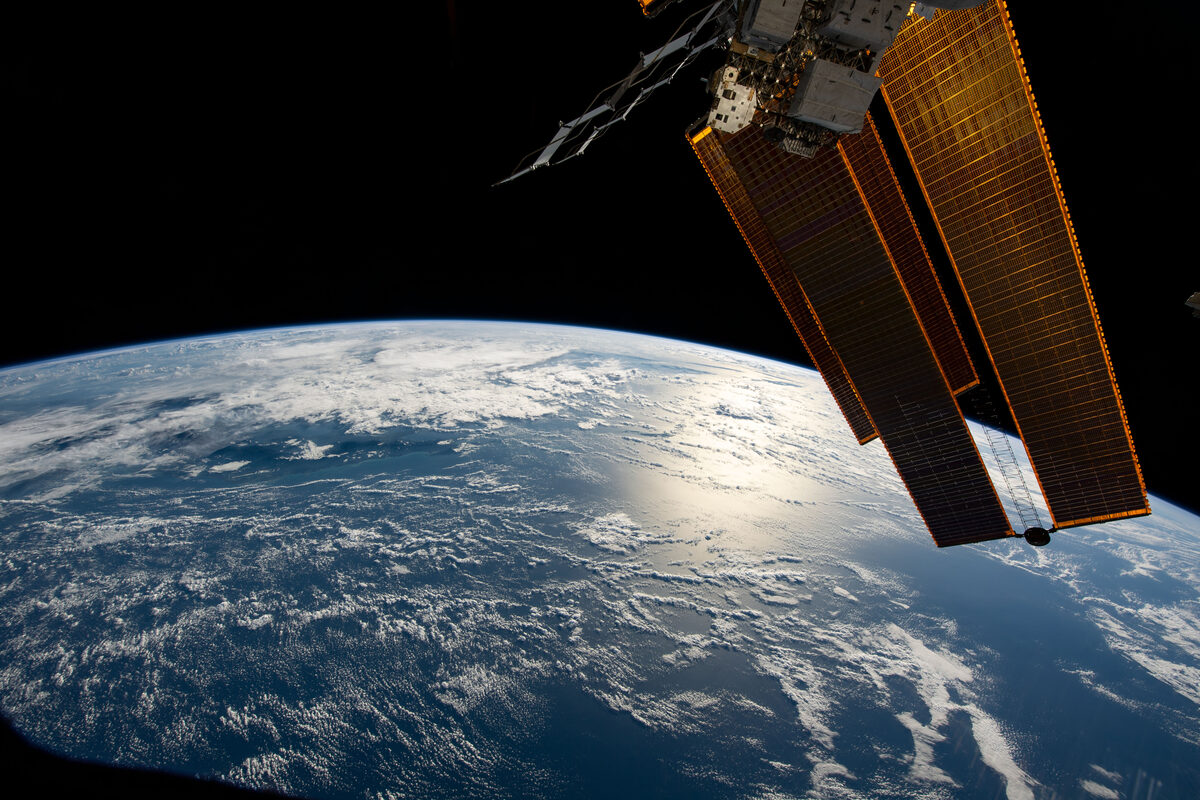
Turyshev uses a 1-megawatt cluster as his reference case. One megawatt is the power delivered to the computing hardware itself, and he places the cluster in a high-sunlight orbit. In his first paper on spacecraft constraints and economic viability, that cluster needs about 5,640 square meters of photovoltaic array, plus about 2,500 square meters of radiators.
The radiators are the part that rarely appears in the pitch decks. On the ground, a data center sheds heat into air or water. In a vacuum, the only way out is to radiate it into space. Nearly every watt the chips draw becomes heat, so the radiator has to be sized for the full load. Turyshev puts the combined mass of solar arrays, energy storage and radiators at 29.4 kilograms per kilowatt of IT power. Once the rest of the spacecraft is added (structure, avionics and so on), the total rises to 34 to 59 kg/kW.
The economics squeeze
Those mass figures convert directly into a budget. Turyshev assumes roughly 40 kg/kW and compares it with a terrestrial data-center cost of $10,000 to $40,000 per kilowatt. On those numbers, an orbital facility can afford only $250 to $1,000 per kilogram to cover both launch and building the spacecraft, if it is to break even with the ground.
That ceiling also comes before the costs he lists separately: communications, operations, utilization losses and penalties for limited hardware lifetime. Each of those makes the real allowance smaller. Launch is only part of the problem. The satellite itself has to be built at a cost per kilogram far below what spacecraft usually cost.
Batteries, darkness and the nuclear question
Solar power in low orbit stops and starts. Universe Today's piece on power options notes that in some seasons a satellite spends up to 21 minutes of each orbit in Earth's shadow. At about 15 orbits a day, that adds up to roughly 5 hours and 13 minutes of eclipse daily. Keeping a 1 MW cluster running through those gaps takes batteries weighing about 6.46 tonnes. The cluster's total mass reaches about 43 tonnes before any computing hardware is counted.
A fission reactor would remove the need for both the solar wings and the batteries. It doesn't remove the radiators. A reactor adds its own waste heat from power conversion, at a much higher temperature than the chips' heat, so it needs separate radiators. Universe Today's account of Turyshev's analysis says a nuclear-powered cluster would need only about 6% less low-temperature radiator area than a solar one.
Who fixes it?
Terrestrial data centers are never finished. Technicians replace failed drives, swap power supplies and refresh whole racks as faster chips come out. Universe Today's coverage of Turyshev's maintenance work points out that AI accelerators go obsolete every three to five years. A satellite that can't be upgraded falls behind well before its structure wears out.
Turyshev's second paper sets out a lifecycle plan built on plug-and-play orbital replacement units. These come in tiers, from a 5 kW compute module up to an entire 100 kW satellite node. He argues human servicing is not economical until a system reaches several hundred megawatts. Racks that astronauts could work on would need pressurized housings, airlocks and life support, so he assigns the work to robots.
The reference design in that paper is a 1 MW cluster made of 10 active 100 kW nodes, one reserve node, and about 200 compute cartridges of 5 kW each. Its deployed mass, at around 50 to 75 kg/kW, is higher than the first paper's 34 to 59 kg/kW spacecraft estimate.
The workload estimates are the most striking part of the paper. Each megawatt-year needs about 70.2 interventions for random failures and life-limited parts, plus 323 to 349 planned refresh operations, for a total of 393 to 419. Turyshev expects planned refreshes to outnumber unplanned repairs, which reflects how fast chips go out of date. Keeping the cluster supplied takes 5.3 to 9.0 tonnes of logistics mass per megawatt-year, about 6.6 tonnes in the nominal case, and 560 to 700 robot-hours of work.
Put another way, a single megawatt of orbital compute needs more than one robotic operation a day, every day, and several tonnes of hardware delivered each year just to keep running.
Scaling against Starmind
Turyshev's papers aren't an analysis of SpaceX's design, and his numbers shouldn't be read as a forecast for Starmind. Still, the comparison helps set the scale. One Starmind satellite at about 250 kW is two and a half times the size of one of Turyshev's 100 kW nodes. Every megawatt of capacity SpaceX deploys carries some version of the same constraints: array area, radiator area, eclipse storage, and a steady flow of replacement hardware.
Not everyone welcomed the approval. The FCC rejected petitions to deny filed by Viasat, Amazon Leo and the American Astronomical Society. The AAS said it was "disheartened and dismayed" by the outcome. FCC Chair Brendan Carr framed the decision as industrial policy, saying compute campuses are "essential to sustaining America's leadership" in AI.
Why It Matters
The Starmind approval is easy to read it as proof that data centers in orbit are coming. The order sets deployment deadlines and authorizes the constellation. Nothing in the coverage cited here suggests it settles whether the thermodynamics and economics work.
Turyshev's work moves the discussion from aspiration to arithmetic. If his figures hold, an orbital data center doesn't win just because launches get cheaper. It has to get combined launch and build costs into the low hundreds of dollars per kilogram. It has to radiate thousands of square meters' worth of heat. It has to survive daily eclipses without heavy batteries or accept the mass, and it needs a robotic servicing system doing hundreds of operations per megawatt every year. Each of these is a hard engineering problem, and the business case needs all of them solved together. The long FCC deadlines leave time to try.
Sources
- Orbital Data Centers: Spacecraft Constraints and Economic Viability (Turyshev, arXiv)
- Operations, Maintenance, and Industrial Scaling of MW-Class Orbital Data Centers (Turyshev, arXiv)
- Robots, Not Astronauts, Will Have to Fix Space Data Centers (Universe Today)
- Should Space Data Centers Run on Solar Panels, Nuclear Reactors, or Both? (Universe Today)
- FCC green lights SpaceX's plan to launch 1 million 'Starmind' data center satellites (Spaceflight Now, via Wayback Machine snapshot)
