
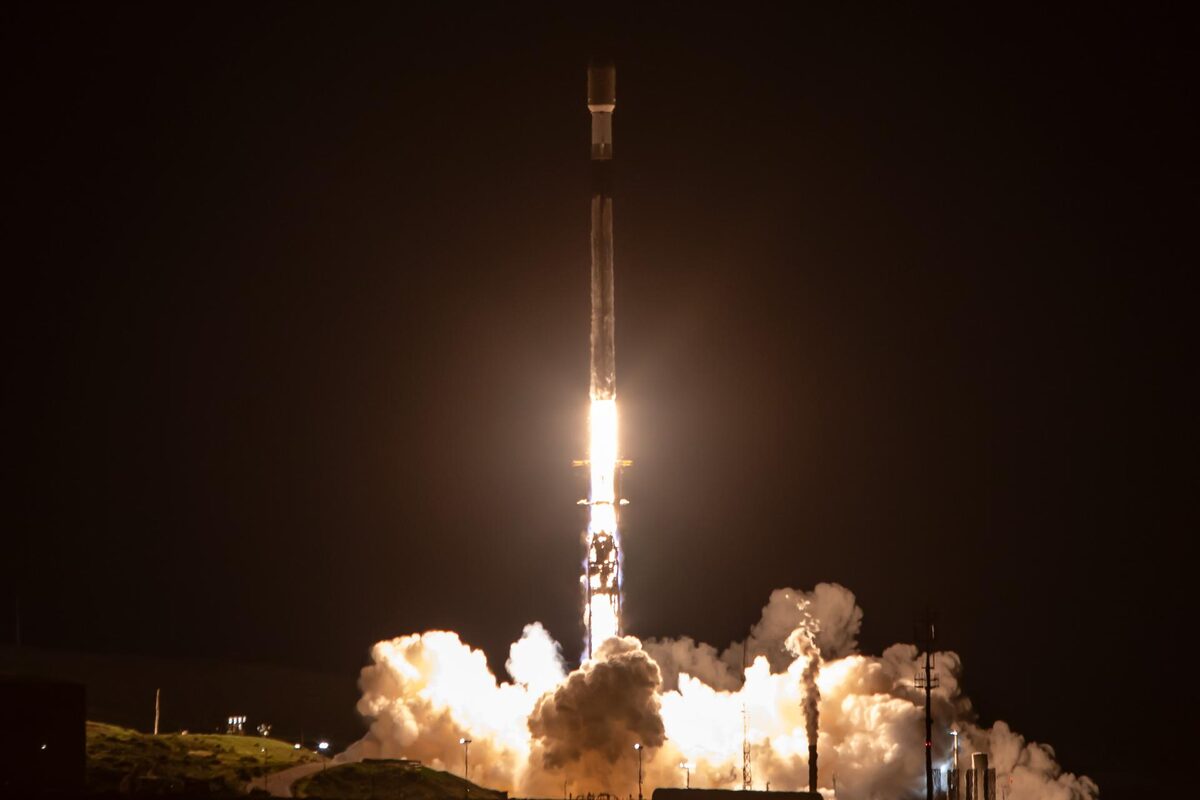
On Nov. 25, the day before Thanksgiving, the Federal Communications Commission's Space Bureau authorized SpaceX to build the largest satellite constellation anyone has proposed. Order DA 26-1273 covers up to 1,000,000 satellites in non-geostationary orbit. SpaceX says these satellites will be orbital data centers, flying under the name Starmind. That is more than 35 times the roughly 28,000 satellites humanity has launched since 1957, according to Space.com.
The approval is not complete, though. The order is formally "granted-in-part/deferred-in-part," and the deferred part matters: the bureau has not decided what SpaceX may do with a million spacecraft once they stop working.
What the FCC actually approved
The order was adopted and released by the Chief of the Space Bureau under ICFS file SAT-LOA-20260108-00016, with call sign S00798. It lets SpaceX place satellites in orbital shells, each 50 km thick, at altitudes from 500 to 1,002 km. The shells sit at two kinds of inclination: about 30 degrees, and sun-synchronous.
The deployment deadlines are long. SpaceX must launch its first satellites by Nov. 25, 2033, have half the constellation up by Nov. 25, 2038, and finish by Nov. 25, 2040. SpaceX had asked for a blanket waiver of the milestone rules. It withdrew that request and asked instead to fall under the Commission's new Part 100 milestone framework, which is how it got this schedule.
FCC Chairman Brendan Carr praised the decision. "This action opens a bold new frontier for the computing infrastructure needed to power America's leadership and growth," he said when it was announced. According to Spaceflight Now, he added: "By moving compute capacity beyond Earth, SpaceX and the many competitors working on their own orbital data centers are meeting the moment."
The disposal question
The most consequential part of the order is the decision it put off. FCC rules require satellites that end their missions below 2,000 km to re-enter the atmosphere. SpaceX asked for a waiver of that rule. The bureau deferred the request until SpaceX provides more information on its alternatives: sending retired satellites into Earth disposal orbits, or into heliocentric orbits around the Sun.
The deferral shows how unusual the proposal is. A heliocentric disposal plan would mean pushing dead spacecraft out of Earth orbit altogether, not letting them burn up. For now, the FCC has approved the constellation without approving any plan to deviate from the standard end-of-life rule. Before deploying any Starmind satellite that will not be disposed of by atmospheric re-entry, SpaceX must file for a modification of its authorization.
The size of each satellite makes the question harder. SpaceX says each Starmind satellite will have a wingspan of about 75 meters and a deployed height of about 30 meters. Speaking at the International Astronautical Congress in October, SpaceX's Michael Nicholls said the satellites would fly in tight-formation clusters of roughly 10 satellites. He said each satellite might draw about 250 kilowatts, which he compared to roughly one Nvidia NVL72 rack of compute. SpaceX is building the spacecraft in partnership with Nvidia, according to Spaceflight Now.
Astronomers objected and got nothing
Viasat and the American Astronomical Society (AAS) were among the groups that petitioned against the application. The bureau set aside their environmental and optical-astronomy concerns as outside its purview. It said SpaceX's commitment to coordinate with the National Science Foundation was enough, and it added no conditions to protect astronomy.
That outcome stands out because of the scale. Starlink, the largest constellation in orbit today, has nearly 11,200 satellites, according to astrophysicist Jonathan McDowell's tracker. The new authorization allows almost 90 times that number, and each Starmind satellite is very large. In practice, the FCC has left the reflectivity and sky-brightness questions for SpaceX and the NSF to work out between themselves. The AAS said it was "disheartened and dismayed" by the decision.
Timeline and launch math
SpaceX's own schedule is much shorter than the FCC's deadlines. Elon Musk expects the first Starmind launch in the third quarter of 2027, aboard Starship. At a talk hosted by Baron Capital, he said, according to Spaceflight Now: "We'll start off slow, but then it will ramp to significant volume probably in '28 and then very large volume in '29."
Starship's record so far is limited. According to Space.com, it has deployed 26 next-generation Starlink satellites across its two most recent test flights. Space.com notes that Starship can carry at most 60 V3 Starlinks per launch, so a 100,000-satellite Starlink network would take about 1,700 launches. Starmind satellites are different spacecraft with much larger deployed dimensions, so that figure can't simply be scaled up. Still, it gives a sense of how many launches a seven-figure constellation would require.
SpaceX's business case is also large. The company points to a long-term addressable market of $28.5 trillion, nearly $23 trillion of it in enterprise AI, according to Space.com. That number comes from SpaceX itself and should be read as a pitch. The orbital data-center business does not exist yet.
Why It Matters
This order turns orbital computing from a concept in conference talks into a licensed U.S. system with deadlines attached. It also shows where the FCC now sets its limits. The bureau is willing to approve enormous satellite counts on long schedules, and it is not willing to treat optical astronomy or environmental effects as reasons to impose conditions. The one point where it held back was what happens to satellites at the end of their lives, and that issue gets harder as the satellites get bigger and more numerous.
Many questions remain open. The order does not settle whether Starship can reach a launch rate high enough to deploy a constellation like this, whether sun-synchronous and 30-degree shells between 500 and 1,002 km can hold this much hardware safely, or whether the economics work. The first deadline is seven years away, and SpaceX says it plans to start in less than one. The disposal waiver, which the FCC deferred, may end up being the decision that matters most.
Sources
- FCC DA 26-1273: Memorandum Opinion and Order and Authorization, Space Exploration Holdings LLC (SpaceX Orbital Data Center System / Starmind)
- FCC green lights SpaceX's plan to launch 1 million 'Starmind' data center satellites (Spaceflight Now, via mirror)
- Green light for Starmind: SpaceX gets approval to launch 1 million AI satellites (Space.com)
