
Autumn is when the sky starts dressing for Halloween, and two of its best October targets need no costume at all. One is a star that visibly changes brightness over a few hours. The other is a ghostly glow that only the most patient observers will ever glimpse. NASA's Night Sky Network October notes point to both, and a UK amateur guide supplies the timing you need to catch the star in the act.
The Demon Star: what you are looking at
Algol sits in Perseus and goes by several sinister names, including the Demon Star and "The Ghoul." Per NASA's Night Sky Network, it is visible in autumn after 9 PM in the northeast, in the same neighborhood as Cassiopeia and Andromeda. The name traces to the Arabic Ra's al-Ghul, "demon's head," according to Space.com.
The wink is not intrinsic pulsation. Algol is a triple system, and its brightness changes come from an eclipsing pair seen nearly edge-on, so each star periodically passes in front of the other. NASA says the pair drops from magnitude +2.1 to +3.4 about every three days. Space.com gives a slightly different range, about +2.0 to +3.3, and a more precise period of roughly 2 days, 20 hours and 48.8 minutes. The two sources agree on the size of the change, about 1.3 magnitudes, and differ only in rounding of the endpoints, so treat the exact numbers as approximate.
How long does the dimming last?
Not long. Space.com reports that the variation the naked eye can pick up is confined to less than 10 hours of each cycle, and that most of the change happens within three hours before and three hours after mid-eclipse. It also says Algol's light varies noticeably for about four hours. That is the practical constraint: Algol spends most of its 2.9-day cycle at full brightness, so you need to time your observation around a minimum.
Use a comparison star
Judging brightness by eye is easier against a known reference. NASA suggests comparing Algol with Almach (Gamma Andromedae), using binoculars or a small telescope. Space.com adds a useful yardstick: at maximum Algol is about equal to Almach, and at minimum it is slightly brighter than Alpha Trianguli. Check it before the eclipse, again near minimum, and you should see the difference.
October minima to plan around
The Derekscope guide lists minimum-brightness times in GMT that are well placed for UK observers. Note that it is an amateur source and is best treated as a timing reference only.
- October 12 at 05:38
- October 15 at 02:27
- October 17 at 23:16
- October 20 at 20:05
The same guide lists early November minima on Nov 4 (04:10), Nov 7 (00:59), Nov 9 (21:48) and Nov 12 (18:36). Because the dimming is noticeable for several hours around minimum, begin watching about three hours beforehand. Convert GMT to your local time, and remember that the listed times are for UK-placed observers, so check them against your own location. The October 17 (late evening) and October 20 (early evening) events are the friendliest scheduling of the month for a casual look from the UK.
The Witch Head Nebula: a much harder catch
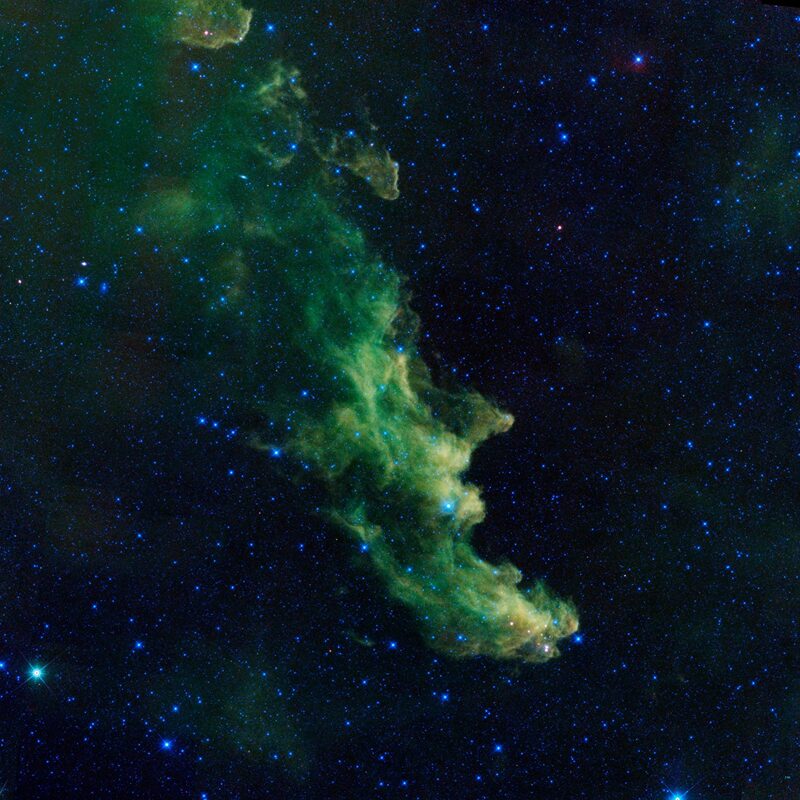
If Algol is the easy win, the Witch Head Nebula is the challenge. Catalogued as IC 2118, it is a reflection nebula about 900 light-years away, lying between Eridanus and Orion and illuminated by the star Rigel. Reflection nebulae rely on nearby starlight to be visible, which makes them hard to see with the naked eye, especially at this distance. NASA is candid about what it takes: telescopes with very large apertures and low magnification, under dark skies. It adds that astrophotographers can image the outline within a few hours, depending on equipment and sky quality. Expect a real challenge from a bright suburban backyard.
More seasonal oddities
NASA's notes also mention the Witch's Broom, a section of the Western Veil Nebula in Cygnus, and point readers to a Spitzer image of the Jack-o'-lantern Nebula. The article also references a TESS light curve of Algol, which shows the eclipse dips directly.
Why It Matters
Algol is one of the most accessible demonstrations that stars can be measured without a professional telescope. Watching a star fade and recover over an evening is a real observation of a binary system's geometry, and comparing against reference stars is the same basic technique variable-star observers use. It costs nothing, needs no equipment beyond your eyes, and gives a concrete reason to go outside on a specific night. The Witch Head Nebula, by contrast, is a lesson in how faint the universe can be: a nebula lit by one of the sky's brightest stars can still be nearly invisible without dark skies and the right instrument.
