
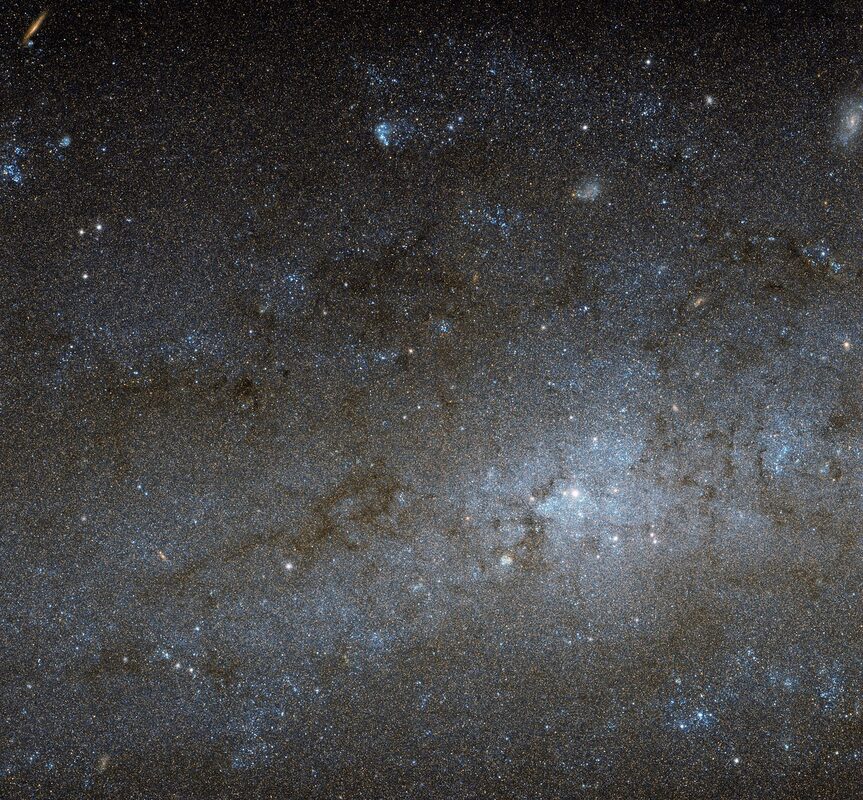
Every large spiral galaxy, including our own, keeps a crowded, chaotic neighborhood at its center. Packed around the supermassive black hole are two distinct structures: a nuclear star cluster, a dense knot of stars often just a few parsecs across, and a nuclear stellar disk, a flattened, rotating disk of stars spanning hundreds of parsecs. For years, astronomers have generally treated these as separate problems — the cluster forms one way, the disk forms another, and the two happen to end up in the same neighborhood. A new simulation project suggests that assumption is wrong.
The project, called SMUGGLE-Ring, is described in a preprint posted to arXiv by SungWon Kwak, Mathias Schultheis, Ivan Minchev, Cristina Chiappini, and collaborators, with a revised version posted August 2, 2026. The team modeled the evolution of a galaxy roughly as massive as the Milky Way at high resolution, tracking gas, stars, and dark matter together as the galaxy's structure evolved. What they found is a single mechanism responsible for building both central structures at once: a galactic bar roughly 5 kiloparsecs long that acts, in the words of lead researcher SungWon Kwak of the Leibniz Institute for Astrophysics Potsdam (AIP), like a "cosmic conveyor belt."
How the Conveyor Belt Works
Galactic bars are elongated, rotating concentrations of stars that form in the inner regions of many disk galaxies, including the Milky Way. They're not just a cosmetic feature. Bars are efficient at funneling gas inward, because their gravity disrupts the smooth, near-circular orbits that gas would otherwise follow, driving it toward the galactic center.
In the SMUGGLE-Ring simulation, that inflow doesn't stop once it reaches the center — it sustains itself over a long stretch of the galaxy's evolution. According to the arXiv preprint, this steady supply of inward-flowing gas builds the nuclear stellar disk from the inside out, meaning the innermost parts of the disk form first, with new star formation extending the disk outward over time. The same gas reservoir that feeds the disk also feeds the nuclear star cluster, tying the fates of the two structures together rather than letting them assemble independently.
Feedback from the stars themselves — radiation, stellar winds, and supernova explosions pushing back against infalling gas — turns out to be the mechanism that keeps the nuclear gas disk from growing without bound. The preprint describes stellar feedback as the process that regulates the size of the nuclear gas disk, effectively setting a limit on how far the inside-out growth can extend before feedback pushes back hard enough to slow it.
A Star Cluster Takes a Long Way Home
One of the more striking individual events the simulation captured involves a massive star cluster forming away from the galactic center and then migrating inward. According to the arXiv paper, a cluster with roughly 30 million solar masses spirals into the center of the simulated galaxy over time, eventually merging into the nuclear structures. That's a dramatic illustration of how the nuclear star cluster isn't necessarily built solely from gas that condenses in place — mergers of star clusters formed elsewhere in the galaxy's inner disk can contribute mass as well, feeding into the same nuclear structure that's simultaneously growing from freshly inflowing gas.
A Live Dark Matter Halo — and a Surprising Gap
Beyond the stars and gas, the simulation notably treated the galaxy's dark matter halo as dynamic rather than fixed. As reported by Universe Today's Matthew Williams, the SMUGGLE-Ring team — drawing on researchers at AIP, the Observatoire de la Côte d'Azur, the MIT Kavli Institute, UC Riverside, Tsinghua University, and other institutions — modeled dark matter as live particles able to respond gravitationally to the evolving baryonic structure, rather than assuming it stays put as an unchanging background scaffold.
That choice paid off with an unexpected result: the simulation revealed what the team is calling a "dark gap" — a region around the bar with a reduced dark matter presence, which the researchers describe as evidence of the gravitational interaction between stars and dark matter driven by the rotation of the stellar bar. It's the kind of feature that likely wouldn't show up in a simulation that treated dark matter as static, since it depends on dark matter particles actually responding to the bar's evolving gravitational field over time.
Why It Matters
The nuclear star cluster and nuclear stellar disk aren't just academic curiosities — they sit at the boundary where galaxy-scale processes meet the extreme environment immediately surrounding a supermassive black hole. Understanding how they form together, rather than separately, changes how astronomers should interpret the structures they observe at the centers of real galaxies, including our own Milky Way, whose central regions carry the fossil record of exactly this kind of gas-driven, bar-fed growth.
It also reframes the galactic bar from a passive stellar feature into an active construction tool — one that doesn't just funnel gas toward the center once, but sustains that inflow long enough to shape multiple nested structures over cosmic time. And the emergence of the "dark gap" is a reminder that some galactic-center features may only be visible in simulations sophisticated enough to let dark matter respond dynamically to what's happening in the visible galaxy, rather than assuming it just sits there. As telescopes push deeper into the crowded, dust-obscured heart of the Milky Way in the years ahead, this simulation gives observers a specific, testable picture of how that neighborhood came to look the way it does.
