
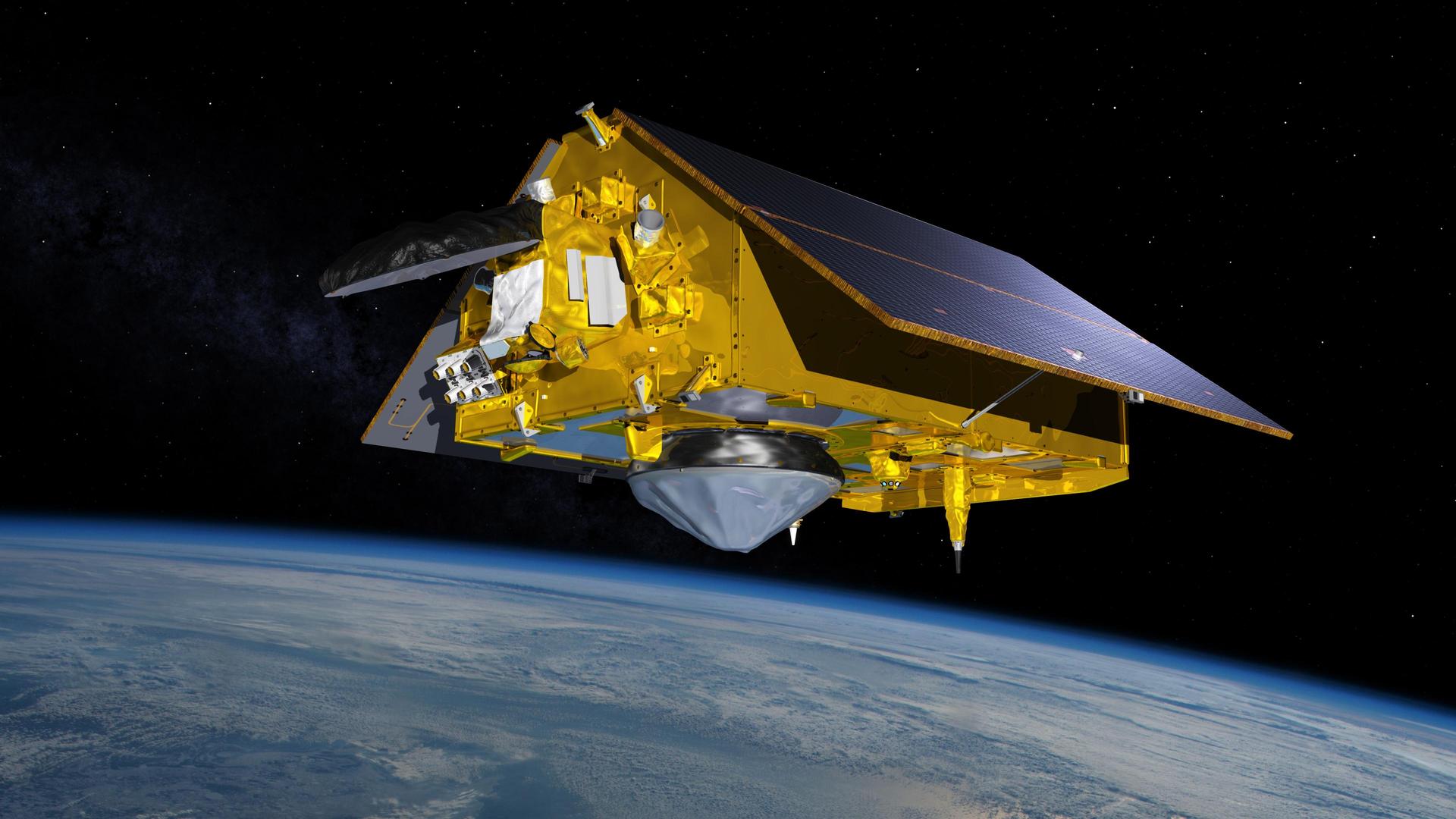
Ask most people what GPS does and you will get some version of "it tells you where you are." That is true, and it undersells the constellation badly. About 12,550 miles above the Earth, the same satellites that anchor your phone's position fix are also carrying instruments whose entire job is to notice a nuclear detonation and report it.
On July 23, 2026, the National Nuclear Security Administration announced that it had delivered its fifth next-generation Global Burst Detector payload to the U.S. Space Force this month, clearing the way for integration onto a GPS satellite. It is an unglamorous milestone — a box handed from one government organization to another, well ahead of any launch — but the box belongs to a mission that has run since the early 1960s, more than six decades of watch.
What a Global Burst Detector actually is
The GBD is the space-based component of the U.S. Nuclear Detonation Detection System, or USNDS. Rather than fly a dedicated fleet of detection satellites, the United States hosts the sensors as payloads on GPS spacecraft — in this case, the Lockheed Martin-built GPS III and GPS IIIF buses that populate medium Earth orbit at roughly 12,550 miles, where NNSA says GBD sensors provide 24/7 monitoring. The arrangement is elegant for the obvious reason: a constellation engineered to put a satellite in view of every point on the planet, at all times, is exactly the constellation you want if your goal is to see a flash anywhere on Earth the moment it happens.
What makes the payload interesting is that it is not one instrument but a set of them, built by different weapons laboratories and aimed at different physics. Sandia National Laboratories designs and produces the optical sensors and the sensor management subsystem, including hyper-temporal instruments capable of thousands of frames per second. Los Alamos National Laboratory develops the X-ray sensors, the charged-particle sensors, and the electromagnetic pulse sensors — specialized broadband radio-frequency receivers that record and timestamp transient pulse signatures. Lawrence Livermore National Laboratory and The Aerospace Corporation provide independent systems engineering and mission assurance, validating the effort through computer modeling.
The reason for that multi-phenomenology spread is straightforward once you think about the failure mode. A single bright flash, seen by a single optical sensor from 12,550 miles up, is an ambiguous piece of evidence; the natural world produces a great many bright, fast events that are not nuclear detonations. That is exactly the job the high-speed optical instruments are described as doing — discriminating valid bursts from natural phenomena — inside a payload built to capture and correlate detonation signatures across multiple sensor suites. Detection is the easy half. Confidence is the hard half, and confidence is what a national-level decision maker actually needs.
NNSA framed the delivery in deterrence terms. "A strong nuclear deterrence posture is critical to shielding America against attack, and the delivery of this capability provides the nation with the capability to detect nuclear detonations under all conditions," said Matthew Napoli, NNSA Deputy Administrator for Defense Nuclear Nonproliferation. The operative phrase is "under all conditions" — the system is meant to work regardless of where a detonation occurs or who is looking away at the time.
From delivery to orbit
Delivery to the Space Force is not the finish line; it is closer to the halfway mark. The payload now faces final thermal vacuum testing, the standard gauntlet in which hardware is baked and frozen in a chamber pumped down to space-like pressure to prove it survives the thermal cycling of orbit. After that comes hardware integration at the satellite assembly facility — NNSA describes the payload as going to the Space Force's GPS spacecraft contractor for integration and launch — then shipment to Cape Canaveral Space Force Station for launch processing.
That sequence is the quiet logic of the whole program. Before it flies, this payload has already been through design, manufacturing, technology development, review, testing and certification for spaceflight. Delivering a fifth next-generation payload is less about adding a dramatic new capability than about keeping a detection mission that dates to the early 1960s stocked with current hardware.
The same day, a much less flattering GPS headline
Within the same 24 hours, the other end of the GPS enterprise produced news of a different character. The Air Force Life Cycle Management Center is taking over Increments 1 and 2 of the Military GPS User Equipment program — MGUE, the effort to field receivers that can actually use the military's encrypted M-code signal, designed for secure positioning, navigation and timing when conventional satellite signals are being jammed or spoofed — from Space Systems Command and the Space Force.
The handoff follows years of delays, compounded by divided responsibility: Space Systems Command developed the core receiver technology while the individual military services handled platform integration. The Government Accountability Office repeatedly found that the arrangement contributed to problems coordinating receiver development, platform integration, testing and fielding. Increment 1, aimed at common cards for ground, aviation and maritime systems, hit hardware and software problems as contractors worked to meet encryption, security and anti-jamming requirements within the size and power limits of military platforms. Increment 2, intended to bring newer-generation chips to handheld devices and munitions, encountered design and power-consumption challenges. Individual services will still have to fund modifications, conduct testing and decide when to replace older receivers.
The timeline is the part that stings. M-code development began in the late 1990s. The first satellite capable of broadcasting M-code launched in 2005. An M-Code Aviation Receivers Joint Program Office was not stood up until 2024, and the program's first two increments are being reassigned to a different organization in 2026.
Why It Matters
Read together, the two announcements sketch a precise picture of where American space capability is strong and where it is not. The orbital segment works. A payload that fuses optical, X-ray, charged-particle and radio-frequency sensing from four institutions, rides an existing constellation to global coverage, and has anchored an explosion-detection mission for more than six decades is a genuine engineering achievement — and one that runs on hardware most people have never heard of, on satellites they think of as a mapping utility.
The ground and cockpit segment is where the program keeps stumbling. Two decades after the first M-code-capable satellite reached orbit, the receivers that would let aircraft, vehicles and troops use that signal are still being reorganized between commands, with the services themselves left to fund and schedule the upgrades. A signal nobody can receive is not a capability; it is a line item. The gap between what is flying and what is fielded is the recurring structural failure of modern military space, and MGUE is the textbook case.
There is also a nonproliferation dimension worth stating plainly — the delivery came from NNSA's defense nuclear nonproliferation directorate, and Napoli's framing was explicitly about detecting detonations "under all conditions." The GBD exists so that if a nuclear weapon is ever detonated, the United States knows it happened and can say so with technical confidence rather than inference. It is the sort of infrastructure whose value is measured entirely in events that have not occurred — which is precisely why a routine payload delivery, announced in a press release, is worth more attention than it usually gets.
Sources
- NNSA Delivers Next-Generation Global Burst Detector for Space Force GPS Satellite — National Nuclear Security Administration, July 23, 2026
- NNSA Delivers Fifth Next-Generation Global Burst Detector Payload to U.S. Space Force for GPS Integration — SatNews, July 23, 2026
- Air Force takes over troubled military GPS receiver program — SpaceNews, July 23, 2026
