
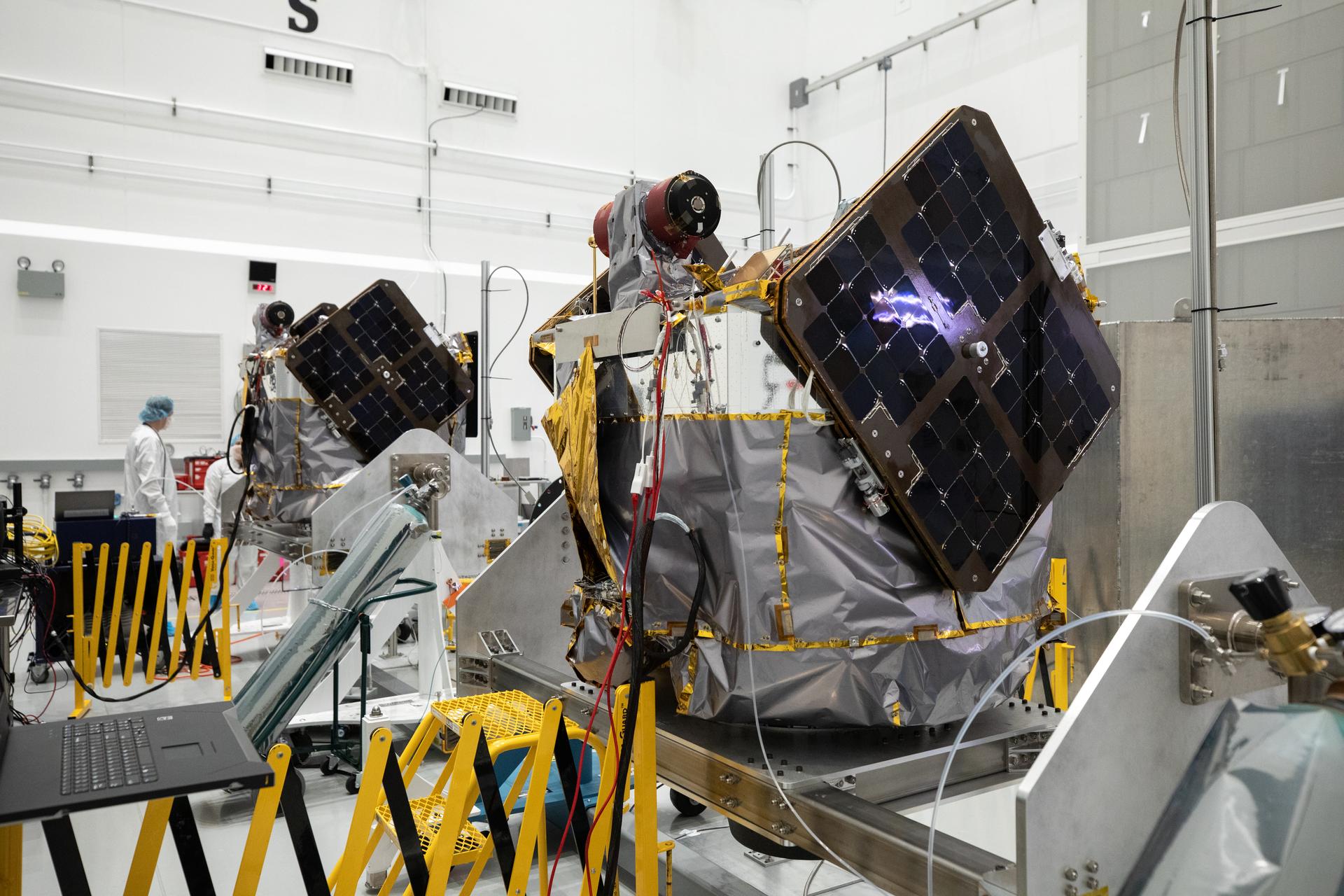
Spacecraft that are leaving Earth for good sometimes take one last photo of home before they go. NASA's twin ESCAPADE probes, named Blue and Gold, did that this month. On November 9, 2026, at about 9 a.m. EST, roughly three hours after its closest approach, the second of the two spacecraft to fly by Earth pointed its camera back at the planet and took images of the Western Hemisphere from about 38,500 miles (62,000 kilometers) away. EarthSky describes that distance as six times closer than the Moon.
The pictures were released on November 23 by NASA's ESCAPADE mission blog. They were taken in visible and infrared light with the spacecraft's Visible and Infrared Observation System, a camera provided by Northern Arizona University. The images are credited to NASA, UC Berkeley and Northern Arizona University. One of the spacecraft's solar panels appears in the foreground.
Two flybys, one destination
Blue and Gold did not pass Earth together. According to EarthSky, the two flybys happened two days apart, on November 7 and November 9, 2026, one for each spacecraft. Each one was a powered flyby. NASA describes this as combining an engine burn with Earth's gravity to propel the spacecraft onto a 10-month journey to Mars. The mission site says Blue and Gold were the first NASA spacecraft to successfully complete powered Earth gravity assists.
EarthSky reports that the spacecraft are expected to arrive at Mars on September 7 and September 9, 2027. The two-day gap between the Earth flybys is matched by a two-day gap between the arrivals.
The flybys took place about a year after launch. ESCAPADE lifted off on November 13, 2025, on Blue Origin's New Glenn rocket from Launch Complex 36 at Cape Canaveral Space Force Station in Florida. EarthSky notes it was only the second launch of the New Glenn heavy-lift vehicle, after its initial launch in January 2025.
Small spacecraft, two of them
The ESCAPADE probes are not large. EarthSky describes each one as about the size of a mini-fridge. The mission site at UC Berkeley's Space Sciences Laboratory, which leads the mission, calls it a twin-spacecraft Class D mission and puts its cost at under $80 million, a fraction of the cost of the multi-hundred-million and billion-dollar planetary missions that came before it.
The goal is to put both satellites into orbit around Mars. The mission is built around having two spacecraft, and Mars is the reason. The Berkeley team describes the planet as having a hybrid magnetosphere. Earth has a strong global magnetic field that creates a magnetosphere protecting it from the solar wind. Mars does not have a global field like that. What it has is a mix, according to EarthSky: a magnetosphere induced in part by the solar wind's interaction with the Martian atmosphere, similar to Venus, plus localized magnetic fields frozen into patches of the crust, left over from an ancient global field. Because the two probes will take simultaneous observations from different locations, scientists hope to see the real-time response of Mars' magnetic environment as the solar wind buffets it. One spacecraft alone could not separate a change over time from a difference between places.
What the parting shot shows
The Earth images are not the science, but they are useful as a demonstration. Taking an image a few hours after a powered flyby is consistent with a spacecraft that is pointing where its operators expect and an instrument that works after a year in space. The infrared version also shows temperature differences: in NASA's color scales, warmer areas appear in white, yellow and orange or green, and cooler areas in blue and purple.
The vantage point is also unusual. At 38,500 miles, the spacecraft was far enough away to see the Western Hemisphere of Earth in a single frame. That distance is short in interplanetary terms. At roughly six times that distance, the Moon orbits much farther out. As each spacecraft made its close approach, NASA adds, a commercial satellite photographed the pair from roughly 3,000 miles away, and a mission team member photographed one passing overhead from his home near Los Angeles.
Why It Matters
ESCAPADE is about a basic question in planetary science: how did Mars lose so much of its atmosphere? NASA says that once the spacecraft are in orbit, the mission will study how the solar wind, a million-mile-per-hour stream of particles from the Sun, interacts with the Martian environment and leads to atmospheric loss on the Red Planet. EarthSky adds that scientists expect the mission to help them understand how Mars lost most of its atmosphere over time, and how it lost its global magnetic field.
The Berkeley team says the mission builds on the legacy of NASA's MAVEN Mars orbiter, for a fraction of the cost. ESCAPADE adds two matched spacecraft measuring the same environment at once, at under $80 million in total. If the approach works, it would show that small spacecraft working in pairs can deliver useful planetary science at a much lower price than a single large mission.
The mission also has a practical side. The Berkeley mission site says ESCAPADE supports NASA's exploration goals by characterizing space weather and ionospheric variability at Mars, which disrupts communication and navigation signals.
What comes next
For the next 10 months, Blue and Gold will cruise toward Mars, ahead of expected arrivals on September 7 and 9, 2027. Once there, the two spacecraft will orbit the planet in complementary orbits to study how solar particles and the Martian atmosphere behave around the regions of remnant crustal magnetism.
