
The press releases about nuclear-powered spacecraft usually stop at the reactor, but most of the hard engineering sits around it. On Nov. 24, NASA said it has locked in key elements of the mission for SR-1 Freedom, the fission-powered spacecraft it wants to send beyond Earth orbit in late 2028. The changes that came out of the review are mostly about geometry, heat and communications, which is where a mission like this tends to succeed or fail.
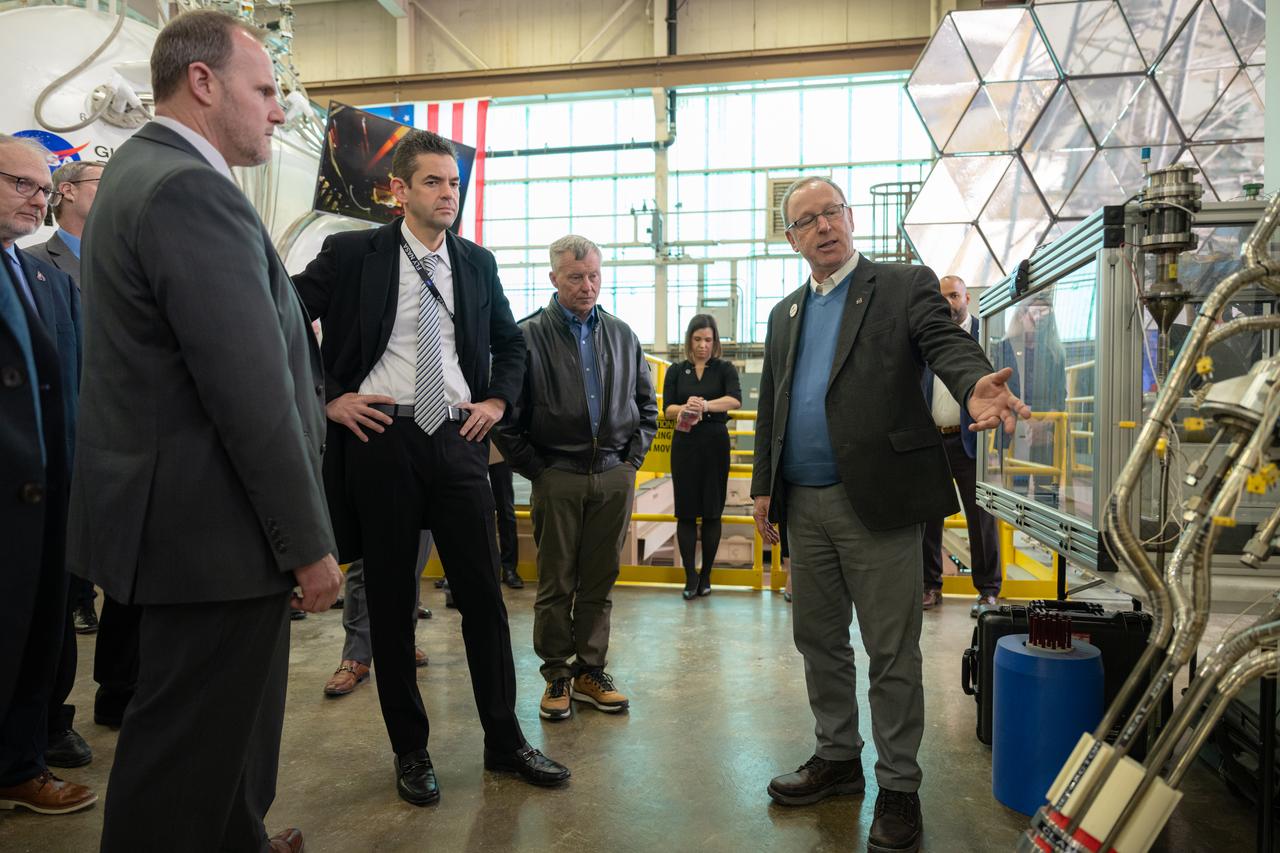
The decisions came from a major mission design review at NASA's Glenn Research Center in Cleveland in October. Experts from across NASA, the Department of Energy and industry took part. NASA said the decisions moved the mission from an early concept toward a defined spacecraft design. That is not the same as freezing every bolt: NASA says teams are still evaluating the number of radiator panels, the output power of the nuclear power module and how long the reactor will operate.
What changed
Four items stand out in NASA's announcement.
- A shorter boom. The boom separates the reactor from the spacecraft's main body, known as the Power and Propulsion Element. It will be shorter than the one shown in early illustrations, which NASA says will reduce weight, simplify assembly and help streamline the design.
- A closer reactor. NASA and DOE experts determined that improvements in shielding and spacecraft design will allow the reactor to operate closer to the rest of the spacecraft. NASA says this simplifies integration while maintaining the radiation protection needed for the spacecraft's electronics and the SkyFall payload.
- Larger X-band antennas. As part of updating the communications system for the journey to Mars, SR-1 Freedom will use larger X-band antenna dishes to send data back to Earth.
- A heat-rejection contract. NASA awarded a $39.3 million contract to the Johns Hopkins University Applied Physics Laboratory (APL) to develop the heat rejection system for the nuclear power module. APL is working with Advanced Cooling Technologies as a key commercial partner for heat pipe and composite radiator technologies. NASA says APL will design, build, test and evaluate the system and produce the flight hardware.
This review is a separate step from the award of the reactor itself. It covers how the power module fits onto the rest of the spacecraft and how the spacecraft gets rid of its waste heat.
Distance versus shielding
A space reactor's layout comes down to a basic trade. Radiation weakens with distance, so one way to protect the electronics and payload is to put the reactor at the end of a long boom. The other is to add shielding. NASA's statement points to both changes together: a shorter boom, and a reactor that can sit closer thanks to better shielding and spacecraft design.
NASA did not give the new boom length or the shield's mass in its announcement, so the size of the change is unknown. The direction is still clear: a more compact vehicle that NASA says is simpler to assemble and integrate. The American Nuclear Society's March report on the mission described a boron carbide radiation shield among the key specifications.
The radiator problem
The $39.3 million heat-rejection contract may be the most telling item in the announcement. In space, heat can only leave a spacecraft as radiation; there is no air or water to carry it away. Any power system that converts heat to electricity leaves waste heat behind, so radiators are a core part of the power system, not an accessory. NASA describes the heat rejection system as a key part of demonstrating nuclear electric propulsion in space, and says it will help lay the groundwork and industrial production foundation for future high-power nuclear systems. A dedicated contract for it, held by APL with a specialist thermal partner, is consistent with that priority.
How the mission is supposed to fly
SR-1 Freedom is not a pure nuclear vehicle. NASA says it will use both nuclear and solar power, and the operating plan switches between them.
- After launch, once the spacecraft has left Earth orbit, SR-1 Freedom activates the reactor and gradually increases its power.
- The reactor runs for an initial period, sending performance data to Earth, and then shuts down.
- Solar arrays power the spacecraft as it cruises to Mars.
- After it delivers SkyFall to Martian orbit, the reactor is restarted to collect additional data on performance in deep space.
The restart is a central part of the demonstration. Running a reactor in space, shutting it down and starting it again after a long cruise tests more than one continuous run would. A successful restart would tell mission planners a lot about how dependable fission power can be for later missions.
The payload is SkyFall, a capsule carrying three next-generation helicopters to Mars. NASA says they will study Martian geology and climate history, explore new terrain and search for signs of subsurface ice. SR-1 Freedom is therefore both a technology demonstration and a delivery vehicle, and the delivery gives the demonstration a fixed deadline.
Where this came from
NASA Administrator Jared Isaacman introduced the concept in March at the agency's Ignition event. Program director Steve Sinacore is quoted in the new announcement. According to the American Nuclear Society's Nuclear News, the March 24 announcements included plans to launch a nuclear electric propulsion spacecraft to Mars in December 2028 and a three-phase plan for a lunar base incorporating nuclear-driven heat and power. Both followed a December 2025 executive order.
BBC Sky at Night Magazine reported at the time that Space Reactor-1 Freedom is meant to demonstrate advanced nuclear electric propulsion in deep space. It noted NASA's view that the approach could enable high-power missions beyond Jupiter, where solar arrays are not effective.
The schedule remains aggressive. The concept was announced in March, a major design review followed in October, and NASA is still targeting a late-2028 launch. That leaves about two years to turn the design decisions into flight hardware, including a nuclear power module, its radiators and a Mars helicopter payload.
Why It Matters
NASA has studied space fission power for decades, and very little of it has flown. The American Nuclear Society reported that NASA's only flight reactor to reach space, SNAP-10A, stopped working after 43 days because of a nonnuclear component failure. SR-1 Freedom is billed as the first fission-powered spacecraft to travel beyond Earth orbit. The October review moves it from an early concept toward a defined vehicle. The changes are practical ones: a more compact layout made possible in part by better shielding, larger antennas, and a funded effort on heat rejection.
If the in-space start, shutdown and restart sequence works, it will show that a reactor can be treated as a power source that can be switched on and off over a long mission. NASA says SR-1 will demonstrate how fission power can enable long-duration missions and exploration deeper into the solar system. If the 2028 date slips, the work on shielding and radiators should still carry over to whatever flies next. Either way, this is the period when the design has to prove it can be built and flown.
Sources
- Teams Lock in Mission Architecture for NASA's SR-1 Freedom (NASA, Nov. 24, 2026)
- NASA announces plan for space nuclear propulsion by 2028 (American Nuclear Society, Nuclear News, March 25, 2026)
- NASA plans to launch a nuclear-powered spacecraft to Mars before the end of 2028 (BBC Sky at Night Magazine, March 25, 2026)
