
The joint ESA and JAXA BepiColombo mission is in orbit around Mercury. The arrival was rougher than the plan, though. The thruster burn meant to secure the spacecraft's orbit stopped well before it was supposed to, and the spacecraft dropped into safe mode. Engineers then worked through the night to find out where the vehicle had ended up. In an update published on 23 November, ESA said a software glitch caused the problem. The agency says the spacecraft is now in a stable orbit and the next major step is still on schedule.
This is a follow-up to our earlier coverage of the orbit insertion. ESA's later account adds the details that were missing from the first reports.
What happened during the burn
On 21 November at 18:24 UTC (1:24 p.m. EST), the Mercury Planetary Orbiter (MPO) fired its four axial thrusters as it passed 635 kilometers above Mercury's surface. The burn was planned to last 37 minutes. It was autonomously interrupted, and when contact was re-established the spacecraft was in safe mode. Safe mode is a protective state in which a spacecraft ceases all non-essential activities when it encounters unexpected conditions. By then the burn had achieved around 77 percent of the total planned velocity change.
ESA traced the problem to a software glitch. Teams at the European Space Operations Centre (ESOC) worked around the clock with lead spacecraft manufacturer Airbus and colleagues across the joint ESA and JAXA mission to understand the situation. Contact with the spacecraft was re-established through ESA's Estrack New Norcia deep-space antenna. The answer came at around 01:00 local time, from Flight Dynamics Manager Frank Budnik: "We confirm Mercury orbit capture!" ESA's account also includes comments from Flight Operations Director Ignacio Tanco, who said that finding the spacecraft in safe mode was "like flipping a switch" and that everybody focused on understanding what had happened.
The spacecraft still ended up in orbit, and ESA calls it stable. So the shortfall did not cost the mission its arrival. ESA says teams have traced the anomaly to a software issue involving attitude guidance and thruster control, and that they are continuing to investigate. The orbit is not the one planned: it has a period of 75 hours rather than the originally planned 58 hours. ESA says the remaining insertion sequence has already been adapted to the new trajectory, with no additional burns required.
A first for interplanetary arrivals
ESA says BepiColombo's arrival is the first time "weak stability capture" has been used to enter orbit around another planet. The technique involves arriving at lower speeds than is typical for planetary missions, and ESA says it had previously only been used by some spacecraft travelling to Earth's moon. BepiColombo's solar electric propulsion and nine planetary flybys reduced its speed relative to Mercury, which let it arrive slowly enough for a weak gravity capture. ESA notes that such a capture is only temporary, which is why Mercury orbit insertion is essential: the thruster burns turn it into a lasting orbit. ESA presents the first as a milestone in its own right, separate from the glitch.
Only the second visitor to stay
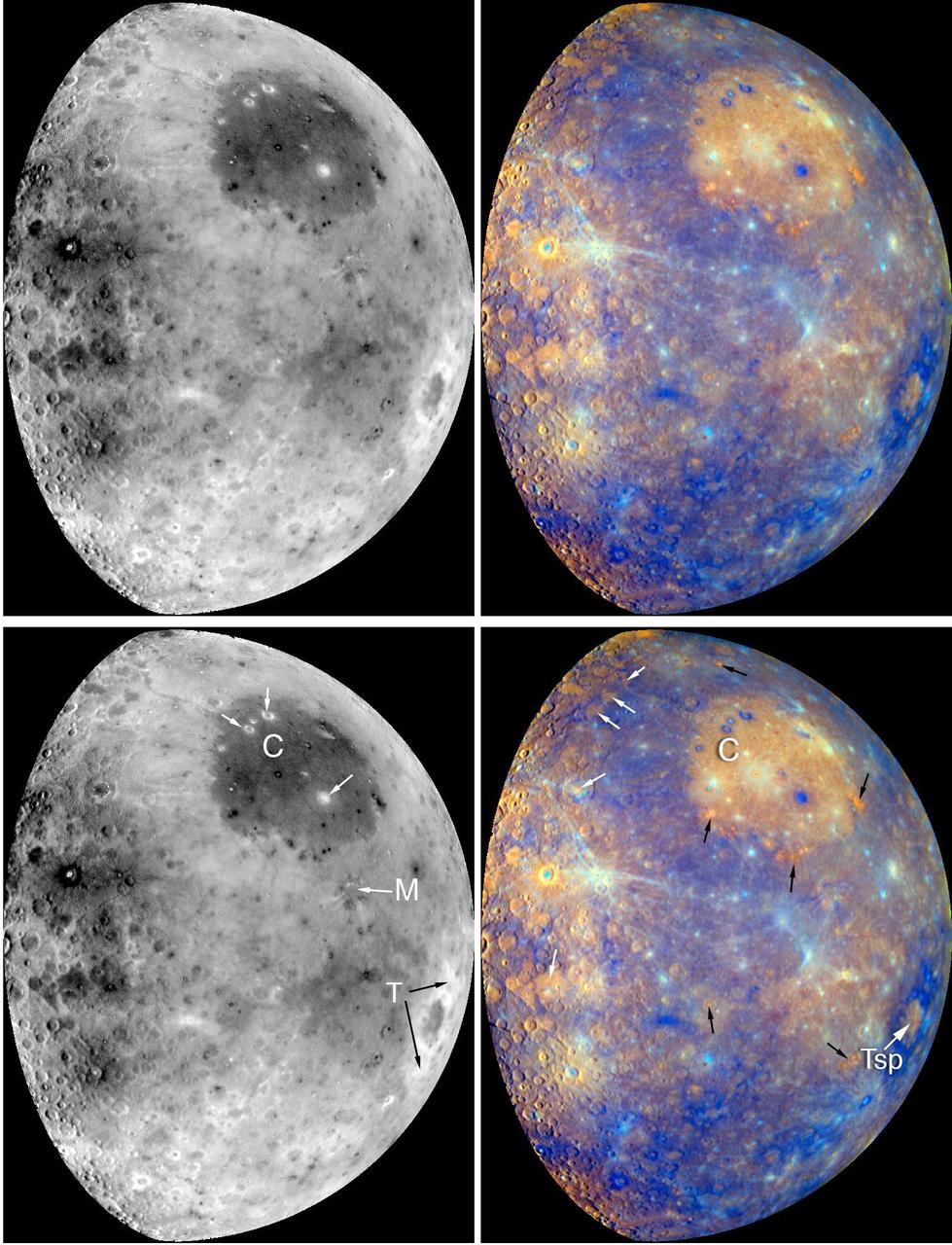
BepiColombo is only the second spacecraft ever to orbit Mercury. The first was NASA's MESSENGER, which orbited the planet from March 2011 to April 2015. According to JAXA, only two spacecraft had visited Mercury at all before BepiColombo: Mariner 10 and MESSENGER.
The trip was long. BepiColombo launched on an Ariane 5 in October 2018 as a stack of three parts: ESA's MPO, JAXA's Mercury Magnetospheric Orbiter (called Mio, or MMO), and the Mercury Transfer Module (MTM), which provided power and propulsion for the cruise. The MTM released the MPO and Mio on 3 September. The two orbiters then reached Mercury still joined together.
JAXA calls BepiColombo the first large-scale cooperative project between Japan and Europe. The mission is designed to study Mercury's magnetic field, magnetosphere, interior and surface, with the two orbiters supplying complementary data from different vantage points. One of the main targets is Mercury's unusual structure. JAXA notes that the planet has an enormous core, about three quarters of the planet's radius.
What comes next
The next key event is separation. The two science orbiters are due to part on 9 December (10 December in Japan). After that, Mio will settle into its own highly elliptical polar orbit, while the MPO conducts a series of engine burns. Space.com reports that the whole arrival phase lasts about six months. The MPO is due to reach its final polar orbit on 10 March 2027, and science operations are scheduled to begin on 6 April 2027.
ESA says the mission remains on track for the 9 December separation and that the changes do not affect the MPO's ability to reach its planned science orbit. That suggests the shortened burn has not pushed back the main timeline.
Why It Matters
Mercury is one of the hardest places in the inner solar system to reach and stay. As Space.com notes, spacecraft approaching it are accelerated to high velocities by the Sun's gravity and must shed a great deal of kinetic energy to be captured. MESSENGER is the only other orbiter so far, and it finished its mission more than a decade ago. That leaves major questions open, including why such a small planet has such a large core and how its magnetic field and magnetosphere behave. BepiColombo is designed to address them with two spacecraft working together. A failed orbit capture would have ended that after eight years in flight.
The anomaly is also a reminder that much of the risk in modern deep-space missions sits in software. Here, a software issue cut short the most critical maneuver of the mission. A recovery that still produced a stable orbit, while also making the first use of weak stability capture at another planet, says a lot about the margins in the mission design and about the operations teams. The full explanation of the glitch is the part to watch between now and 9 December.
