
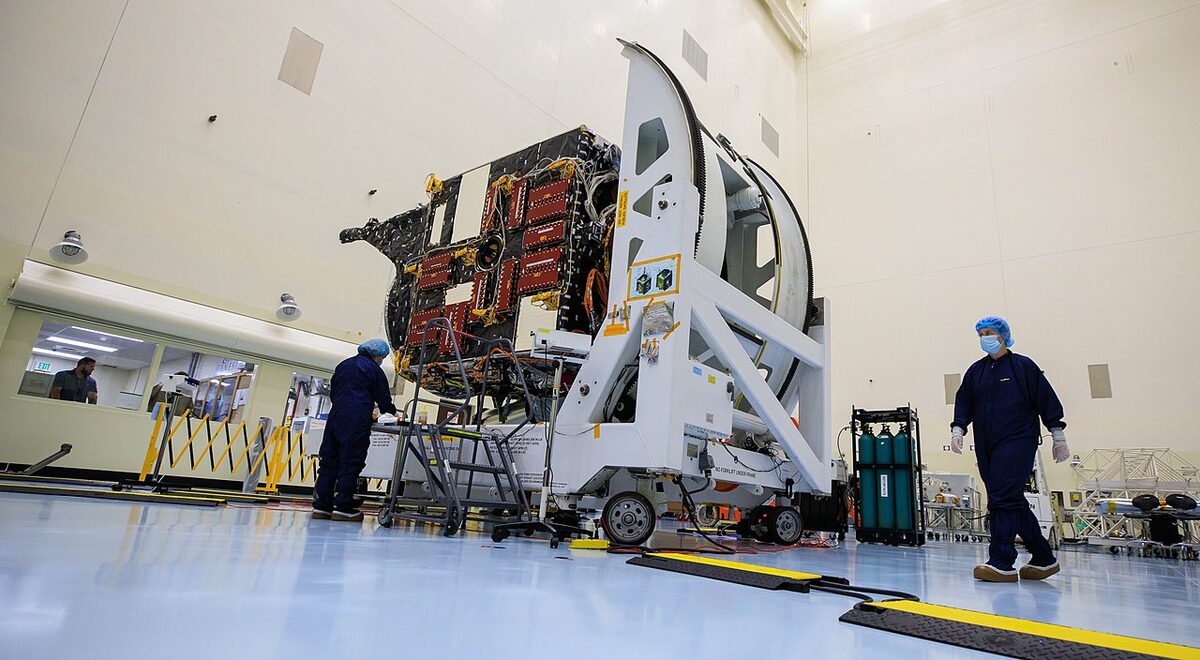
Most of the worlds we explore are made of rock and ice. The target of NASA's Psyche mission is something stranger: a 220-kilometre-wide asteroid, also named Psyche, that appears to be made in large part of metal. Astronomers have long suspected it could be the battered remnant of a small planet's core — the dense iron-and-nickel heart that would normally lie buried thousands of kilometres beneath a rocky mantle, here stripped bare by ancient collisions and left orbiting the Sun between Mars and Jupiter. If that is what it is, Psyche offers something no drill could ever reach: a direct look at the kind of core that hides at the centre of Earth.
The journey, on a whisper of thrust
Psyche launched in October 2023, but it is taking the slow road. Rather than chemical rockets that burn hard and brief, the spacecraft is propelled by solar-electric ion engines, which use electricity from its broad solar arrays to fling charged xenon atoms out the back. The thrust is gentle — comparable to the weight of a few coins in your hand — but it never stops, and over months and years that patient push builds up enormous speed for a fraction of the propellant a conventional rocket would burn. The engines glow a faint, science-fiction blue as they run. The trajectory threads past Mars for a gravity assist in 2026, borrowing the planet's momentum, before arriving at the asteroid in 2029 to settle into orbit and spend more than two years mapping it.
We know Psyche is unusual from afar. Radar bounced off it returns unusually strongly, the way metal does, and both its density and the spectrum of sunlight it reflects point to a metal-rich composition rather than ordinary rock. Those same clues spawned a popular but misleading headline — that the asteroid's iron and nickel would be worth some absurd, many-quintillion-dollar fortune. It is a fun number and beside the point: there is no way to bring such a thing home or sell it, and the mission's value is scientific, not economic. Psyche is compelling because of what it can teach us about how planets are built, not because of what its metal might fetch.
Why a metal world is worth the trip
The scientific payoff hinges on a question we cannot answer at home. Earth has an iron core, and so do Mars, Mercury, and the Moon — cores are a defining feature of rocky planets, the engines that, in Earth's case, generate the magnetic field shielding life from space radiation. But a planet's core is permanently out of reach; the deepest hole humans have ever drilled barely scratches the crust. If Psyche really is an exposed core, it is a fossil of a process that built the rocky planets, frozen and available for inspection. Even if it turns out to be something else — perhaps a primordial body of a metal-rich composition that never fully melted — it would still be a type of world we have never seen up close, and either answer is scientifically valuable.
The spacecraft carries instruments to map the asteroid's surface, measure its gravity to probe what lies inside, and detect any faint magnetic field — a magnetic signature would be a strong hint that Psyche once churned as a molten core. Its cameras will reveal whether the surface looks like shattered metal, frozen lava, or something no one predicted. There is genuine suspense here, because nobody knows what a metal world looks like. Every previous asteroid encounter has shown rock and rubble; Psyche may show metallic cliffs, or sulphur-stained plains, or features that don't resemble anything in the catalogue.
Psyche also carries a secondary experiment that points to the future: a technology demonstration of deep-space laser communications, beaming data home on infrared light rather than radio, a step toward the high-bandwidth links that crewed missions to Mars will eventually need. For now, the spacecraft is doing the quiet work that defines deep-space exploration — coasting on its blue glow across the gulf to the asteroid belt, years from arrival, carrying the instruments that will finally let us see the inside of a planet from the outside.
