
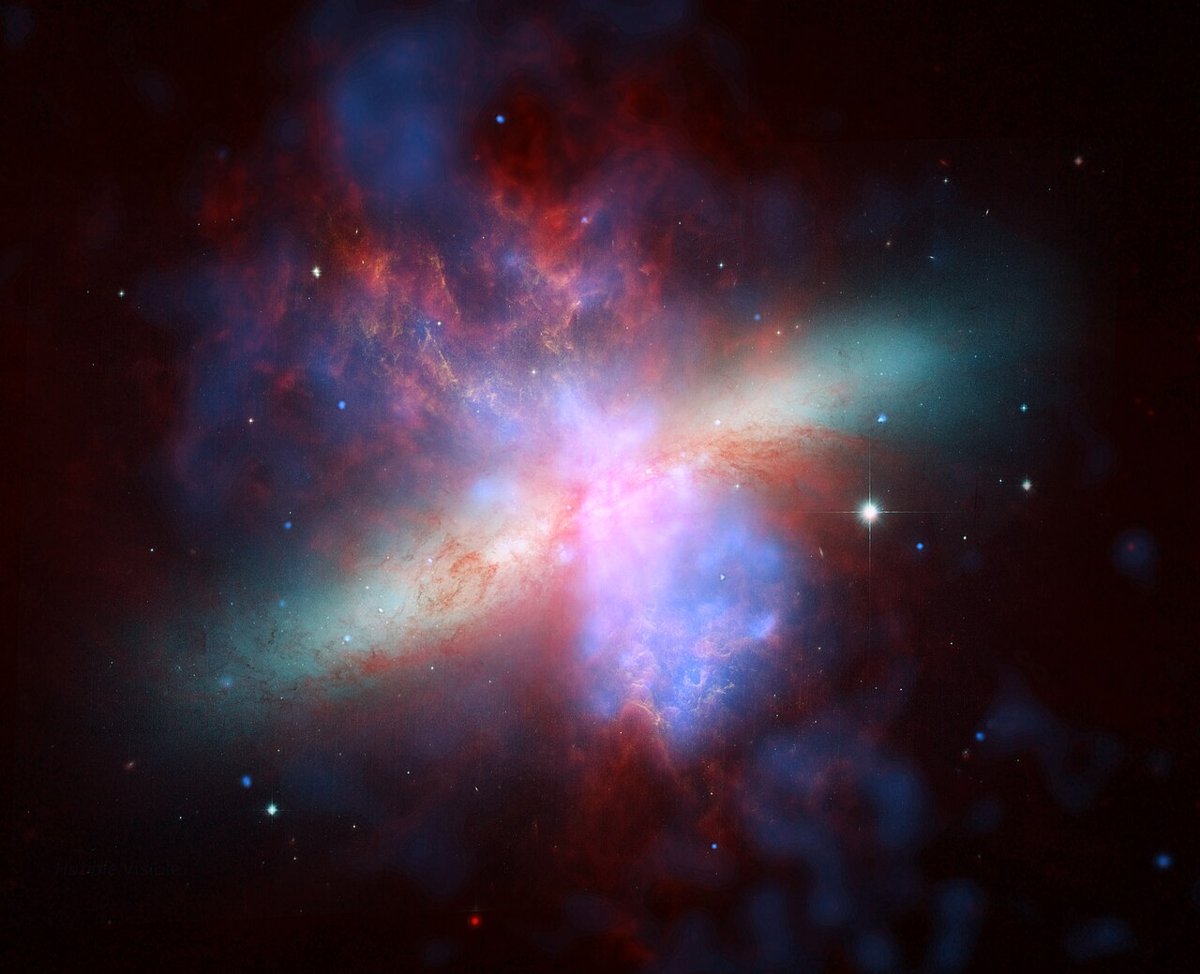
Most of the universe is invisible. Not hidden behind something, not too far away — literally invisible, radiating in wavelengths the human eye was never built to detect. A star-forming nebula that appears as a dark void in visible light blazes with infrared emission from warm dust. A galaxy cluster that looks serene in an optical photograph seethes with hundred-million-degree gas visible only in X-rays. A dying star that fades from view at one wavelength screams across the sky in gamma rays.
NASA's Great Observatories program was built on this insight. Rather than pouring resources into a single all-purpose telescope, the agency conceived a fleet of four flagship space telescopes, each optimized for a different slice of the electromagnetic spectrum. Together, they would see what no single instrument could: the full radiative signature of the cosmos. The result was one of the most productive strategies in the history of observational astronomy.
The Logic of the Fleet
The electromagnetic spectrum spans an enormous range, from radio waves with wavelengths measured in meters to gamma rays with wavelengths smaller than an atomic nucleus. Earth's atmosphere blocks most of this radiation. Visible light and radio waves pass through relatively unimpeded, but infrared is absorbed by water vapor, ultraviolet is screened by ozone, and X-rays and gamma rays never reach the ground at all. Ground-based telescopes, no matter how large, are fundamentally blind to most of the universe's output.
Space-based telescopes solve the atmospheric problem, but each wavelength regime demands radically different engineering. Visible-light mirrors work by reflection at normal incidence — light bounces off a curved surface and converges at a focus. X-ray photons, carrying far more energy, would penetrate a conventional mirror rather than reflect from it; they require a grazing-incidence design where photons skim the surface at shallow angles, like stones skipping across water. Infrared detectors must be cooled to cryogenic temperatures to prevent the telescope's own thermal emission from swamping the faint signals it seeks. Gamma-ray instruments dispense with focusing optics entirely and rely on scintillation detectors and coded aperture masks.
No single telescope design can accommodate all of these constraints. The Great Observatories program embraced this reality and turned it into a strategy: four telescopes, four engineering philosophies, four windows onto the same universe.
Hubble: The Visible and Ultraviolet Eye
The Hubble Space Telescope, launched on April 24, 1990, was the first of the four and remains the most famous space telescope ever built. Operating primarily in visible and ultraviolet wavelengths with some near-infrared capability, Hubble orbits in low Earth orbit, close enough for astronauts to reach it — a design choice that proved crucial.
Hubble's early history is well known: the primary mirror's spherical aberration, diagnosed shortly after launch, was corrected during the first servicing mission. Subsequent servicing missions upgraded its instruments, replaced aging components, and extended its operational life far beyond original projections. More than three decades after launch, Hubble remains an active observatory with more than 1.7 million observations in its archive.
Its contributions span nearly every domain of astrophysics. Hubble observations helped establish that the expansion of the universe is accelerating — the discovery of dark energy. It has characterized the atmospheres of exoplanets by analyzing starlight filtered through their gaseous envelopes during transits. Its deep-field images, exposing tiny patches of sky for hundreds of hours, revealed thousands of galaxies stretching back to the early universe and reshaped our understanding of galaxy formation and evolution.
But Hubble's greatest strategic value was what it could not see. Every Hubble image carried implicit questions that only its sibling observatories could answer. A galaxy imaged in visible light might be forming stars or might be quiescent — only infrared observations could penetrate the dust and reveal the truth. A cluster of galaxies might appear gravitationally relaxed in optical wavelengths while hiding violent processes visible only in X-rays.
Compton: The Gamma-Ray Survey
The Compton Gamma Ray Observatory, launched on April 5, 1991, was the second Great Observatory and the most massive scientific instrument placed in orbit at that time. It carried four instruments sensitive to different gamma-ray energies, collectively covering an enormous energy range.
Gamma-ray astronomy is fundamentally different from other wavelength regimes. Individual gamma-ray photons carry millions to billions of times more energy than visible-light photons, and they originate in the most extreme environments in the universe: the jets of supermassive black holes, the surfaces of neutron stars, the expanding debris fields of supernovae, and the mysterious sources known as gamma-ray bursts.
Compton's contributions reshaped high-energy astrophysics. It identified blazars — a class of active galaxies whose relativistic jets point almost directly at Earth, producing intense and variable gamma-ray emission. It mapped the distribution of a radioactive aluminum isotope across the Milky Way, tracing recent nucleosynthesis and star death throughout the galaxy. And it provided critical evidence that gamma-ray bursts originate at cosmological distances, ending decades of debate about whether these brief, intense flashes were local phenomena or the most energetic explosions in the universe.
After nine years of operation, a gyroscope failure raised concerns about the ability to control Compton's reentry. NASA made the decision to deorbit the observatory in a controlled manner on June 4, 2000, bringing the spacecraft safely into the Pacific Ocean.
Chandra: The X-Ray Microscope
The Chandra X-ray Observatory, launched on July 23, 1999, brought angular resolution to X-ray astronomy that had never been achieved before — eight times sharper than any previous X-ray telescope and capable of detecting sources more than twenty times fainter. Its mirrors, four nested pairs of cylindrical shells polished to atomic-level smoothness, use the grazing-incidence principle: X-ray photons strike the mirror surface at angles of less than a degree, ricocheting toward the focus rather than being absorbed.
Chandra operates in a highly elliptical orbit that carries it far from Earth, spending most of each orbit above the charged-particle belts that would otherwise overwhelm its detectors. The Smithsonian Astrophysical Observatory in Cambridge, Massachusetts manages its science operations and flight control.
Where Hubble sees stars and galaxies, Chandra sees the hot, violent, and extreme. Galaxy clusters — the largest gravitationally bound structures in the universe — are filled with gas heated to tens of millions of degrees by gravitational compression. This gas is invisible at optical wavelengths but dominates the cluster's baryonic mass, and Chandra maps it in exquisite detail. Black holes accreting matter produce X-ray emission from their superheated surroundings. Supernova remnants, the expanding shells of stellar explosions, reveal their shock structures and elemental composition in X-rays. Young stars, surprisingly, are powerful X-ray sources, and Chandra has surveyed star-forming regions to study the high-energy environments surrounding newborn stellar systems.
Spitzer: The Infrared Explorer
The Spitzer Space Telescope, launched on August 25, 2003, was the fourth and final Great Observatory. It observed in the infrared — the wavelengths just beyond red visible light — where warm dust, cool stars, planet-forming disks, and the most distant galaxies in the universe radiate most of their energy.
Spitzer's engineering reflected the unique demands of infrared astronomy. Its 85-centimeter primary mirror was modest by flagship standards, but the telescope's sensitivity depended less on mirror size than on temperature. Any warm object emits infrared radiation, including the telescope itself. To prevent its own thermal glow from swamping the faint cosmic signals it sought, Spitzer launched with a supply of liquid helium that cooled the instrument to approximately five kelvins — just five degrees above absolute zero. This cryogenic phase lasted from 2003 to 2009. When the helium was exhausted, Spitzer continued operating in a "warm" mode using two of its infrared detector channels, extending its mission for another decade.
Rather than orbiting Earth, Spitzer followed an Earth-trailing heliocentric orbit, gradually drifting away from our planet. This kept it far from Earth's infrared glow and allowed continuous observations uninterrupted by the planet's shadow.
Spitzer's discoveries capitalized on infrared's ability to penetrate dust and detect thermal emission. In 2005, it made the first direct detection of light from an exoplanet — not reflected starlight, but the planet's own thermal glow. It discovered a vast, diffuse ring around Saturn associated with the moon Phoebe. And in 2017, Spitzer observations were central to characterizing the TRAPPIST-1 system, a nearby star orbited by seven roughly Earth-sized planets, several in the habitable zone. NASA retired Spitzer on January 30, 2020, after more than sixteen years of operations.
The Power of Multi-Wavelength Astronomy
The Great Observatories' strategic value was always greater than the sum of its parts. When astronomers trained multiple observatories on the same target, each wavelength revealed a different physical process.
Consider a galaxy cluster. Hubble shows the individual galaxies — their shapes, colors, and distribution. Chandra reveals the hot intracluster medium, a vast reservoir of gas that outweighs all the visible galaxies combined and traces the cluster's gravitational potential. Spitzer detects the infrared emission from dust-enshrouded star formation within the cluster's galaxies, activity hidden from optical view. And Compton, during its operational years, could detect gamma-ray emission from active galactic nuclei within or behind the cluster, revealing the most energetic particle acceleration processes at work.
No single wavelength tells the complete story. A supernova remnant in visible light is a delicate filigree of glowing gas; in X-rays, it is a blast wave plowing into the interstellar medium at thousands of kilometers per second. A star-forming region in visible light is a dark cloud; in infrared, it is a nursery of newborn stars still embedded in their natal dust. The Great Observatories program made these complementary views routine rather than exceptional.
Why It Matters
The Great Observatories program demonstrated something that transcends any single discovery: the immense scientific return of strategic coordination. By designing four flagship telescopes as a coherent system rather than four independent projects, NASA created an observational capability that revealed the universe in its full electromagnetic complexity.
Two of the four — Hubble and Chandra — continue operating decades beyond their design lifetimes. Compton and Spitzer completed their missions and returned data archives that astronomers still mine for new results. The program's intellectual descendants are visible in every modern space telescope: the James Webb Space Telescope, optimized for infrared wavelengths, carries forward Spitzer's legacy with vastly greater sensitivity, while proposed future X-ray observatories aim to succeed Chandra with next-generation capabilities.
The deeper lesson is methodological. The universe does not confine its physics to a single wavelength. Stars, galaxies, black holes, and the cosmic web all radiate across the spectrum, and understanding any of them completely requires observations across multiple wavebands. The Great Observatories program was the first systematic attempt to match the breadth of the universe's output with the breadth of humanity's instruments — and it worked.
