
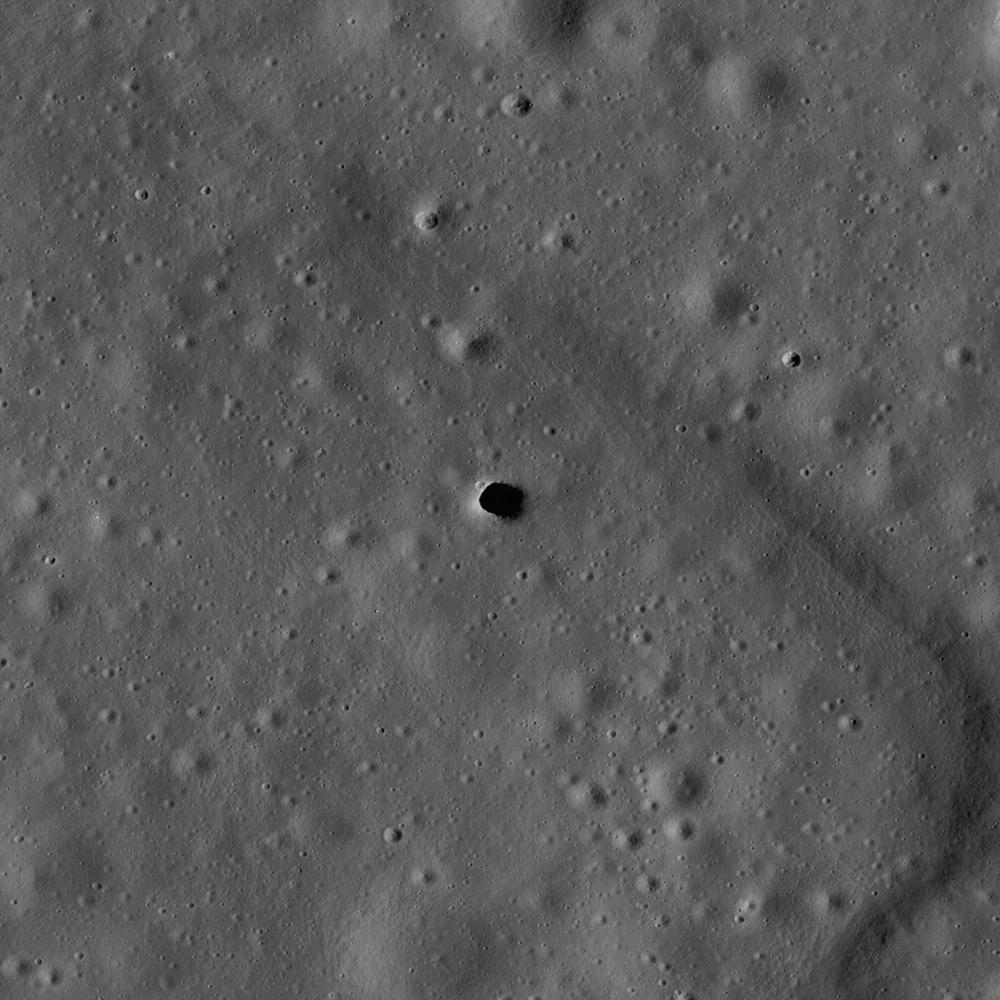
There is a hole in the Moon's Oceanus Procellarum, and NASA wants to know how far down, and how far sideways, it goes. On Sept. 30 the agency announced three new science payload suites for its Moon Base Program. One of them, called GIMLI, has a single target: the Marius Hills Pit. Its job is to work out whether the pit is just a pit or the entrance to a large underground lava tube.
The answer could matter well beyond planetary science. If a big void sits under the surface, NASA says confirming it could shift future habitat planning toward natural, ready-made shelters.
What NASA selected
The three suites were chosen through PRISM and will fly to the Moon on commercial landers under the Commercial Lunar Payload Services (CLPS) initiative, as part of the Moon Base Program. According to NASA's release, written by Lauren E. Low at NASA Headquarters, the selections are:
- LEMS-SP (Lunar Environment Monitoring Station - South Pole), led by principal investigator Mehdi Benna of the University of Maryland, Baltimore County: an autonomous environmental and hazard monitoring station that uses a short-period seismometer and tracks micrometeoroids and volatiles.
- GIMLI, led by Nathaniel Putzig of the Planetary Science Institute (PSI): a payload deployed at the Marius Hills Pit to hunt for subterranean lava tubes.
- DISCO (Depth Imager with Spectral and Color Optics), led by Ariel Deutsch of NASA's Ames Research Center: an investigation of ice in micro-cold traps and of how rocket exhaust disturbs the lunar surface.
The announcement quoted Nicky Fox, associate administrator of NASA's Science Mission Directorate, and Brad Bailey, director of the agency's Exploration Science Strategy Integration Office. On Oct. 2, NASA updated the release to correct the full names of DISCO and GIMLI. The agency now spells out GIMLI as "Geophysical Instruments for Marius Lunar pit Investigation."
The target: a skylight in Oceanus Procellarum
The Marius Hills Pit is a skylight, an opening in the surface on the Moon's nearside, in Oceanus Procellarum. Universe Today describes the area as one of the Moon's most volcanically diverse regions. Researchers theorize that such skylights open onto stable lava tubes left over from when the Moon was still geologically active, roughly 3.8 to 3 billion years ago.
Orbiters have found compelling evidence that caves and lava tubes may lie beneath the lunar surface, but GIMLI would examine the pit directly from the ground. In the words of the PSI release reposted by ScienceDaily, the goal is to determine whether a potentially large cave stretches underground from the pit opening, and if so, to estimate how big it is.
How GIMLI will look underground
GIMLI combines several measurements rather than relying on one. Universe Today lists the suite's instruments:
- Ground-penetrating radar to probe beneath the surface. According to the PSI release, the Norwegian Space Agency will provide the radar.
- Seismic sensors, including an active-source seismic system built by Honeybee Robotics.
- A gravimeter to measure gravity. PSI's description includes gravity measurements among the methods used to size a hidden void.
- Cameras to image the surface and the pit walls.
The instruments will ride on a lander and a rover, both supplied through CLPS. Universe Today notes that Honeybee Robotics is building much of the hardware and that the Norwegian Space Agency is a partner on the PSI-led proposal. Funding comes through PRISM.
Putzig points to the seismic work as a notable step. He said it has long been a desire of his to reintroduce intentional active-source seismic methods to planetary science, which he says has essentially not been done since the Apollo astronauts conducted the first seismic surveys on the Moon. Combining that method with ground-penetrating radar and gravity measurements, he said, should allow a much better understanding of subsurface properties, including the anticipated detection of a lava tube extending away from the pit. PSI CEO Amanda Hendrix was also quoted in the coverage.
Even a null result would carry value. PSI says that if no cave is found, the measurements could still help explain how the pit formed, and the pit's walls expose layers of regolith and lava flows that normally remain buried. Gareth Morgan, PSI senior scientist and deputy principal investigator, said confirming a substantial lava tube would give insight into how volcanism operated on the Moon.
Why It Matters
NASA states plainly why it wants to know what is under the Marius Hills Pit. Confirming such void spaces, its release says, could shift future habitat planning, offering natural, ready-made shelters that provide thermal stability and shielding from ionizing radiation and micrometeoroid bombardment.
The decision has to rest on measurements, though, not hope. Whether the pit leads into a large underground lava tube is exactly what is unknown, and GIMLI is designed to collect the data to find out: radar, seismic and gravity measurements, supported by camera images of the surface and pit walls.
GIMLI also fits a wider pattern in this round of selections. LEMS-SP will serve as a long-term environmental and hazard monitoring station. DISCO will study ice and how rocket exhaust disturbs the surface. GIMLI will scout possible natural shelters underground. NASA says the payloads will help researchers understand lunar resources, map natural shelters and assess environmental hazards for Moon Base.
What we don't know yet
None of the sources released so far gives a launch date, landing window or specific CLPS lander for GIMLI. NASA has picked the science and the destination. When the hardware actually reaches Oceanus Procellarum hasn't been announced. Until GIMLI's measurements come back, nobody can say whether a large lava tube really lies beyond the pit's edge.
Sources
- NASA Adds New Science Investigations for Moon Base (NASA, Sept. 30, 2026; updated Oct. 2)
- NASA Selects GIMLI to Search the Marius Lunar Pit for a Potential Lunar Base Site (Universe Today, Oct. 8, 2026)
- This mysterious hole on the Moon may open into a giant cave (ScienceDaily / Planetary Science Institute, Oct. 5, 2026)
