
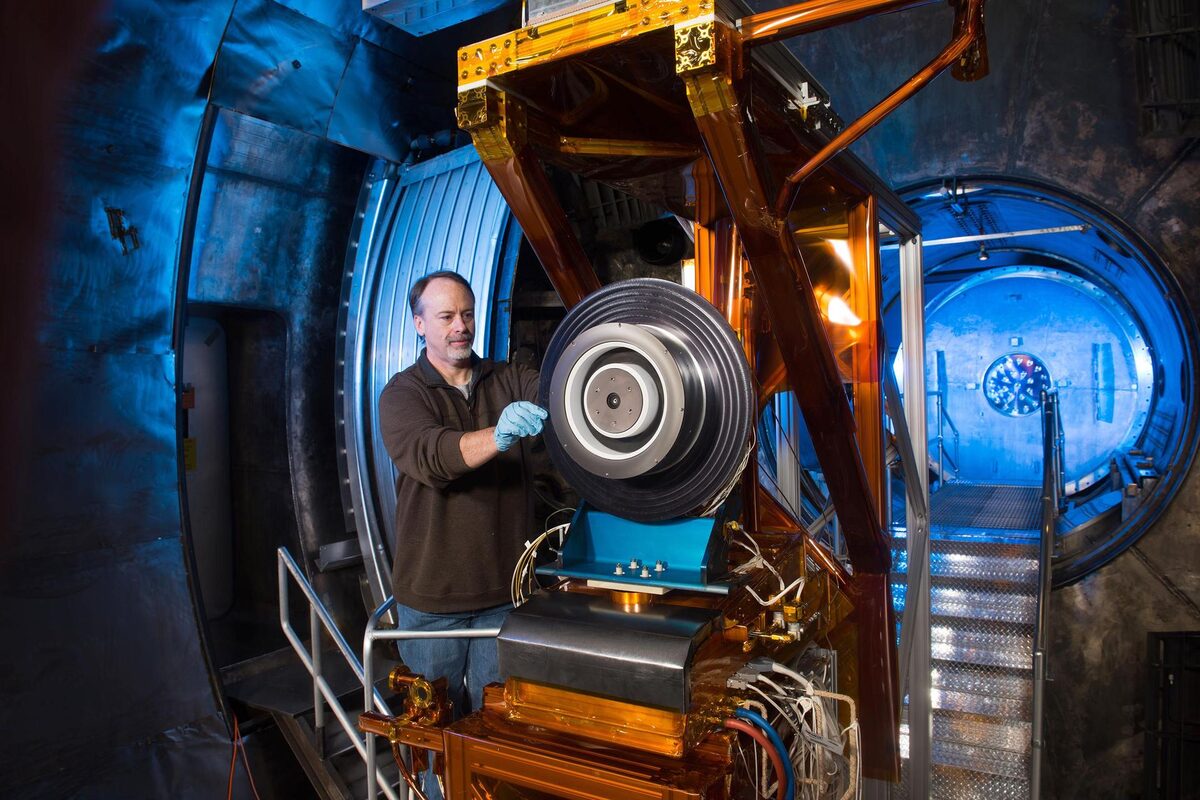
NASA wants US industry to build a better mid-size electric thruster, and it is offering money, technology and test time to whoever does it. The agency's Advanced Mid-Power Electric Rocket Challenge, or AMPERE, offers $500,000 split between up to two US companies (as much as $250,000 each) that design, build and demonstrate Hall effect thruster prototypes in the 3 to 7 kilowatt class.
NASA first posted the challenge on Nov. 9, 2026. A follow-up announcement on Nov. 18 came ahead of a virtual industry day held Thursday, Nov. 19. Registration stays open until Jan. 27, 2027, at 5 p.m. EST.
AMPERE is the first entry in what NASA calls its Tech Maturation Prize series. The format matters as much as the dollar figure. This is not a contest to come up with a clever idea. It is a staged program meant to move thruster hardware toward something a company could actually sell.
What a Hall thruster does
Hall effect thrusters are electric propulsion devices, and NASA describes them as part of solar electric propulsion (SEP) systems. They trade the large, brief push of a chemical rocket for a small push that can run for a very long time. According to NASA, the SEP system a Hall thruster belongs to uses 10 times less propellant than an equivalent chemical rocket. On a spacecraft where every kilogram counts, that is a big deal.
The physics is neat. As New Space Economy explains, an electric field accelerates ionized propellant out of the thruster to produce thrust. A magnetic field mainly controls the much lighter electrons. A cathode supplies electrons to the discharge and helps neutralize the exhaust plume, balancing the departing positive charge. Hall thrusters have flown using xenon, krypton and argon.
That last detail connects to one of the challenge's main offers. NASA will license its own Hall thruster technology that uses krypton, at no cost, to the companies that reach the prototype stage.
How the challenge is structured
AMPERE runs in three phases, and the field narrows as it goes.
- Phase 1: Design. Teams submit a concept design, a manufacturing plan, and projections of cost and performance. That combination tells you what NASA cares about. It wants to see whether a thruster can be built at a sensible price, not only whether it can be built.
- Phase 2: Prototype. Up to two teams move on to build prototypes. They work with NASA staff and get no-cost licenses to NASA's krypton Hall thruster technology.
- Phase 3: Test. Prototypes are tested at NASA's Glenn Research Center at no charge to the competitors.
Entry is limited to companies incorporated in the US, according to New Space Economy. A repost of NASA's original notice on Space Launch Schedule describes the invitation in those terms: US commercial companies are asked to develop and demonstrate mid-power Hall effect thruster prototypes.
Glenn and the Jet Propulsion Laboratory manage the project. Funding comes from NASA's Research and Technology Mission Directorate. Yet2 administers the challenge through the NASA Center of Excellence for Collaborative Innovation. Dr. Jason Frieman of Glenn is a co-owner of the AMPERE project and spoke for the agency in its announcement.
More than a cash prize
The cash is only one piece of the offer. NASA's announcement also lists a no-cost license to NASA-developed krypton thruster technology, collaboration with NASA personnel during prototyping, and testing at Glenn at no cost to the teams. Dr. Frieman said the approach seeks to remove key barriers and facilitate commercialization by giving winners access to NASA expertise, state-of-the-art technologies and world-class facilities at no cost.
The Phase 1 requirements also show the goal. Asking for a manufacturing plan and cost projections at the concept stage suggests AMPERE is about commercialization, not just a one-off demonstration. That reading is ours; NASA describes the aim as accelerating the maturation of mid-power systems.
Why It Matters
The 3 to 7 kilowatt range was identified by government and industry stakeholders as critical. New Space Economy notes that this power class is relevant to satellite, defense and exploration missions. NASA's announcement calls Hall thruster systems critical technology for propelling satellites and deep space robotic vehicles.
Hall thrusters already fly. The open question is who builds them and with what propellant. By offering its krypton technology for free and paying for testing, NASA is aiming to accelerate the maturation of mid-power systems that could support future NASA and commercial missions. If it succeeds, that could make it easier for customers to buy such thrusters from US suppliers.
As the first Tech Maturation Prize, AMPERE is also a test of the format. The challenge tries to carry a technology from licensed NASA design toward a product, and later entries in the series will show how the format fares.
Key dates
- Nov. 9, 2026: Challenge announced.
- Nov. 19, 2026: Virtual industry day.
- Jan. 27, 2027, 5 p.m. EST: Registration closes.
