
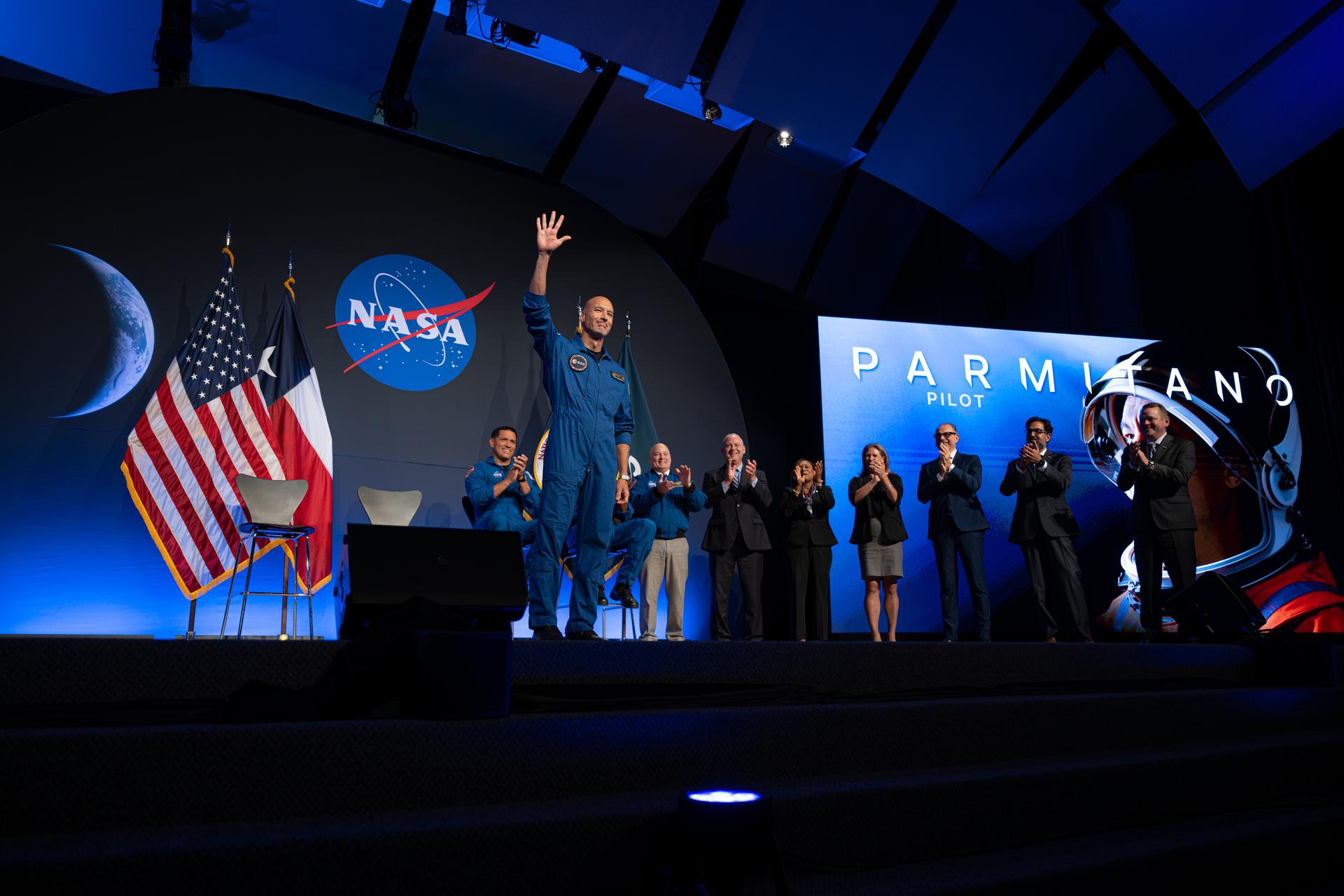
For most of the Apollo era and the decades that followed, the people flying America's crewed spacecraft were, almost by definition, Americans. That convention is now being formally bent. In a press release dated June 9, 2026, the European Space Agency announced that one of its own, astronaut Luca Parmitano, will fly as pilot on NASA's Artemis III mission. It is the kind of personnel decision that reads like a footnote and functions like a treaty clause.
The announcement did not arrive in isolation. Over a tight window in the second week of June 2026, NASA and ESA stacked up a series of moves that, taken together, describe a partnership being deliberately knotted tighter: a crew seat, hardware commitments, and two signed agreements. These are the kinds of decisions where the real architecture of spaceflight cooperation gets set, well away from launch pads.
The crew seat and the hardware behind it
The headline item is Parmitano. ESA's press release (PR N° 29-2026) states plainly that the ESA astronaut "joins NASA's Artemis III Mission as Pilot." For a European to hold the pilot's role on a flagship American crewed mission is a meaningful escalation of how integrated the two agencies have become — a seat at the front of the vehicle rather than a passenger slot negotiated as a courtesy.
But seats are not given for free, and the same announcement makes the quid pro quo explicit. ESA is providing its third European Service Module for this crewed test flight. The service module is the part of the Orion spacecraft that supplies propulsion, power, water, and air — in other words, the component that keeps the crew alive and moving through space. By building these modules, ESA has made itself structurally indispensable to the Artemis campaign: NASA cannot fly Orion without European hardware bolted to the back of it. A pilot's seat is, in that light, a logical extension of a partnership where Europe already supplies a load-bearing piece of the spacecraft.
ESA's release also clarifies what this particular flight is meant to demonstrate. The crewed test flight, conducted in Earth orbit, is designed to test rendezvous and docking capabilities — the precise, choreographed maneuvers of bringing two spacecraft together — ahead of future lunar landing missions that the Artemis program is ultimately building toward. That framing matters: this is a test flight with a job to do, not a victory lap, and the procedures it validates are prerequisites for putting humans back on the lunar surface.
Two signatures
While the crew news drew attention, the more durable cooperation may have been the paperwork. NASA and ESA finalized two agreements.
The first is an Earth-science partnership. According to NASA, the agreement is aimed at the continuity of Earth observations, advancing the understanding of Earth systems and climate change, and collaborating on an open-data policy. None of those phrases are decorative. Continuity is the central problem of climate science from orbit: a gap between one satellite's retirement and its successor's launch can leave a hole in long-running data records that no amount of later effort fully repairs. An open-data commitment, meanwhile, determines whether those observations are usable by researchers worldwide or locked behind institutional walls. NASA noted that the United States and Europe together provide more than 70% of the world's Earth science data, which gives a sense of how much of the global record this single partnership underwrites.
The second agreement is a memorandum of understanding on the Lunar Pathfinder mission — a lunar-relay communications effort. Relay infrastructure is the unglamorous plumbing of lunar exploration: a spacecraft positioned to pass signals between assets on or near the Moon and operators back on Earth. Per NASA, the spacecraft will provide S-band and Ultra-High Frequency channels for communications, with X-band frequencies relaying communications to Earth, and NASA will arrange delivery through its Commercial Lunar Payload Services program. As lunar activity ramps up under Artemis and beyond, a shared communications backbone is exactly the sort of capability that benefits from being built jointly rather than duplicated.
What happens next
The institutional rhythm continued past the signatures. In a separate media invitation (PR N° 30-2026, dated June 10, 2026), ESA flagged an information session following its 347th Council, scheduled for Wednesday, June 17 at 15:30 CEST. Such sessions are where agencies translate closed-door council decisions into public-facing detail — the venue where the consequences of the meeting are spelled out for the press and, by extension, for everyone watching the transatlantic relationship.
Why It Matters
It is easy to treat astronaut assignments and signed memoranda as separate genres of news — one human-interest, one bureaucratic. The events of mid-June 2026 are most usefully read together. Naming a European pilot, committing a third European Service Module, signing an Earth-science partnership, and inking a Lunar Pathfinder MOU are individually modest steps; collectively they describe two agencies binding their crewed, scientific, and communications programs into a single shared dependency. That has upsides — pooled cost, redundancy against either side's political swings, and a genuinely international crew — and it concentrates risk, because a partnership this interlocked is only as steady as the commitment both sides can sustain. The seat and the hardware are the headline; the durable cooperation written into the agreements is the load-bearing wall.
