
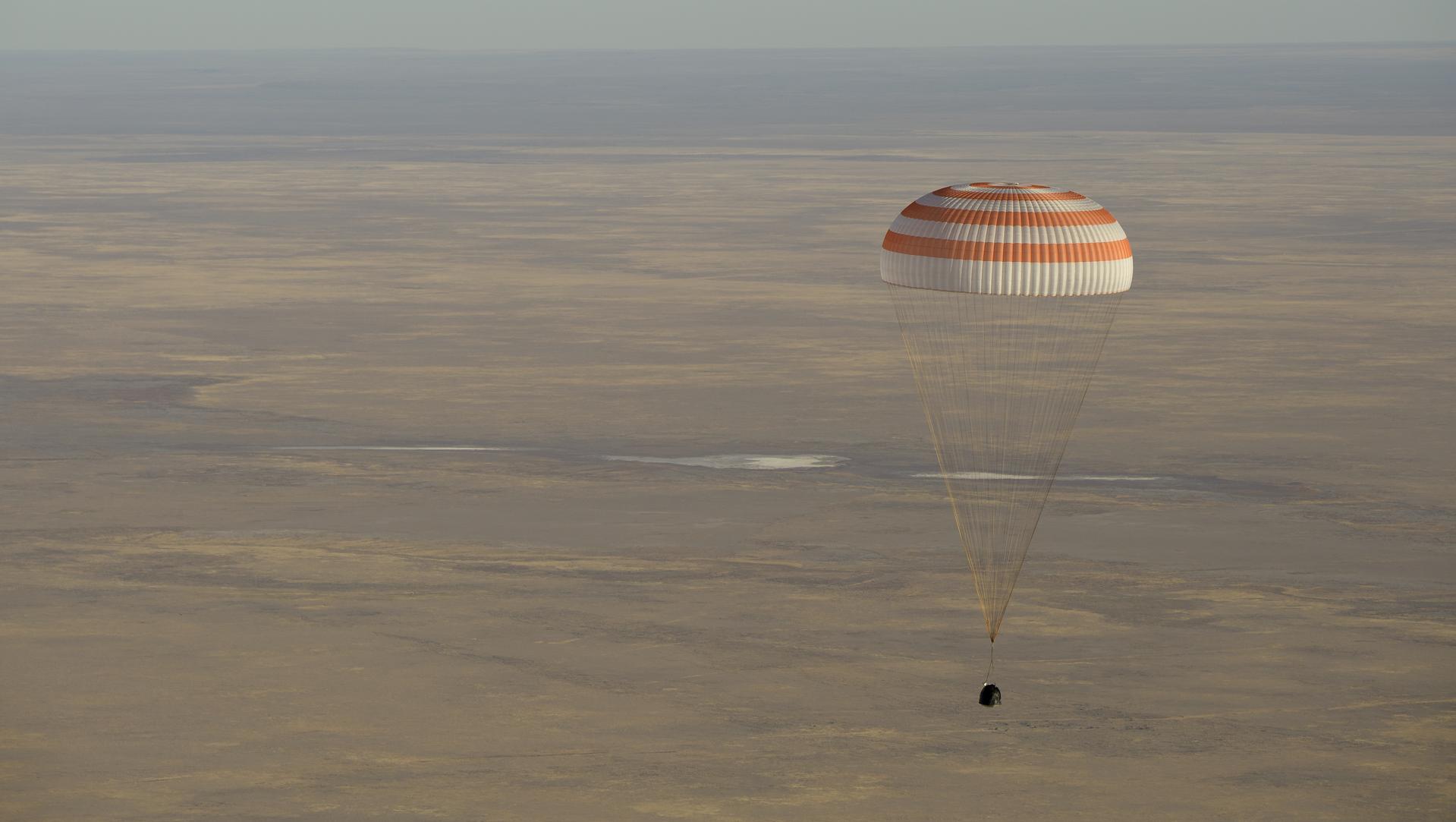
A Soyuz MS-28 capsule thumped down on the Kazakh steppe southeast of Dzhezkazgan at 5:27 a.m. CDT on July 26, 2026, closing out a 241-day stay aboard the International Space Station for NASA astronaut Chris Williams and Roscosmos cosmonauts Sergey Kud-Sverchkov and Sergei Mikaev. The parachute-assisted landing marked the end of Expedition 74 and, in the process, racked up some genuinely large numbers: 3,856 trips around the planet and more than 102 million miles logged since the spacecraft launched and docked to the station on November 27, 2025.
For two of the three crew members, the ride down was also a first. Williams and Mikaev were flying their maiden spaceflights; Kud-Sverchkov, by contrast, was making his second trip to orbit, having previously logged 185 days aboard the station in 2020-2021. That mix — rookies and a veteran sharing a single Soyuz descent module — is fairly typical of how NASA and Roscosmos have crewed these seats for years, spreading experience across a small capsule that has almost no margin for error on the way home.
How the Descent Played Out
Soyuz landings are a compressed, high-stakes sequence: undocking, a deorbit burn, atmospheric reentry, and then a parachute descent that ends in a hard, dusty touchdown on the steppe rather than a splashdown or runway landing. NASA's space station blog, recapping the return under the headline "Expedition 74 Trio Returns to Earth Inside Soyuz," detailed what came next — standard post-landing procedure for any Soyuz crew. Recovery teams met the capsule on the ground, medical staff ran initial checks on all three crew members right at the landing site, and helicopters ferried them to Karaganda, Kazakhstan, for further evaluation. From there, Williams boarded a NASA aircraft bound for Johnson Space Center in Houston, while his Roscosmos crewmates headed home to Star City near Moscow.
That handoff — steppe, to helicopter, to regional airport, to a long transcontinental flight home — is the same choreography that's played out after nearly every Soyuz landing for two decades. It's unglamorous compared to a splashdown broadcast live with drone footage of a recovery ship, but it's proven remarkably reliable.
Independent Confirmation
The landing wasn't reported by NASA alone. CBS News confirmed the touchdown, the 241-day mission duration, and the full descent timeline independently, while Space.com verified both the landing time and location. CBS also detailed who was left behind: seven other spacefarers remained aboard the station as Expedition 75 got underway — NASA's Jessica Meir, who took command from Kud-Sverchkov in a change-of-command ceremony the day before landing, along with Jack Hathaway and Anil Menon, ESA's Sophie Adenot, and Roscosmos's Andrey Fedyaev, Pyotr Dubrov, and Anna Kikina — even as their former crewmates were still in transit back to Houston and Star City. The station, in other words, didn't pause for the departure — it kept running.
Why It Matters
The most notable thing about this landing may be the least dramatic: it happened at all, on schedule, using the same US-Russian choreography that has ferried astronauts and cosmonauts to and from the ISS since 2000. Neither NASA's nor CBS's reporting framed the landing in explicitly geopolitical terms — the coverage stuck to mission mechanics, crew names, and numbers. But the ISS has long functioned as one of the few remaining venues where the two countries continue to cooperate directly and routinely, and every uneventful Soyuz landing is, in a small way, a data point that the arrangement still works.
There's also a practical dimension. With seven crew members continuing station operations under Expedition 75, the research cadence doesn't skip a beat when a Soyuz departs — a reminder that ISS staffing is a rolling, overlapping process rather than a hard changeover. Missions like this one, however routine they look from the ground, are the mechanism by which that continuity is maintained: crews rotate, seats get refilled, and the orbiting laboratory keeps generating data.
By the Numbers
- 241 days — total mission duration, from docking on November 27, 2025, to landing on July 26, 2026
- 3,856 — orbits of Earth completed
- 102+ million miles — distance traveled
- 3 — crew members: Chris Williams (NASA), Sergey Kud-Sverchkov (Roscosmos), Sergei Mikaev (Roscosmos)
- 7 — crew members remaining aboard the ISS under Expedition 75
None of that mileage or orbit count changes the underlying story much: three people went to space, did their jobs for eight months, and came home safely to a patch of steppe that has served as a landing zone for Soyuz capsules since the earliest days of the Soviet space program. What's changed is the backdrop — a geopolitical climate in which the ISS partnership is increasingly cited less as a scientific footnote and more as evidence that two governments can still make a decades-old agreement function, one Soyuz landing at a time.
