
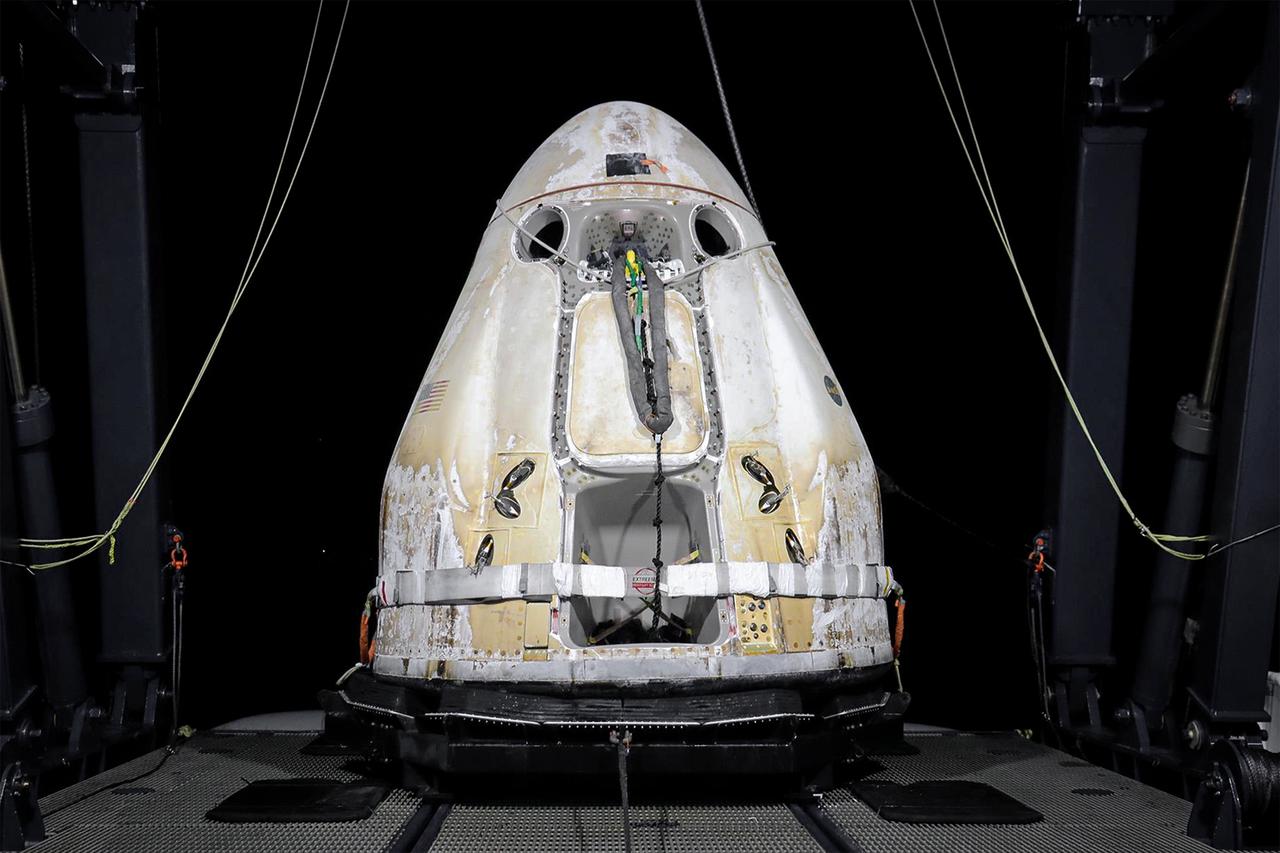
Most rideshare missions are about getting things up. SpaceX's Bandwagon-5 also carries two capsules that are built to come back down. When the Falcon 9 lifts off from Cape Canaveral, it will carry a second flight of SpaceX's own Starfall reentry capsule and Varda's W-7 pharmaceutical capsule. They share the rocket with 30 other payloads, including a maneuvering demonstrator that Portal Space Systems plans to start flying for customers in 2027.
The launch was set for Monday, Oct. 19, but SpaceX called it off early that morning. According to Spaceflight Now, poor weather in the booster recovery zone forced the scrub. The new target is Tuesday, Oct. 20, with a one-hour window that opens at 6:30 a.m. EDT (1030 UTC) from Space Launch Complex 40. The 45th Weather Squadron gives a 90 percent chance of acceptable launch weather.
The booster
The first stage is B1085, flying for the 19th time. If it lands on the droneship A Shortall of Gravitas as planned, it will be that ship's 167th booster landing and the 672nd landing of a Falcon booster overall. Flying a booster 19 times barely counts as news anymore. Still, the scrub shows that recovery is now part of the launch decision. Weather in the recovery zone, not at the pad, was the reason for the delay.
Starfall, round two
The most interesting payload belongs to SpaceX. Starfall is the company's reentry capsule, and it first flew in June. SpaceX has not said what this Starfall carries. Spaceflight Now noted that the company did not state what payloads, if any, were onboard for this flight.
Most of what is publicly known about the vehicle comes from regulators. Spaceflight Now cites the Federal Aviation Administration's environmental assessment for the capsule's size: about 0.75 meters tall, 3.1 meters across and about 2,100 kilograms, with room for up to 1,000 kilograms of payload. That makes it a wide, flat vehicle, much broader than it is tall.
The FAA's environmental review page lists the Final Environmental Assessment for "SpaceX Starfall Reentry Vehicle Operations in the Pacific Ocean" as complete, along with its FONSI/ROD (Finding of No Significant Impact and Record of Decision). The proposed action was to modify SpaceX's vehicle operator license so the company could reenter two Starfall vehicles from orbit, using the Pacific Ocean as the reentry site.
Starfall is also becoming something customers can book, not just a SpaceX experiment. Payload reported that Exolaunch had signed on to support customer payloads on a Starfall reentry mission. That mission is scheduled to launch on Starship no earlier than 2029. It is Exolaunch's first Earth-return mission and its first commitment to Starship. The payloads it expects to carry span biotech, pharmaceutical and in-space manufacturing applications. Payload also listed Starfall's capacity as 1,000 kg, which matches the figure from the FAA assessment.
Varda's ninth capsule
The second capsule is a more familiar kind of flight. Varda's W-7 is the company's ninth reentry capsule launched to date, even though its name suggests seventh. Its two successors, W-8 and W-9, flew earlier this month on the Transporter-18 mission. Spaceflight Now describes W-7 as about three times smaller than Starfall. Its job is a drug-research experiment: it will study whether microgravity can improve the solubility of a cancer drug, Protac.
Varda's premise, in its own words quoted by Spaceflight Now, is that molecules can crystallize differently in microgravity than on Earth, potentially producing crystal forms with improved properties, including better solubility. If the experiment succeeds, Varda says, it could help turn powerful protein-degrading molecules into more practical and effective cancer treatments. On this flight, W-7 shares the ride with a far larger reentry capsule.
Portal's Starburst-1
Not everything on Bandwagon-5 is coming home. Portal Space Systems is flying Starburst-1, a 260-kilogram spacecraft designed to perform orbital maneuvers. It can support a customer payload of up to 50 kg, and Portal advertises customer flights starting in 2027. According to the company, this first demonstration is fully funded by Portal to prove capability ahead of customer missions.
The rest of the manifest
Starfall is one of 32 payloads on the mission. Exolaunch manifested 20 of the other 31. According to Spaceflight Now, those include four radio-frequency monitoring satellites from HawkEye 360, four communications satellites for Iceye and six navigation satellites from Xona Space Systems.
Exolaunch is also changing hands. Payload reported that the company is set to be acquired by EQT, with the deal expected to close in the fourth quarter of 2026.
Why It Matters
For years, rideshare missions have been a one-way service: cheap rides to orbit for small satellites. Bandwagon-5 shows a second business taking shape alongside that one: getting things back. Two reentry capsules of very different sizes, from two different companies, are flying on the same rocket. One comes from a company that has now launched nine of them. The other comes from the launch provider itself, and it already has a customer booking, with Exolaunch's flight scheduled no earlier than 2029.
Regulators are part of this story too. Starfall's reentries required a modification to SpaceX's FAA license and a completed environmental assessment, and the proposed action covered two vehicles. Any routine return service will likely need more of these approvals. How smoothly regulators can issue them may matter as much as the hardware.
Many questions remain open. SpaceX hasn't said what this Starfall carries. Varda's microgravity drug results have to justify the cost of going to orbit. And Exolaunch's booked Starfall flight is years away on a vehicle that is still in development. Even so, the companies involved are now treating Earth return as something they plan around, not a one-off stunt.
