
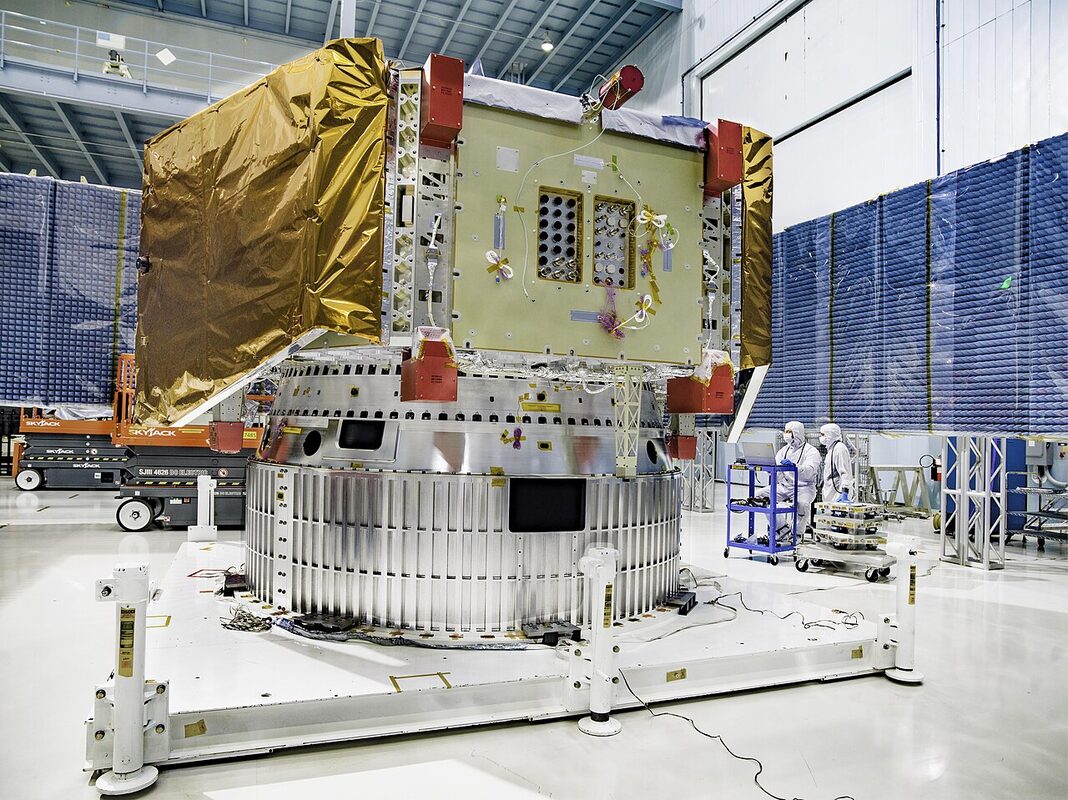
NASA's Nancy Grace Roman Space Telescope, the agency's next flagship observatory, has reached the stage where the news is logistical: engineers are packing it for the road. Construction finished in November 2025, the spacecraft cleared its final environmental tests without a serious hitch, and NASA is now targeting a launch around the end of August 2026 — well ahead of a readiness deadline that had sat in mid-2027. For a flagship space telescope, arriving early is almost as unusual as the science it promises.
The instrument's defining trick
Roman is often described as carrying a mirror the size of Hubble's, and it does — 2.4 metres. But matching Hubble's resolution is not the point. Roman's distinguishing feature is its field of view, roughly a hundred times larger than Hubble's at comparable sharpness. Where Hubble photographs the sky through a keyhole, Roman photographs it through a picture window, capturing in a single exposure what would take its predecessor hundreds. That changes the kind of question an observatory can answer. Hubble and Webb are built to stare deeply at small targets; Roman is built to survey — to map enormous swaths of sky, repeatedly, in the near-infrared.
What a survey machine is for
Three goals shaped the design. The first is dark energy, the unknown influence accelerating the universe's expansion. By measuring the shapes and distances of vast numbers of galaxies across cosmic time, Roman can trace how cosmic structure grew and how the expansion rate changed — a direct probe of whether dark energy behaves as a constant or something stranger. The second is dark matter, mapped through the subtle gravitational distortion it imprints on the light of background galaxies. The third is exoplanets, found by a method Roman is almost uniquely suited to: gravitational microlensing, in which a foreground star and its planets briefly magnify a background star. Microlensing is sensitive to worlds at wide orbits and even free-floating planets bound to no star at all — a population other techniques largely miss. A wide, repeated infrared survey is the natural way to catch these fleeting, unpredictable events in bulk.
Behind that picture-window view sits an enormous detector. Roman's Wide Field Instrument carries roughly 300 megapixels across eighteen sensors, and a single observation captures an area of sky larger than a hundred full Moons at Hubble-class sharpness — a combination that, until now, forced an impossible choice between resolution and coverage. The mission will generate data on a scale that itself reshapes how astronomers work, favoring statistical studies of millions of objects over the careful examination of a few. Roman also carries a coronagraph, an instrument that masks a star's glare to reveal faint companions beside it — a technology demonstration meant to mature the techniques a future observatory will need to directly image Earth-like planets around other stars.
Why the early arrival matters
Roman reaching the pad early is notable for a second reason beyond efficiency: it lands the observatory in the middle of a turbulent moment for NASA science, where budget proposals have repeatedly threatened the broader portfolio. A finished, on-schedule flagship is the strongest possible argument for the value of the work — a counterexample to the narrative that big science missions inevitably balloon and slip. Once on orbit, Roman is designed to operate alongside Webb and the ground-based Vera C. Rubin Observatory, the three forming a complementary trio: Rubin sweeping the sky from the ground, Roman surveying it in infrared from space, and Webb following up the most interesting targets in fine detail. The next decade of astronomy is being built around that division of labor, and Roman is the piece that has just moved from construction to countdown. When it reaches orbit and begins to survey, the long-promised era of wide-field space astronomy — mapping the sky not through keyholes but in sweeping vistas — finally begins in earnest.