
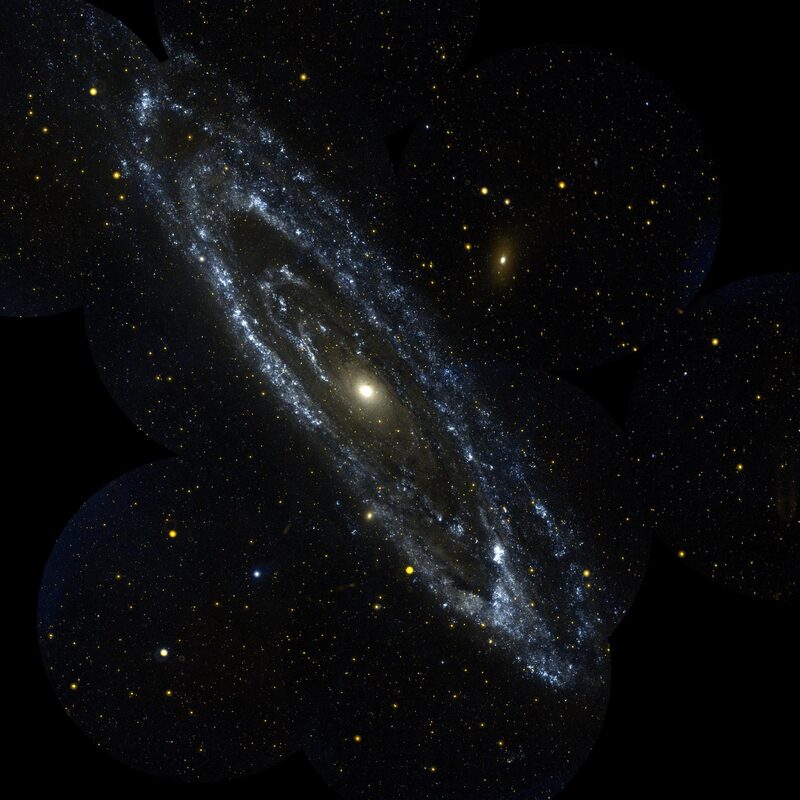
Most guide stars point you to one thing. Mirach, also called Beta Andromedae, points you to three galaxies. One of them is the most famous galaxy in the sky, one is a faint spiral that rewards a dark site, and the third sits so close to Mirach's glare that it has earned the nickname "Mirach's Ghost." Autumn evenings are when all three are well placed, and this week NASA's Astronomy Picture of the Day gave a good reason to look at the biggest of them more closely.
Meet the signpost
Mirach is no faint, hard-to-find star. According to EarthSky's guide, it is a 2nd-magnitude red giant about 200 light-years away. It has about three to four times the mass of the sun, has swollen to roughly 100 times the sun's diameter, and shines about 1,900 times more brightly. That last number explains why it's easy to see without a telescope from 200 light-years off. It also explains why it causes trouble for one of the galaxies it leads to.
Mirach is only moderately bright by the standards of the sky's brightest stars, but it is bright enough to work as a signpost, and its orange tint stands out once you know where to look. Getting to it is the easy part. What makes it useful is the geometry around it.
The star-hop, step by step
The method EarthSky describes uses just two stars: Mirach and a fainter neighbor, Mu Andromedae.
- To the Andromeda Galaxy (M31): Start at Mirach and find Mu Andromedae. Draw a line from Mirach to Mu, then keep going about the same distance again past Mu. That brings you to M31, the Andromeda Galaxy, about 2.5 million light-years away.
- To M33: Go back to Mirach and head the opposite way, away from Mu. Continue the line past Mirach for twice the Mu-to-Mirach distance and you reach the Triangulum Galaxy, M33.
- To NGC 404: No hop needed. NGC 404 sits right beside Mirach in the sky, only about a tenth of a degree away.
It's one of the tidier star-hops in the autumn sky: a straight line through one bright star, with a galaxy at each end and a third tucked right next to the star in the middle. Binoculars are enough for M31, even from suburban skies. M33 is fainter and can still be a challenge in binoculars and small telescopes. The third calls for a telescope and some patience. NGC 404 is faint, around magnitude 11, and the real problem is the 2nd-magnitude star next to it.
The ghost in the glare
NGC 404 is, in the words of a 2008 Caltech release from NASA's Galaxy Evolution Explorer (GALEX) mission, the nearest example of a lenticular galaxy. It lies "hidden in the glare" of Mirach, which is how it became known as the "Ghost of Mirach." Lenticular galaxies are disk-shaped, with little ongoing star formation and no spiral arms. Under that view, NGC 404 should be a quiet, ageing system.
GALEX looked in ultraviolet light, where young, hot stars show up, and found something different. Its images showed an extended ring of new stars around NGC 404. David Thilker of Johns Hopkins University said the team had thought the galaxy was essentially dead, but that it has an extended ring of new stars: "It's like the living dead." Earlier radio observations had already found a matching ring of hydrogen gas, which the authors of that study attributed to a collision with a small neighboring galaxy about 900 million years ago. The ultraviolet data indicated that star formation began as that gas settled into the galaxy's plane.
For backyard observers, the result changes how NGC 404 looks in an eyepiece. When you pick out the small smudge next to Mirach's glare, you're looking at a galaxy whose apparent retirement turned out to be only part of the story.
Zooming in on Andromeda: NGC 206
The big galaxy at the end of the hop got its own spotlight this week. NASA's Astronomy Picture of the Day for November 13, an image credited to David Cruz, centers on NGC 206, a large stellar association in the southwestern extent of M31's disk.
The numbers explain why it stands out. NASA says NGC 206 spans about 4,000 light-years, much larger than the open clusters of young stars in the Milky Way's disk. That is comparable in size to the giant stellar nurseries NGC 604 in M33 (the second galaxy on Mirach's route) and the Tarantula Nebula in the Large Magellanic Cloud. Its youngest massive stars are less than 10 million years old, which on cosmic timescales means they formed very recently, and its bright blue stars mark it as young.
That links the route together. You can stand under one sky, start at a single red giant, and reach two galaxies that each host a giant star-forming complex: NGC 206 in Andromeda and NGC 604 in M33. Right next to that star sits a third galaxy that was thought to be done forming stars and wasn't.
Practical notes for the session
A few points to plan around, based on how the hop works:
- Do M31 first. It's the easiest target and confirms you have the Mirach-to-Mu line right. If the line ends at a fuzzy oval glow, your geometry is correct.
- Give M33 darker skies. Taking the hop the other way is the same method with twice the distance. Count it out carefully rather than guessing.
- Hunt NGC 404 last. Your eyes will be at their most dark-adapted by then. Since Mirach is the problem, try putting the bright star just outside the field of view so its glare doesn't wash out the galaxy.
Why It Matters
Star-hops are usually treated as a navigation trick, but this one also touches several ideas about how galaxies change over time. M31 and the NGC 206 image show large-scale star formation in a big spiral, with massive stars under 10 million years old in a structure thousands of light-years across. NGC 604 in M33 is another example of the same kind of giant complex. NGC 404 complicates the neat categories. A galaxy class associated with little ongoing star formation turned out to have a ring of new stars, which GALEX revealed by looking in ultraviolet light.
All of that is reachable by aiming at one 2nd-magnitude star. It's a useful reminder that what you see through the eyepiece is a starting point. Ultraviolet surveys and detailed images like Cruz's fill in what the eye can't pick up, and Mirach is the place to start.
