
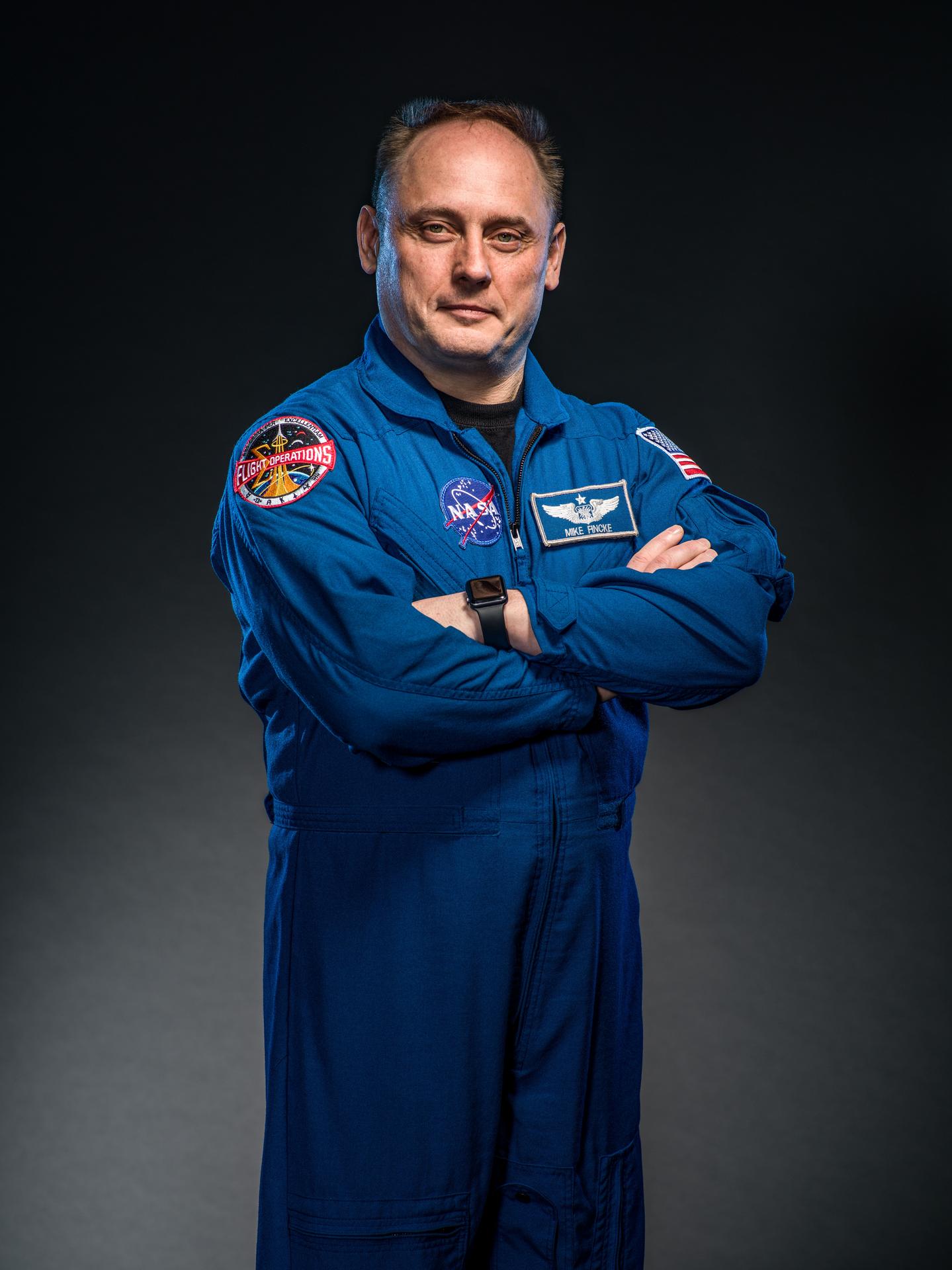
NASA announced on August 12, 2026, that astronaut Mike Fincke is retiring from the agency after a 30-year career, closing out a run that included four spaceflights, a fourth-place ranking on NASA's all-time cumulative spaceflight-duration list, and a January medical emergency that cut short his final mission aboard the International Space Station.
Fincke joined NASA's 16th astronaut class in 1996. Over three decades he flew four missions across three different types of human-rated spacecraft — two aboard Soyuz, one aboard the space shuttle, and one piloting SpaceX's Dragon — amassing 549 cumulative days in space and logging 48 hours and 37 minutes of spacewalk time. That body of flight experience placed him fourth among all NASA astronauts for total time spent off the planet.
His career ended not with a planned final splashdown but with an abrupt return to Earth. On January 7, 2026, during dinner aboard the ISS the night before a scheduled spacewalk as part of the Crew-11 mission, Fincke lost the ability to speak for approximately 20 minutes. NASA brought him and his Crew-11 crewmates home early as a precautionary measure, cutting the mission short. The agency has not given an official reason tying the medical event directly to his retirement, and the two announcements — the January evacuation and the August retirement — have been treated by NASA as separate matters.
A 30-Year Career Across Three Spacecraft
Few astronauts can say they've flown three distinct types of human-rated vehicles across four missions in a single career, and Fincke's tenure at NASA stretched long enough to span very different eras of American spaceflight. From his 1996 selection through his cut-short Crew-11 mission this year, he built one of the longest flight records in agency history, culminating in a spacewalk total of nearly 49 hours — time spent working outside the station in a suit, exposed to vacuum, on tasks that leave little room for error.
That record put him in rare company: only three NASA astronauts have logged more cumulative time in space.
The January Incident
According to Fincke's own account, relayed to the Associated Press, the loss of speech occurred during dinner aboard the station ahead of a scheduled spacewalk. He is a Pittsburgh-area native, and the roughly 20-minute episode was serious enough that NASA opted not to wait it out in orbit — the agency brought him home rather than risk a spacewalk, or an extended stay, with an unresolved medical question hanging over the crew.
NASA has not publicly detailed a diagnosis or cause for the temporary speech loss, and it has stopped short of linking the incident to Wednesday's retirement announcement. The timing — a dramatic in-flight medical event in January followed by a retirement announcement seven months later — invites the obvious question, but NASA's public statements have kept the two events formally separate.
Why It Matters
Fincke's exit removes one of the most experienced hands in NASA's active astronaut corps at a moment when the agency is leaning heavily on veteran crew members to bridge Commercial Crew operations, ongoing ISS science, and preparations for missions beyond low Earth orbit. Astronauts with multi-vehicle, multi-decade experience are not easily replaced — the training pipeline for a new astronaut candidate to reach flight-ready status, let alone to accumulate hundreds of days of orbital and spacewalk experience, takes years.
The January incident is also a reminder of how thin the margin is for medical events in orbit. A crew member losing the ability to speak, even briefly, during preparation for a high-risk spacewalk is exactly the kind of scenario mission planners train for but hope never to see. That NASA chose to evacuate rather than monitor the situation on station underscores how conservatively the agency treats any unexplained neurological symptom in microgravity, where medical evacuation options are limited and diagnostic tools are far more constrained than on Earth. As NASA leans on aging veteran astronauts for high-tempo mission schedules, in-flight health events like Fincke's are likely to draw closer scrutiny — both for what they mean for individual crew members and for how they shape return-to-flight and medical-clearance policy going forward.
What Comes Next
NASA's announcement did not detail Fincke's post-retirement plans. The agency's statement focused on the scope of his career — the four spaceflights, the spacewalk hours, the cumulative days in orbit — rather than on the circumstances of his final mission. For now, his departure leaves NASA's active corps with one fewer astronaut carrying institutional memory of Shuttle-to-Commercial-Crew-era operations, at a time when that kind of experience is increasingly scarce.
