
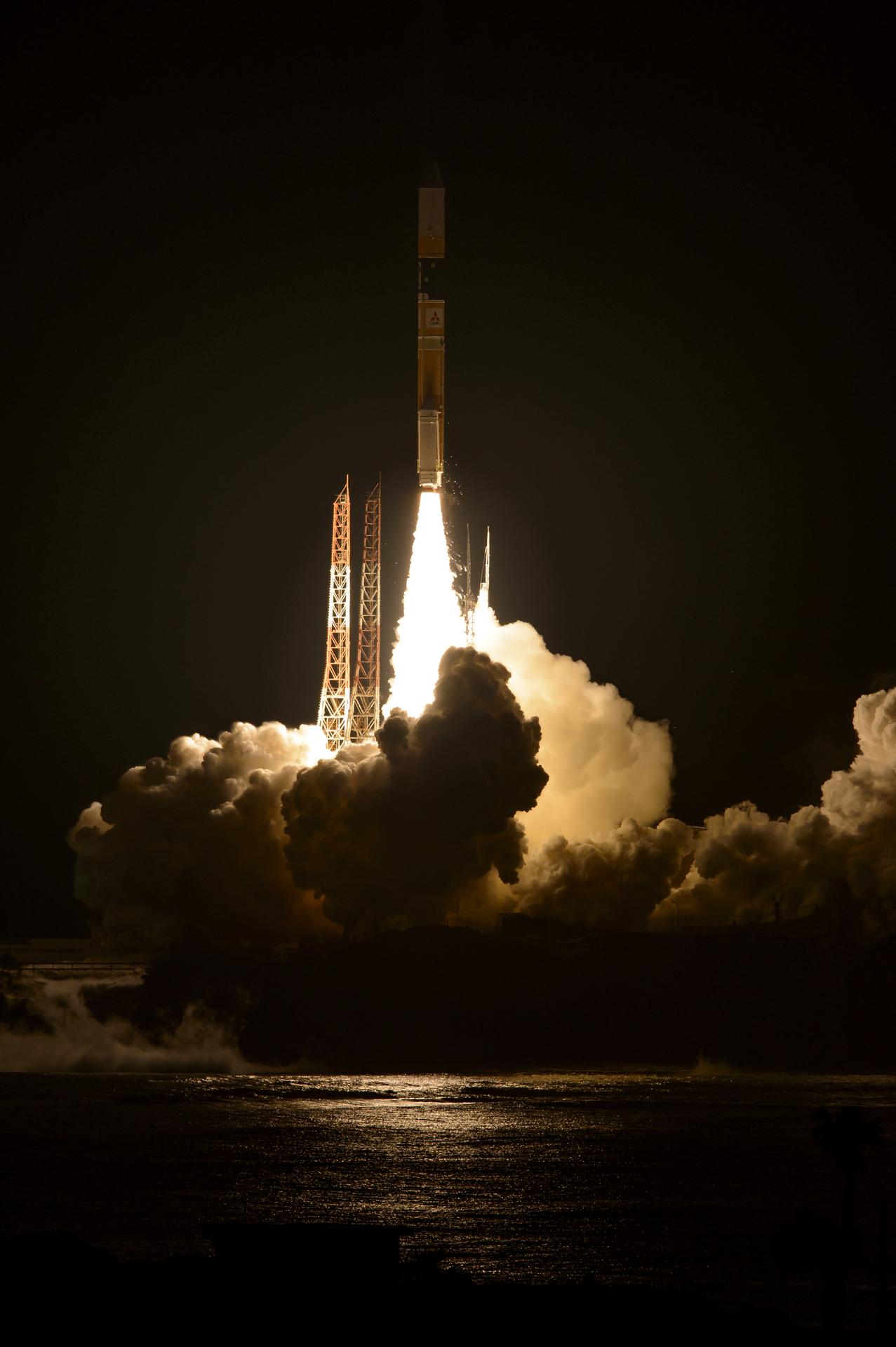
Third time may be the charm for Japan's newest navigation satellite. JAXA announced August 8 that H3 Flight No. 9, carrying the Michibiki No. 7 satellite (QZS-7), will lift off from the Yoshinobu Launch Complex at Tanegashima Space Center during a window of 04:00 to 05:30 JST on August 11 — 19:00 to 20:30 UTC on August 10 for those following along from the other side of the date line. Launch tracking site Space Launch Schedule lists the mission as "Go For Launch," with a target time of 19:23 UTC, squarely inside JAXA's stated window.
Getting to this point has been a fight with the weather. The mission was originally slated for August 7, but JAXA postponed it as Typhoon T2613 — named "Dolphin" — bore down on the region. The agency reset for August 10, then scrubbed that date too, saying in its August 8 release that "weather conditions necessary for the launch may not be satisfied." If the August 11 attempt slips as well, JAXA has reserved backup launch periods running August 12–31 and September 3–30, so there is plenty of runway left in the calendar.
An anchor for the Quasi-Zenith system
QZS-7 is the newest addition to Japan's Quasi-Zenith Satellite System (QZSS), a regional navigation constellation designed not to replace GPS but to shore it up where it struggles most over Japan. QZSS satellites broadcast GPS-interoperable and augmentation signals alongside original Japanese QZSS signals, from inclined, elliptical geosynchronous orbits chosen for high-elevation visibility over users in urban canyons and mountainous terrain — exactly the environments, dense high-rise cities and steep valleys, where signals from GPS satellites low on the horizon get blocked or bounced. With Michibiki No. 7 in place, the system that augments GPS over urban and mountainous Japan grows stronger still.
The ride to orbit is the H3-22 variant of Japan's flagship rocket: two LE-9 main engines on the core stage, two SRB-3 solid boosters strapped alongside, and a short payload fairing. Flight 9's job is to deliver the navigation satellite to geostationary transfer orbit, from which QZS-7 will work its way to its operational station.
The other passenger: a U.S. Space Force surveillance payload
What makes this launch more than a domestic infrastructure story is the program QZS-7's constellation belongs to. Under the QZSS-Hosted Payload program — the first bilateral U.S.–Japan cooperative space effort focused on national security — two U.S. space-domain-awareness payloads designed and built by MIT Lincoln Laboratory are being hosted on Japanese satellites, and QZS-7 is in line to carry the second of the pair.
The first of the two launched on QZS-6, which flew on an H3 from Tanegashima on February 2, 2025. That sensor delivers near-real-time data to the U.S. Space Surveillance Network, sharpening the Defense Department's understanding of the geosynchronous orbit regime above the Indo-Pacific — the crowded, strategically sensitive ring of orbit where communications, missile-warning, and intelligence satellites park. A second sensor operating alongside it would extend that watch.
The arrangement is a study in quiet, practical alliance plumbing. The program covers the integration, launch, and operations of both payloads, and pulls together an unusual roster of partners: the U.S. Space Force's Space Systems Command, Japan's National Space Policy Secretariat, and Mitsubishi Electric. Getting American surveillance hardware bolted onto Japanese navigation satellites took a two-year integration and test campaign before the first payload ever left the ground.
Why It Matters
For Japan, building out QZSS is about resilience. GPS is a foreign-owned utility that modern Japanese infrastructure — from smartphones to surveying to precision agriculture — depends on daily. A more robust quasi-zenith constellation gives Japan augmentation signals tuned to its own geography and a measure of independence if GPS service ever degrades over the region. Urban canyons in Tokyo and mountain valleys in the interior are precisely where standard GPS geometry falls apart; QZSS exists to fill that gap.
For the United States, the hosted payloads solve a different problem: persistent eyes on the geosynchronous belt over the Indo-Pacific, delivered without buying dedicated satellites or launches. Hosting sensors on an ally's navigation spacecraft is cheaper and faster than flying standalone missions, and it binds the two countries' space enterprises together in a way that joint statements never could. That this is the first bilateral U.S.–Japan national-security space program makes the QZSS-Hosted Payload effort a template — proof that allied hosted payloads can go from agreement to orbit, surviving a two-year integration campaign and, now, a string of typhoon-season scrubs.
And for JAXA, every H3 flight still counts. Flight 9 carrying a national navigation asset for a constellation tied into an allied security program is a statement of confidence in the rocket — one the agency clearly prefers to make in good weather, even if Typhoon Dolphin had other plans for the first two attempts.
If the skies over Tanegashima cooperate, the wait ends in the pre-dawn hours of August 11, Japan time.
Sources
- JAXA: Launch Schedule of MICHIBIKI No. 7 (QZS-7) aboard H3 Flight No. 9 [Rescheduled]
- JAXA: Postponement of MICHIBIKI No. 7 launch due to Typhoon T2613 (Dolphin)
- MIT Lincoln Laboratory: US Space Force's Space Systems Command and Japan launch first bilateral space effort
- Space Launch Schedule: H3-22 | Michibiki 7 (QZS-7)
