
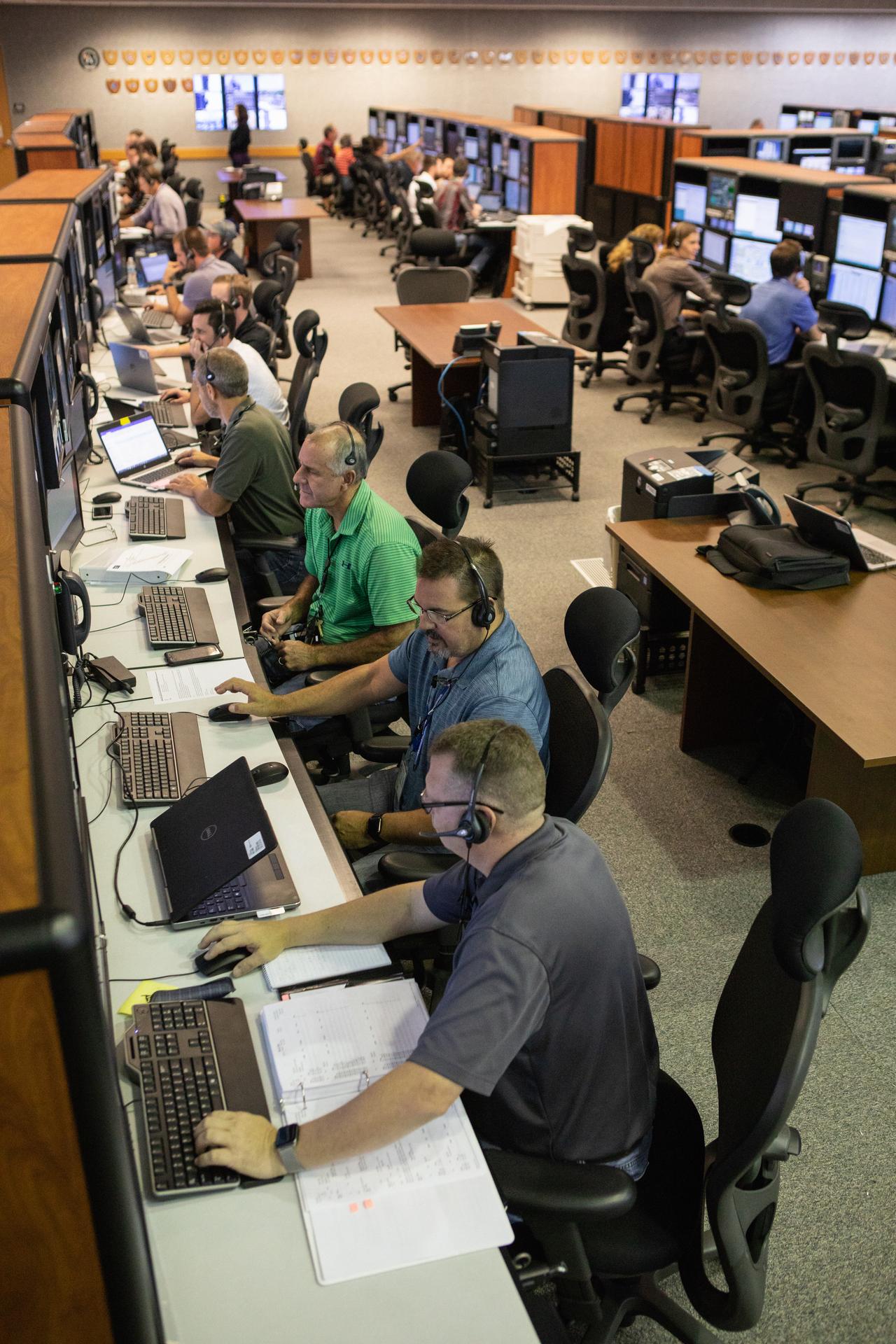
For years, "AI in the operations center" has mostly meant one vendor's chatbot bolted onto one narrow task. In May, at Nellis Air Force Base outside Las Vegas, the Department of the Air Force tried something messier and more ambitious: putting six different companies' AI tools into the same room, on the same problem, at the same time — and letting Guardians and Airmen see whether the machines could actually work together instead of just working alongside each other.
The event was called the Multi-Decision Advantage Sprint for Human-Machine Teaming, or MASH, and it ran for two weeks at the Shadow Operations Center-Nellis facility, known as ShOC-N. According to an official Space Force release, roughly 100 people took part: Guardians from the Space Force, Airmen from the Air Force, civilian engineers, and developers from six industry teams, working alongside ShOC-N's own in-house software staff.
What the exercise actually tested
MASH wasn't a single demo of a single tool. It was structured around three distinct decision functions that a battle-management crew has to work through when planning action against a target: recommending what actions can be taken against a target, ranking which available capabilities are best suited to produce a given effect, and — once an effect and a capability have been matched — building out the additional supporting capabilities needed across the execution window to back up that match.
Each of those functions has historically been handled by a human analyst working through checklists, reference material, and institutional experience — a process that can eat up significant time when a crew is juggling threats across air, space, cyber, maritime, and ground domains simultaneously. The premise of MASH was to see whether large language models and agentic AI workflows could take on pieces of that work, and whether tools built by competing companies could be made to talk to each other well enough to hand off data mid-process.
That interoperability piece was arguably the harder engineering problem. Six vendors don't normally build to a shared standard, and a battle-management workflow that only works if every operator uses the same company's product isn't much of a workflow — it's a sales pitch. To get around that, the Air Force Research Laboratory built an orchestrator layer specifically to let different vendors' tools exchange data and metadata seamlessly, according to the Space Force's release. In effect, it's plumbing that lets one company's targeting tool pass its output to another company's ranking tool without a human manually re-entering everything in between.
The numbers behind the headline
The exercise involved the 805th Combat Training Squadron, the Air Force Research Laboratory, and the Advanced Battle Management System Cross-Functional Team, according to DefenseScoop. Col. John Ohlund said the effort validated human-machine teaming's potential to substantially expand the volume of viable options available to commanders during high-tempo operations — a fairly measured way of describing what one participant experienced more viscerally.
Capt. Adam Sochia, who took part in the exercise, told DefenseScoop that a week earlier it had taken his team fifty minutes to an hour to get one tasking done, and that with the tool's help they were able to get five or six taskings done in that same window. That's the number driving most of the coverage of MASH, and it's worth sitting with for a second: a five-to-six-times throughput gain on a task that used to bottleneck at human speed is the kind of change that reshapes what a battle-management crew can realistically keep pace with during a fast-moving operation, rather than just making an existing process marginally faster.
It's a single operator's account from a two-week experiment, not a peer-reviewed study, and the sourcing here doesn't include benchmarks against a control group or details on how "a tasking" was measured. But it's also not a vendor's marketing claim — it's a Guardian or Airman describing what happened during a Pentagon-run exercise, which is a different kind of evidence than a press release promising future capability.
Why this exercise, why now
Air & Space Forces Magazine reported that MASH is meant to build a blueprint for future multi-domain operations generally, and that the integration work done in the experiment is specifically helping build the Department of the Air Force Battle Network — the service's contribution to the broader, still-in-progress Combined Joint All-Domain Command and Control network meant to connect sensors to shooters across domains. That framing matters: MASH wasn't primarily about picking a winning AI vendor. It was about proving whether the underlying integration approach — many tools, one orchestrator, human operators still in the loop making the final call — is viable at all before the Air Force and Space Force commit further to it.
The fact that Guardians were folded directly into an Air Force-run exercise is itself notable. It was, according to reporting on the event, the first time ShOC-N had another military service actively participate in one of its experiments. Space Force battle management has increasingly had to account for effects that ripple across air, cyber, maritime, and ground domains rather than staying confined to orbit, and MASH's decision functions were explicitly domain-spanning rather than space-specific.
Why It Matters
Modern military operations increasingly hinge on how fast a human decision-maker can move from "here's what's happening" to "here's what we're doing about it" across multiple domains at once. That loop — sense, decide, act — has historically been rate-limited by how quickly people can process information, not by how fast weapons or sensors can move. If tools like the ones tested at MASH can reliably compress the "decide" portion of that loop by a factor of five or six, as one operator reported, it changes the tempo an adversary has to match, and it changes how many simultaneous problems a single crew can responsibly track.
It also matters that the Air Force Research Laboratory built connective tissue between six different companies' products rather than picking one vendor and standardizing on it. A single-vendor approach is faster to build but leaves the Pentagon dependent on one company's roadmap and one company's failure modes. An orchestrator model that lets tools be swapped in and out — and lets the government keep multiple vendors honest through competition — is a more resilient (if more complex) way to build toward the kind of multi-domain command-and-control network the Battle Network concept is aiming for.
None of that means the hard problems are solved. A two-week sprint with roughly 100 participants demonstrates that the plumbing can work and that operators found it useful in the moment; it doesn't by itself demonstrate reliability under contested conditions, resistance to bad or adversarial data, or performance against a real thinking opponent rather than an exercise scenario. What MASH does establish is that the integration approach — many AI tools, one shared workflow, humans still making the final call — is no longer just a slide in a briefing. It's something Guardians and Airmen have now run, at Nellis, with real people typing into real terminals.
