
Two clocks ran quietly in orbit back in June, and the U.S. Space Force only made the results public over the July 4th weekend. The first measured how fast a rocket company could get a satellite off the ground after being told to launch. The second measured how fast a different company's spacecraft could find that satellite in orbit, catch up to it, and take its picture — without a human in the loop telling it where to look.
Both clocks stopped early. Rocket Lab launched the VICTUS HAZE mission just 16 hours and 42 minutes after receiving its Notice to Launch from the Space Force on June 19, breaking the prior responsive-launch record by more than 10 hours. Then True Anomaly's JACKAL-0004 spacecraft took over, autonomously locating, approaching, and imaging the newly deployed target satellite in 61 hours — beating the military's own 72-hour tactical deadline and, according to the Space Force, becoming the first autonomous commercial orbital intercept ever flown. The Space Force didn't formally declare the mission a success until July 3, nearly two weeks after the launch, once it had finished reviewing the results.
The Launch: 16 Hours, 42 Minutes
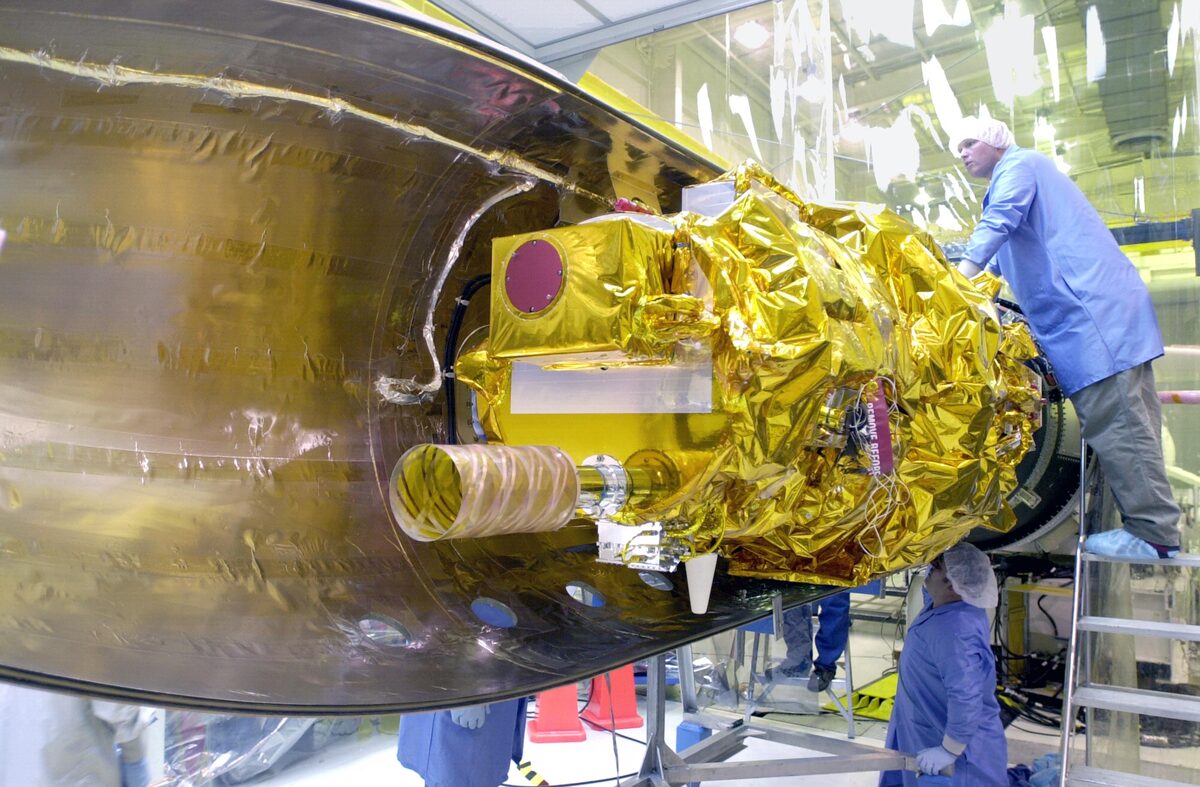
VICTUS HAZE is the latest in the Space Force's "Victus" line of responsive-space demonstrations, missions designed to prove the U.S. can put a satellite into orbit on short notice rather than the years-long timelines typical of traditional space programs. Rocket Lab's contribution was Pioneer, a spacecraft carrying an optical sensor built by Lawrence Livermore National Laboratory. The whole vehicle — sensor, bus, and integration — was designed, built, and tested in just 18 months under a contract worth roughly $32 million.
What made this flight different wasn't just the hardware, but the stopwatch. Rocket Lab didn't know exactly when the Notice to Launch would arrive; when it did, the company had to get Pioneer from a standing, fueled-and-ready state to orbit before the day was out. Sixteen hours and 42 minutes later, it was there.
The Chase: A Non-Cooperative Target on a Deadline
Getting a satellite into orbit fast is one problem. Finding it once it's up there — with no help from the satellite itself — is another.
That's where True Anomaly's JACKAL-0004 came in. According to Air & Space Forces Magazine, the exercise was built specifically to test tactically responsive space (TacRS) capability against a "non-cooperative" target: a spacecraft that isn't broadcasting its position, orientation, or intentions to whoever is chasing it. TechCrunch reported that JACKAL-0004 used onboard sensors alone to detect and identify Pioneer from roughly 2,000 kilometers away before closing the distance. That cooperative-versus-non-cooperative distinction was, by most accounts of the mission, the central technical hurdle: unlike satellite-servicing missions that plan trajectories weeks in advance against a known, cooperative target, JACKAL-0004 had to find an unknown object, acquire it with sensors alone, and plan an intercept trajectory in near-real time.
In practice, that meant JACKAL-0004 couldn't simply steer toward a known set of coordinates radioed up from the ground. It had to search a patch of sky, detect Pioneer optically, work out where the satellite was headed, compute a rendezvous path, and close the distance — all in orbit, at orbital velocities, with limited margin for error and limited time to burn fuel correcting mistakes.
It did all of that in 61 hours, from receipt of the action order to imaging the target. The Space Force's tactical benchmark for the mission was 72 hours. JACKAL-0004 beat it by 11 hours.
Why It Matters
Strip away the acronyms and VICTUS HAZE is really a proof-of-concept for a fairly stark idea: that private companies, not just government satellite operators, can now build the tools to locate and approach objects in orbit on military timelines, without waiting years for a purpose-built government program.
Historically, rendezvous and proximity operations — the maneuvers required to bring one spacecraft close to another — have been slow, deliberate, and planned by ground teams over days or weeks, largely because the targets involved were cooperative: known satellites broadcasting their positions, often with docking-friendly designs. Finding and closing on a non-cooperative object autonomously, on a compressed timeline, is a different and considerably harder problem — one with obvious relevance to space security, where the Space Force has repeatedly flagged the ability of adversary satellites to maneuver, hide, or interfere with U.S. assets.
That JACKAL-0004 pulled this off as a commercial vehicle, on a military deadline, with the launch that put its target into orbit itself breaking a responsive-launch record just days earlier, is the headline the Space Force wanted: it demonstrates an end-to-end pipeline — notice to launch to intercept to imaging — compressed into a matter of days rather than the months or years such sequences have traditionally required. Whether that pipeline can be repeated reliably, scaled, or adapted to genuinely adversarial (rather than cooperative-in-spirit, government-sanctioned) targets remains an open question the Space Force will presumably want answered before declaring TacRS operational.
Sources
- US Space Force demonstrates responsive launch for VICTUS HAZE mission, begins on-orbit operations — Space Systems Command
- Rocket Lab Shatters Responsive Space Record: Launches U.S. Space Force VICTUS HAZE Mission in 16 Hours 42 Minutes
- Space Force Validates First Autonomous Commercial Orbital Intercept in 61 Hours
- Satellites Maneuver Around Each Other on Rapid Timelines for Victus Haze Mission
- Private space pilots are flying orbital missions for the US Space Force
