
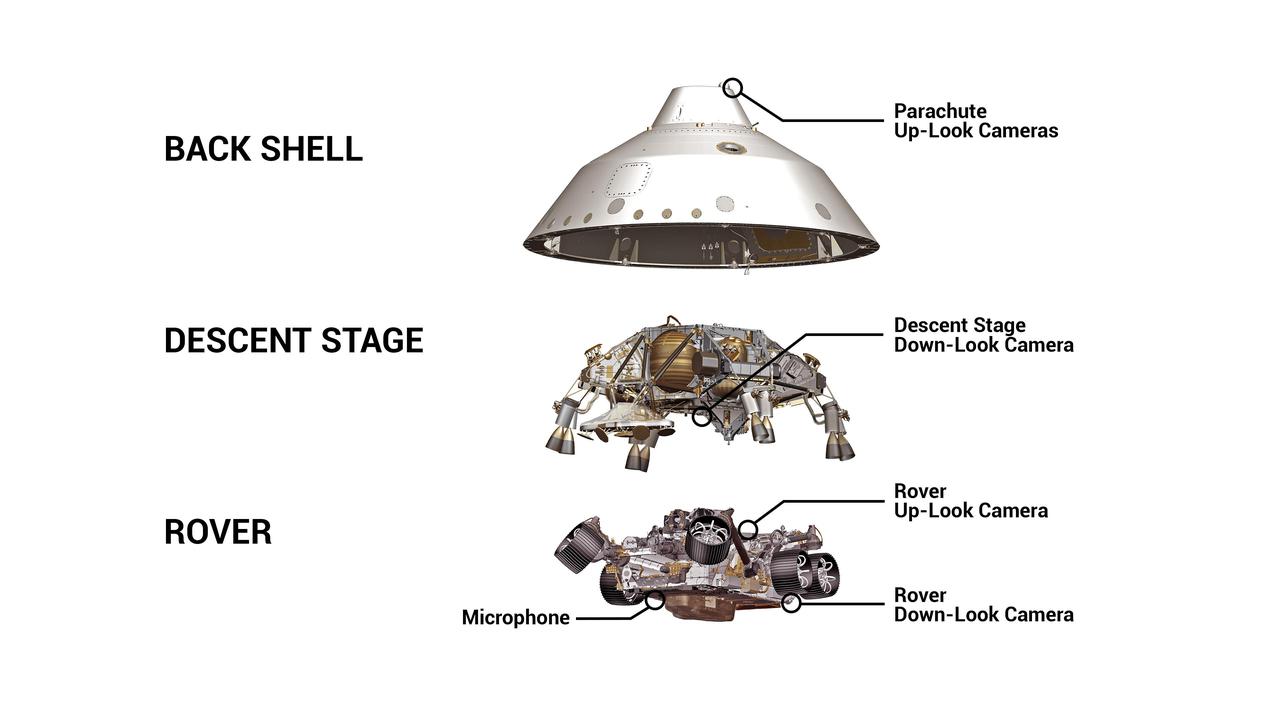
Mars occupies an awkward middle ground for anyone trying to land on it. Its atmosphere is roughly one percent of Earth's surface pressure and almost entirely carbon dioxide — thick enough to generate punishing aerodynamic heating during arrival, yet far too thin for parachutes alone to slow a heavy vehicle to a survivable touchdown speed. Entry, descent, and landing, universally abbreviated EDL, has to bridge that gap in about seven minutes, and it has to do so autonomously, because Mars is too far away for anyone on Earth to intervene.
The deceleration cascade
A lander arrives at interplanetary velocity and must shed almost all of it. The first and largest reduction comes from atmospheric drag against a heat shield, with ablative materials in the PICA family carrying away the thermal load as they char. But a spacecraft's ballistic coefficient — essentially its mass divided by its drag area — combined with the thin Martian air means the vehicle is still travelling at supersonic speed when it runs low on altitude. A disk-gap-band parachute, the design refined over decades of Mars missions, deploys at around Mach 2, near the practical upper limit for such a canopy. Even then, the vehicle remains too fast and the parachute insufficient to set it down safely.
The last kilometre
How a mission covers that final stretch defines its entire architecture. The early, lightweight rovers bounced to a stop inside airbags. Curiosity and Perseverance, far too heavy for that, used the sky crane: a rocket-powered descent stage that fired retrorockets to hover, lowered the rover to the surface on tethers, and then flew itself clear to crash at a safe distance. The system looks baroque because it is — but no simpler approach closes the problem for a one-tonne payload, and the elegance is in the fact that it works at all.
The mass ceiling
One tonne is, roughly, where current EDL technology tops out, and that ceiling is the single most important constraint on the future of Mars exploration. A crewed mission would need to land tens of tonnes — habitats, supplies, an ascent vehicle — an order of magnitude beyond what heat shields and supersonic parachutes can manage. The leading candidate solution is supersonic retropropulsion: firing rocket engines into the oncoming airflow to decelerate while still moving faster than sound, a regime once considered aerodynamically intractable and now central to the design of vehicles like Starship. Until it is demonstrated at full scale at Mars, the surface mass budget remains the hard limit that shapes every serious human-exploration plan.
No one is watching in real time
Compounding all of it is distance. Depending on where Earth and Mars sit in their orbits, a one-way radio signal takes between about four and twenty-four minutes — far longer than EDL itself. By the time controllers on Earth receive the signal that a spacecraft has touched the top of the atmosphere, the entire sequence has, in reality, already succeeded or failed. Every decision — when to deploy the parachute, when to release the heat shield, when to ignite the descent engines, where to steer around a boulder field — is made by onboard software executing pre-loaded logic, with no human in the loop. The seven minutes of terror are not a turn of phrase invented for drama; they are the genuine, unrecoverable interval in which a decade of work and billions of dollars resolve, untouchable, on another planet.
Landing where you mean to
Surviving the descent is only half the challenge; the other half is arriving at a spot worth visiting. The scientifically interesting terrain on Mars — ancient deltas, layered crater rims, fields of hydrated minerals — tends to be exactly the rugged ground most likely to destroy a lander. Perseverance addressed this with terrain-relative navigation, snapping images during descent and matching them against an onboard map in real time to identify hazards and divert toward safe ground, shrinking the landing footprint from tens of kilometres to a precise target within a treacherous crater. That precision is what allowed the mission to be sent to Jezero at all, and it is a prerequisite for any future campaign — including sample return — that depends on landing assets close to one another on purpose rather than scattering them across a plain chosen for being boringly flat.
