
Ask anyone who designs reactors for space what makes them heavy, and the answer is usually the same: the shield. Historically, designers have saved weight with directional shadow shields built from lightweight hydrogen-rich materials such as lithium hydride combined with dense metal. A NASA Technical Reports Server abstract is blunt about the stakes: shielding components are "often the heaviest components" of a Fission Surface Power system, "for which each kilogram matters."
A new study suggests the Moon could handle much of that work for free. Alex Levinsky of Los Alamos National Laboratory led a team that included researchers from NASA Glenn, Oak Ridge National Laboratory, Idaho National Laboratory and Lockheed Martin. They used Monte Carlo radiation transport simulations to test whether the natural shape of the lunar surface, meaning crater walls, hills and ridges, could stand between a reactor and the habitat it powers. The work was funded through a DOE and NASA collaboration and presented at the American Nuclear Society's NETS conference in April 2026.
The short answer is yes, and it doesn't take much terrain.
The problem: a reactor in open ground
The study's reference case is set by NASA's SPARC program, which according to Universe Today is aiming for a 40 kW reactor weighing less than 6,000 kg and mounted on a rover. The team modeled the reactor sitting 1.5 meters above the ground and used the Monte Carlo N-Particle (MCNP) code to follow how radiation spreads across realistic lunar topography.
Without protection, the results are stark. An unshielded reactor of this class gives off radiation that remains deadly even 1 kilometer away. Bringing up enough extra shielding from Earth to protect a habitation zone is extraordinarily expensive, according to Universe Today.
The Moon's lack of an atmosphere helps in one respect. On Earth, radiation that escapes upward from a reactor can scatter off air molecules and come back down onto people who are out of the direct line of sight. Nuclear engineers call this effect "skyshine." Since the Moon has no atmosphere, there is nothing to bounce radiation back down, so skyshine is not a problem. If a solid ridge blocks the straight-line path from core to habitat, most of the threat is blocked with it.
How little terrain is enough
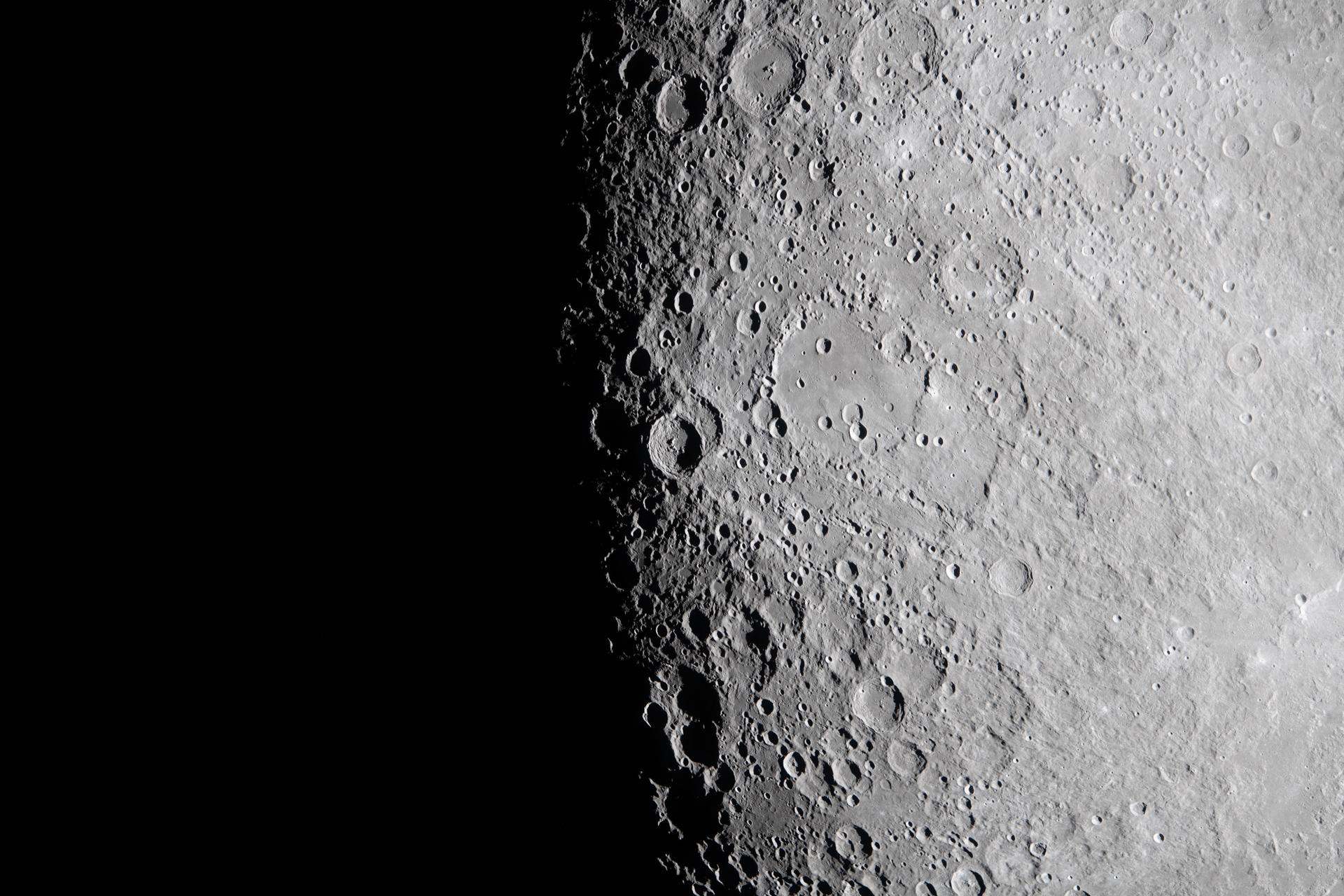
The most striking result is how small that ridge can be. In the simulations, a three-meter-deep crater or a gently sloping three-meter-high hill was enough to cut the dose at the habitat to roughly 0.1 rem per year. The study's limit is 5 rem per year above the Moon's natural background, so that is about 50 times below it.
The team then replaced idealized geometry with real lunar terrain data. One case study looked at Connecting Ridge, near Shackleton crater at the south pole, a site that gets sunlight 80 to 90 percent of the time. The team found a natural depression that could be separated from a simulated base camp by a 120-meter-high crater wall, and the modeled dose dropped to about 0.04 rem per year, leaving the reactor's onboard shadow shield to protect nearby electronics. The analysis also kept slopes to 18 degrees or less, which reflects the practical fact that a rover-mounted reactor has to be driven into position, and steep ground limits where it can go.
The physical logic is simple. Rock and regolith are dense, cost nothing and are already there. Each meter of terrain between the core and the crew is a meter of shield that never had to be launched.
The catch: a crater you can't enter
Terrain shielding has a cost, and it falls on the reactor's own neighborhood. Placing terrain between the reactor and the habitat protects the habitat, but the crater or operational space around the reactor becomes a death zone. Universe Today says astronauts entering it while the reactor runs would quickly develop radiation poisoning, and because regolith reflects neutrons well, landers and other spacecraft could not fly directly over it.
The design philosophy changes as a result. A conventional space reactor carries its shield, so the hazard is contained in the hardware. A terrain-shielded reactor turns part of the landscape into an exclusion area. Mission planners would need to map that area and keep traffic out of it. That is a tradeoff, not necessarily a dealbreaker, but it means that where the reactor goes becomes a site-planning decision as much as an engineering one.
Why It Matters
Power is the main constraint for any long-term presence at the lunar south pole. The American Nuclear Society noted last year that radioisotope generators, fuel cells and solar cells each have limits, from scaling difficulties to refueling needs to an inability to work in the dark of the south pole, and quoted a Power Technology article calling fission "the most viable, durable solution" for a crewed Moon base. At the time, NASA envisioned a lunar reactor of at least 100 kW(e) by 2030. Roscosmos and the China National Space Administration are working together to deploy a reactor to power their planned Lunar Research Station.
Each of those programs faces the same mass problem. Kilograms saved on shielding can go to more power capacity, more science payload or a smaller lander. This study doesn't say a reactor can fly with no shield at all, and it doesn't settle how much hardware shielding could actually be removed in a flight design. What it shows is that the Moon's own topography is a serious shielding resource and should be included in reactor siting from the beginning rather than added later.
The results also suggest that reactor siting and habitat siting are one decision. The best location for a base may turn out to be one with a convenient ridge or crater rim between living quarters and the power plant, plus enough sunlight, as at Connecting Ridge, to back it up. Planners will have to weigh that against the exclusion zone the reactor creates around itself.
