
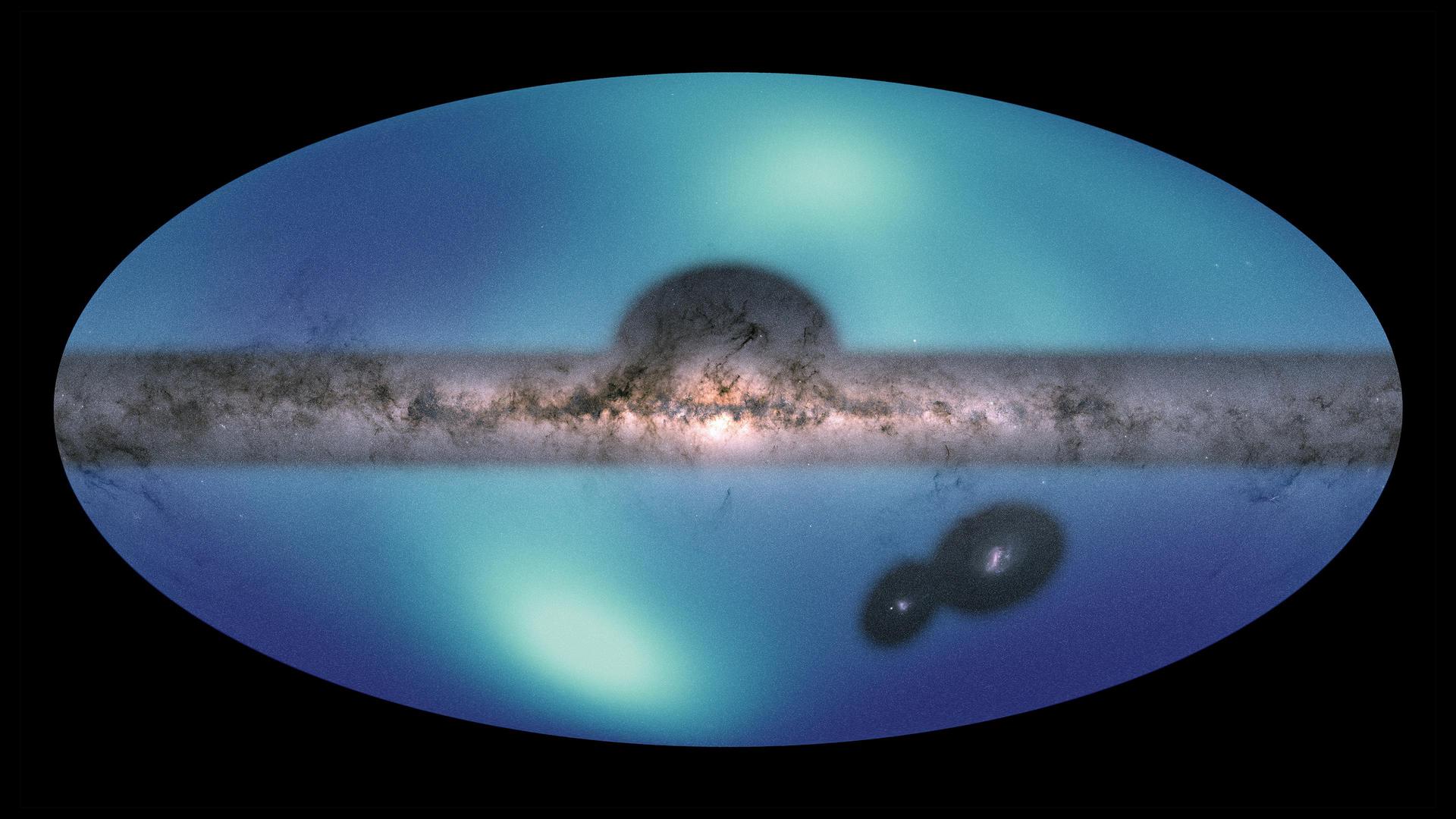
On Wednesday, Dec. 2, the European Space Agency will hold a live webcast to release Gaia Data Release 4. The agency calls it its "largest-ever goldmine of cosmic data," which reads like promotional copy, but the numbers back it up. DR4 holds about 400 terabytes of data. Gaia DR3, the release astronomers have relied on for the past several years, came in at about 10 TB, so DR4 is roughly 40 times larger.
Volume isn't the main change, though. Earlier Gaia catalogs mostly gave researchers finished results: one position, one motion, one brightness per star. With DR4, the measurements those results were built from become public as well.
What exactly is being released
ESA says DR4 is the mission's first "principal" data release. It is built on half of the observations Gaia collected during its 11-year lifetime, which ran from July 2014 to January 2025. Over that time the spacecraft measured the position, distance, proper motion, brightness and colour of more than two billion stars in our Galaxy and beyond. The webcast runs from 14:45 to 16:30 CET on ESA Web TV Two and ESA's YouTube channel.
The contents page on ESA's Gaia Cosmos site lists what the release includes:
- About 2.8 billion sources in total. In contrast to previous releases, data will be published for all processed sources.
- A main table of about 2 billion sources. This is the high-quality subset, with both high-quality astrometry (position and motion) and photometry (brightness). Its parameters are consolidated from several different processing modules.
- Epoch-level data. This is the lower-level material: the observations underlying the source-level catalogue parameters, not only the averaged or fitted values.
- About 400 TB in all. The largest fraction of that volume is the lower-level epoch products.
ESA last updated the contents table on Sept. 14, 2026, and notes that its content is under development and changes can be expected. The agency's release overview adds that final release contents are decided only after validation work is complete.
The "consolidated" main table, explained
The phrase about consolidating parameters across processing modules sounds like internal jargon, but it affects which numbers a user gets.
In Gaia DR3, the default treatment of each source was a single-star model. Many stars, though, belong to binary systems, and a single-star fit is not the best description of them. A model that ignores a companion can give a less accurate position, proper motion and parallax, and parallax is what sets the distance.
ESA uses this case as its example. In DR4's main table, the best-suited model has been applied for a given source, such as a binary-star model instead of the default single-star model used in DR3. A user who queries the main table gets the best available solution for each object, not whatever the first pass produced.
Why the epoch data matter
The epoch data are the bigger change for researchers. In general, the individual epoch observations and transits were held back until the final catalogue, with only limited subsets released earlier, such as for some variable stars. For most sources, outside researchers had a set of fitted parameters and their uncertainties, and could not get at the individual observations underneath.
ESA's table describes the new epoch products as time series of individual astrometric measurements for the sources in the main astrometric processing, plus CCD-level data. Astronomers can refit those observations themselves. They can try models Gaia's pipeline didn't use, combine Gaia's measurements with data from other instruments, or look for small periodic signals that a fitted summary would average out.
Software developers are already preparing. On Nov. 23, a team of 22 authors led by Do Ó posted a software paper on arXiv accompanying version 4.0 of orbitize!, a Python package for Bayesian orbit fitting of planetary and stellar companions. The paper focuses on joint orbit fitting with Gaia DR4 epoch astrometry, and on an implementation of the Orbits for the Extremely Impatient (OFTeI) algorithm. The paper was submitted to the Journal of Open Source Software.
Twenty-two authors released a major version of the package nine days before the data come out, and they built it around a data product that does not yet exist publicly. That suggests many people plan to start working with the data as soon as it is out.
Why It Matters
Gaia's earlier catalogs already serve as the reference for stellar positions and distances across much of astronomy. DR4 matters for three reasons beyond being larger.
Better data for the bulk of users. Many researchers will only query the main table. For them, the switch to consolidated solutions such as binary-star fits should mean fewer hidden errors in the stars they study. A distance that was quietly off because a star has an unseen companion can affect every result that depends on it.
New work for specialists. Researchers who study orbits will be able to work directly with Gaia's individual measurements on a much larger scale than before. The orbitize! update shows that tools to use them are already appearing. Joint fits that combine Gaia epochs with other observations of the same system can constrain orbits better than either dataset alone.
An unfinished mission. DR4 covers only half of Gaia's observations. ESA's release schedule says Gaia DR5, which will draw on the complete 10.5 years of extended-mission data, is expected not before the end of 2030. DR4 is the largest release so far, but ESA does not intend it as the final one.
A note on scale and caution
A 40-fold increase in data volume changes how people use the catalog. DR3 was already large. At 400 TB, the full DR4 release, especially the epoch data, is beyond what most individual researchers would download and browse on their own computers. In practice, many users will probably query the main table, while research groups with more computing resources work with the lower-level data.
There is also a reason to stay cautious. ESA says final release content depends on validation, and the epoch data are new to outside users. Earlier Gaia releases came with lists of known issues and were followed by papers on how to use the data correctly. DR4 will likely go through the same process, and the first rush of results will come before everyone fully understands the data's limitations.
The webcast is on Wednesday, Dec. 2. Researchers can start analyzing the data once ESA publishes it.
