
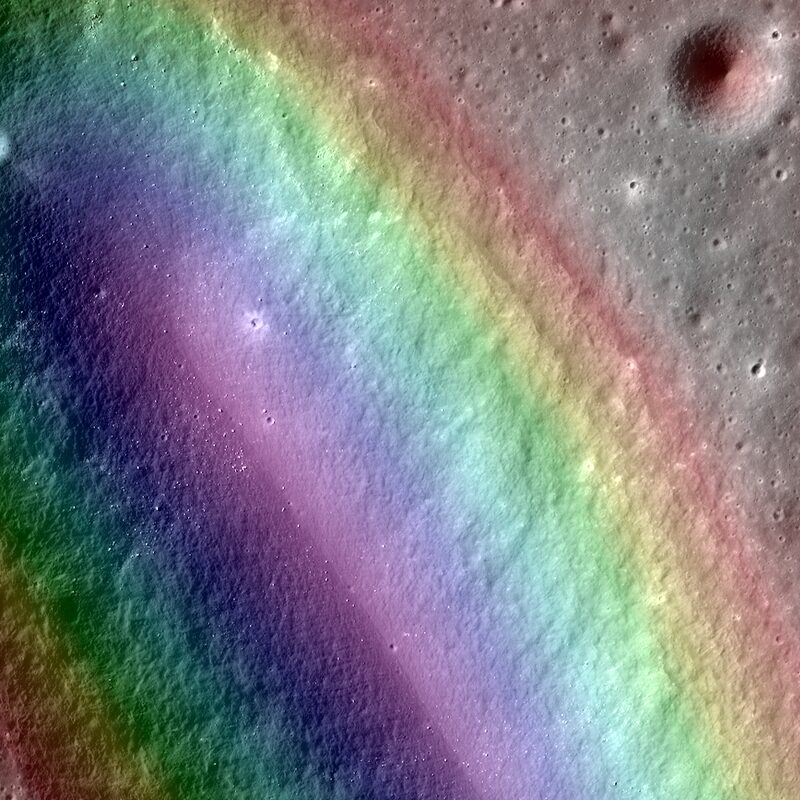
Somewhere on the Moon's eastern limb, sometime between April 11 and May 22, 2024, a rock or icy fragment the size of a three-to-six-story building slammed into the lunar surface at cosmic speed. Nobody saw it happen. No telescope flagged a flash, no spacecraft caught the plume. The event went completely unnoticed for a year and a half — until a routine data-quality check on October 24, 2025, turned up a bright, sharp-edged scar that hadn't been there before.
NASA has now named the feature McGetchin crater, and the agency says it's the kind of thing that happens on the Moon, on average, about once a century or even longer — impact-modeling cited alongside the discovery puts a crater this size at roughly once every 132 years. That makes it one of the more precisely time-stamped violent events in the solar system: scientists can't say exactly which day the impact happened, but they've narrowed the window to about six weeks.
How a Bright New Scar Snuck Past Everyone
The discovery credit goes to Robert Wagner, an image-processing specialist with Intuitive Machines who works with the Lunar Reconnaissance Orbiter Camera (LROC) team. Wagner wasn't hunting for a new crater specifically — he was running a routine data-quality check when a fresh, unusually bright spot on the eastern limb caught his eye against the surrounding, more weathered terrain.
That brightness is the tell. A brand-new impact scar hasn't yet been darkened by billions of years of micrometeorite bombardment and solar-wind "space weathering," so it stands out sharply against older terrain — for a while, anyway, before it fades to match its surroundings over time.
Once Wagner flagged the anomaly, the LROC team — whose home institution is the School of Earth and Space Exploration at Arizona State University — pulled in the rest of LRO's instrument suite to confirm and characterize it. The Wide-Angle Camera, which maps the whole Moon repeatedly with pixels roughly the size of football fields, had already captured the change during its normal global-mapping passes; stacking hundreds of "before" and "after" frames with change-detection software is what let Wagner spot it. The Narrow-Angle Camera then zoomed in for a detailed look, imaging the crater at a resolution of roughly 3 feet per pixel — sharp enough to map its shape and texture precisely.
The clincher came from an instrument that doesn't take pictures at all. LRO's Diviner Lunar Radiometer Experiment, which measures surface temperature, detected a cold spot about 4 miles wide centered on the crater — roughly 16°F cooler at night than the ground around it. Freshly excavated and pulverized regolith holds heat differently than the compacted, weathered surface nearby, so a young impact site shows up as a thermal anomaly even before it's visually obvious. Diviner's readout was independent confirmation that this crater is geologically brand new.
By the Numbers
McGetchin crater measures 728 feet across and 141 feet deep. Coverage of the discovery describes it as bigger than the Roman Colosseum — big enough that, dropped into a major ancient stadium, it would swallow the structure and then some. The impactor itself, scientists estimate, was on the order of a three- to six-story building — small compared to civilization-threatening asteroids, but more than enough to gouge a crater visible from lunar orbit and to raise a thermal signature detectable from above.
The "once-in-a-century" framing isn't editorializing — it's a statistical statement about how often the Moon takes a hit of this particular size, with crater-formation models putting the recurrence interval at around 132 years. Lunar cratering rates are well studied because, unlike Earth, the Moon has no atmosphere, water, or plate tectonics to erase the evidence. Small impacts happen constantly; impacts that leave a 700-foot crater are rare enough that catching one within a few weeks of when it happened, rather than estimating its age from erosion, is a genuine scientific rarity.
Why LRO Was Positioned to Catch This
This is exactly the kind of detection LRO was designed to make. According to the LROC team's own published description of its science objectives, monitoring the Moon for change over time — new impact craters, landslides, and tectonic faults among them — is a key goal of the camera system. LRO has been orbiting the Moon for more than 17 years, repeatedly imaging the same terrain, which lets scientists directly compare "before" and "after" snapshots and catch surface changes that would otherwise be invisible.
That long-baseline, repeat-imaging strategy is precisely how McGetchin was caught: not through a dramatic real-time detection, but through the slow, systematic work of comparing new orbital passes against the existing record and noticing when something doesn't match.
Why It Matters
Impact craters are the Moon's memory. Because there's no weather or plate tectonics to erase them, lunar craters preserve a record of solar system bombardment stretching back billions of years — and scientists use crater counts and sizes to date surfaces across the Moon, Mars, and other rocky bodies. But that dating method depends on knowing, with real precision, how often craters of a given size actually form. Catching a fresh one with a time window bracketed to about six weeks is about as good as that calibration data gets.
McGetchin crater also matters for a more practical reason: NASA and its partners are working to put astronauts and infrastructure back on the Moon under the Artemis program in the years ahead, and a discovery like this is a reminder that impact risk is a factor worth weighing as those plans move forward. A crater this size, from an impactor this size, is a live reminder that the lunar surface is not a static museum piece — it's an environment that occasionally gets rearranged by objects big enough to matter, and LRO's ongoing surveillance is the tool that will keep catching the next one, whenever and wherever it lands.
