
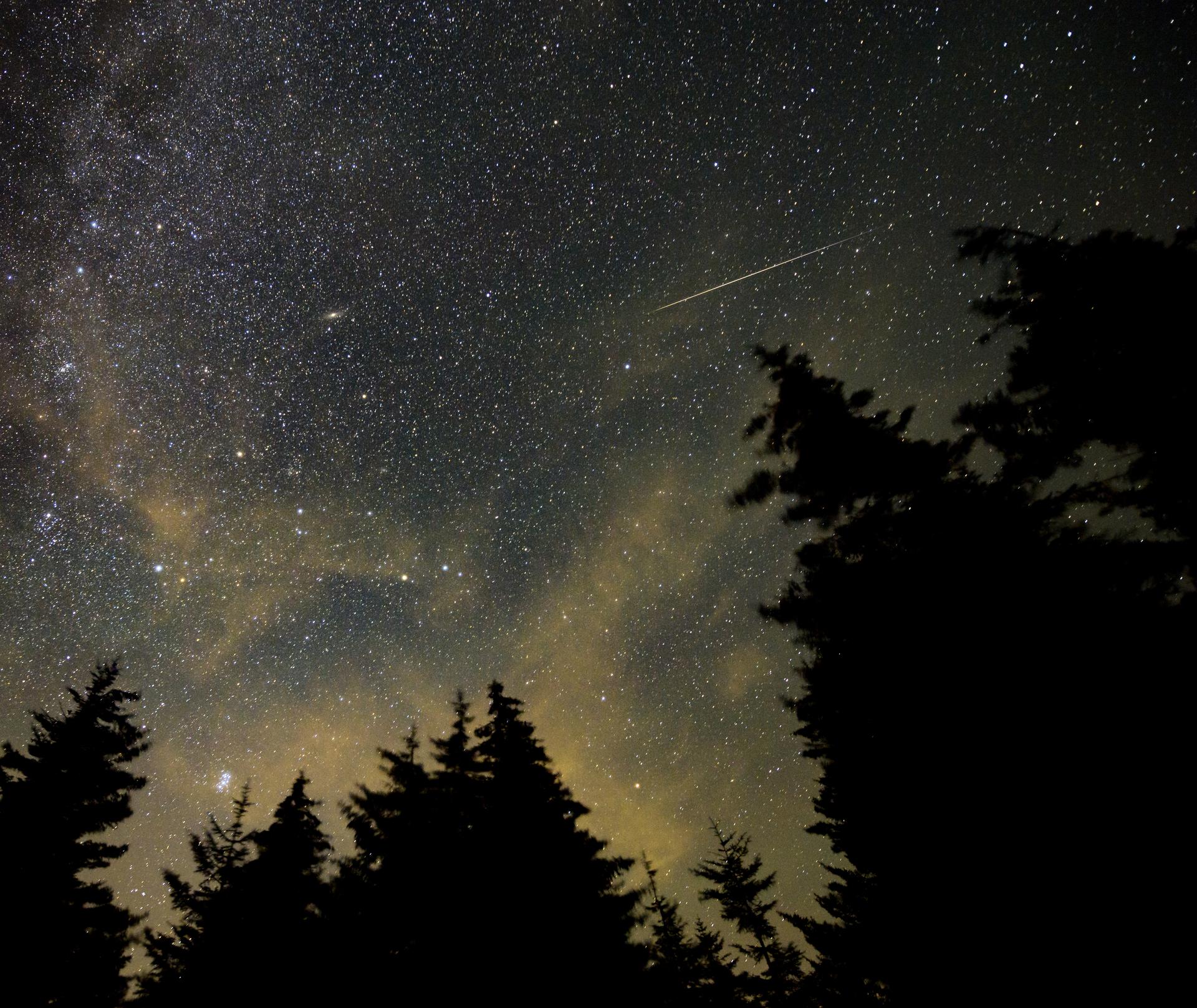
On a November night in 1966, observers in the American Southwest saw a meteor shower so intense that the sky seemed to rain light. According to NASA, the Leonids that year produced thousands of meteors per minute for about 15 minutes. Hourly estimates run from about 144,000, the figure in Space.com's anniversary retrospective, to roughly 160,000 over the southwestern U.S., as cited by Universe Today.
Sixty years on, the Leonids are back, as they are every November. This year they will be much quieter. If you go out expecting a modest shower of fast, sometimes colorful meteors, and not a repeat of 1966, you will probably enjoy it.
What to expect in 2026
The Leonids are active from Nov. 6 to Nov. 30, and NASA lists the peak night as Nov. 16-17. Forecasters agree that 2026 is a lean year. Space.com reports that the International Meteor Organization's 2026 calendar predicts about 15 meteors per hour under ideal conditions, and that observers might see "maybe" 10 to 15 per hour at best, more likely fewer. Universe Today projects about 20 per hour. NASA's general guidance is lower still: under dark skies, observers see fewer than three Leonids per hour.
These numbers measure different things. The IMO and Universe Today figures are best-case peak rates, which assume a dark sky and a radiant high overhead. NASA's figure describes what an observer under dark skies tends to see. In practice, a patient observer at a rural site should expect somewhere between a handful and perhaps 10 to 15 meteors an hour at the best time, and fewer anywhere else.
When exactly is the peak?
The forecasts differ, and the spread is worth knowing if you plan to go out on one particular night. As reported by Space.com and Universe Today, the predicted times of maximum include:
- Maslov: 16:00 UTC on Nov. 17
- IMO 2026 calendar: 23:45 UTC on Nov. 17 (6:45 p.m. EST)
- Campbell-Brown and Brown (RASC): 00:00 UTC on Nov. 18
- Universe Today: 03:00 UT on Nov. 17, which favors Europe near dawn and then North America a few hours later
Most of these forecasts fall between mid-afternoon Nov. 17 and the first minutes of Nov. 18 UTC. For North American observers, the 23:45 UTC and 00:00 UTC predictions land in the early evening of Nov. 17, when the radiant in Leo has not yet climbed high. Universe Today's earlier estimate of 03:00 UT falls in the predawn hours in Europe, and in the late evening of Nov. 16 on the U.S. East Coast. Because the peak time is uncertain, and the shower in a quiet year is a broad, low hump and not a sharp spike, it makes sense to watch the predawn hours of both Nov. 17 and Nov. 18. A single night could fall on the wrong side of the forecasts.
The Moon cooperates
The Moon helps this year. Universe Today notes that on the peak night it will be about 41% illuminated and will reach first quarter the day after Nov. 16-17. Space.com adds that the Moon will set before 11 p.m. Universe Today says it sets in the west just as the Leonid radiant rises in the east. That leaves the darker hours after midnight and before dawn largely free of moonlight.
Look for Leo, and you will find some company. Mars, Jupiter and the bright star Regulus are all very near the radiant this year, so there is something to see even between meteors. You do not need to look straight at the radiant. NASA says it is actually better to view the Leonids away from the radiant, where the meteors appear longer, because meteors near it look short from foreshortening.
Why Leonids look the way they do
The Leonids are debris from Comet 55P/Tempel-Tuttle. Each November Earth passes through dust the comet left behind. Because the comet and Earth move in opposite directions, the grains slam into the atmosphere nearly head-on, according to Space.com. That geometry makes them among the fastest meteors of the year. NASA puts their speed at about 71 km (44 miles) per second. At those speeds even small grains can make bright streaks, sometimes with color. NASA describes Leonids as bright and sometimes colorful.
Storms depend on fresh debris. Tempel-Tuttle takes about 33 years to orbit the sun, and Space.com explains that a storm becomes possible if Earth scores a direct hit on a fresh dust trail the comet ejected over the past several centuries. When that happens, rates can jump from a few per hour to at least 1,000 per hour, the threshold NASA uses for a storm. NASA notes that Leonid storms have come roughly every 33 years. The 1833 and 1966 events, according to Space.com, both reached tens of thousands of meteors per hour. The most recent Leonid storm was in 2002, according to NASA.
Could 1966 happen again?
Not soon, according to the models summarized by Universe Today. Current projections suggest that neither the 2031 nor the 2064 pass of the comet will produce a great storm, and that 2099 is the next candidate for a big one. That is a long wait for anyone hoping to see the sky light up the way it did in 1966.
The years ahead still offer something. Universe Today says we could be due for some enhanced activity in the late 2020s going into the early 2030s, with respectable showers in excess of 100 per hour possible in the early 2030s from older debris streams. That would not be a storm, but it would be far richer than this year's sparse shower. That makes 2026 a useful baseline year: observers who count meteors now will have something to compare against when rates rise.
Why It Matters
Meteor shower forecasting is a test of how well we can model the orbits of tiny comet grains released decades or centuries ago. The spread among the 2026 predictions, eight hours between Maslov's estimate and the RASC team's, and more if Universe Today's earlier time is included, shows that this is still hard. Each year's observed peak time and rate become data for refining those models, and they matter most heading into the possibly enhanced displays of the late 2020s and early 2030s.
For skywatchers, the 60th anniversary is a reminder of how variable the Leonids are. The stream that produced one of the most intense meteor displays on record usually yields only a few meteors an hour. A quiet year with a helpful Moon, Mars and Jupiter near the radiant, and a forecast window that spans both Europe and North America is still worth a cold hour outside.
