
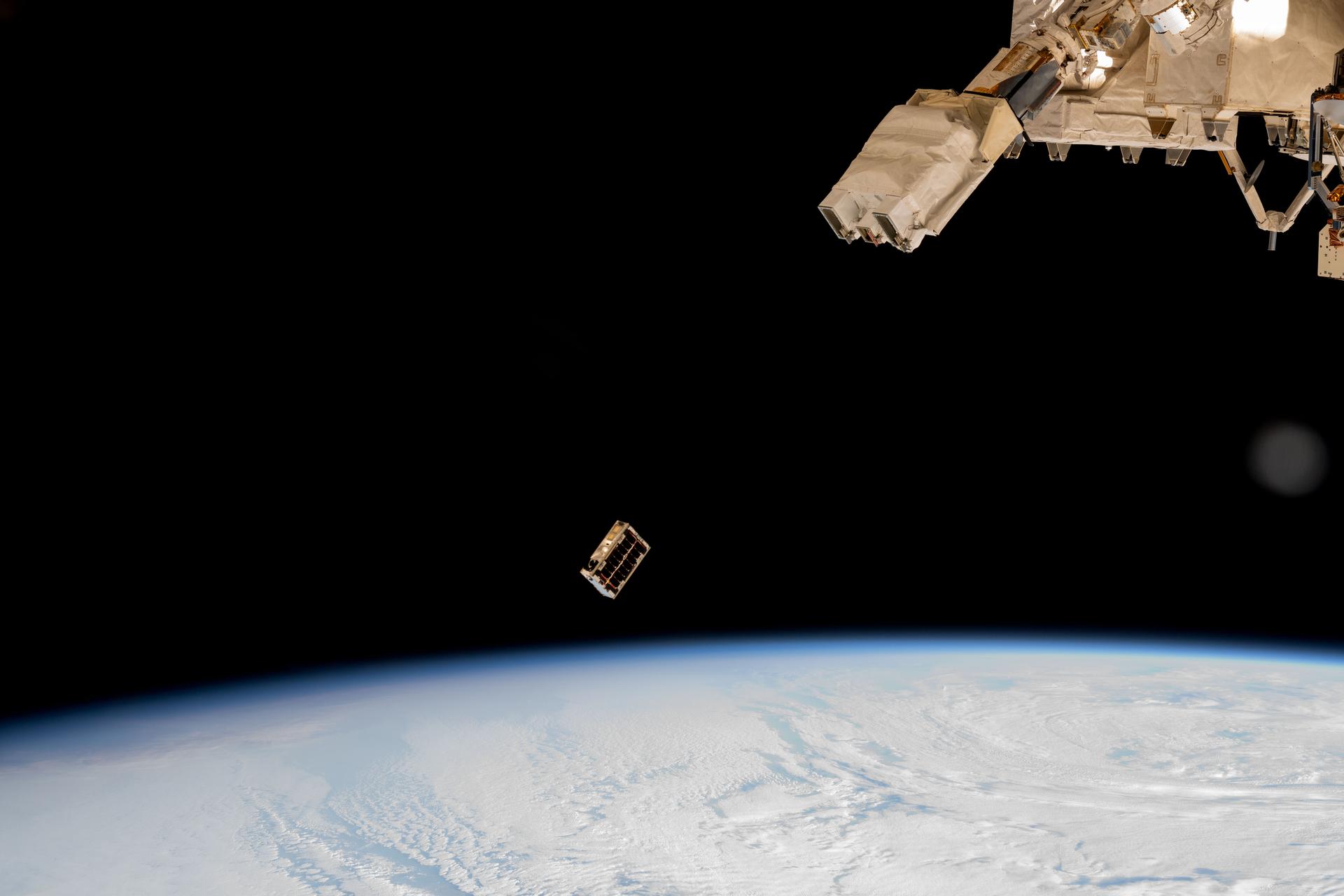
Every satellite ever flown has faced the same brutal accounting problem at low altitude: the lower you go, the more atmosphere you hit, and the more propellant you burn just to stay up. Run out, and you fall. That arithmetic is why the region from roughly 100 to 400 kilometers up — very low Earth orbit, or VLEO — remains largely empty despite offering the sharpest imaging vantage and shortest signal paths in all of spaceflight.
A Spanish startup thinks the fix is to stop carrying propellant at all — and to use the very atmosphere that drags satellites down as the fuel that keeps them up. Kreios Space, based in Nigrán, Spain, announced on August 4 that it has selected Kongsberg NanoAvionics' MP42 microsatellite bus to host the first-ever orbital demonstration of air-breathing electric propulsion (ABEP). The mission, reported by SpaceNews to be scheduled for 2028, would put a roughly 200-kilogram satellite into orbits between 300 and 150 kilometers, where its thruster will scoop up rarefied atmospheric oxygen and nitrogen and accelerate it out the back as propellant.
"Kreios is building the satellites that make sustained operations in Very Low Earth Orbit possible," said Kreios CEO Adrián Senar in the announcement. His counterpart at NanoAvionics, CEO Atle Wøllo, was blunter about the physics: "Kreios is tackling one of the most demanding operating environments in space."
An Engine With No Fuel Tank
The core idea behind ABEP is elegantly simple and fiendishly hard to execute. At around 200 kilometers altitude, the atmosphere is thin but not gone — trace molecules of oxygen and nitrogen still slam into a satellite at orbital velocity. A conventional spacecraft treats those molecules as pure drag. An air-breathing thruster treats them as free propellant: an intake collects and compresses the incoming gas, an electric thruster ionizes it and accelerates it rearward, and the resulting thrust counteracts the drag that would otherwise deorbit the vehicle.
"The altitude can be sustained without requiring any propellant on board, which enables long-term missions," Senar told SpaceNews — at costs, the company says, comparable to operating at 500 kilometers.
The concept has a proven ancestor on the ground. An ESA-led team — with the thruster built by Sitael in Italy and the intake by QuinteScience in Poland — performed the world's first firing of a complete air-breathing electric thruster in a vacuum chamber simulating conditions at 200 kilometers. In that test, molecules arriving at 7.8 kilometers per second were collected, compressed, charged, and accelerated by a dual-stage thruster with no valves or complex parts; the only input required was electrical power. Engineers ignited the thruster on xenon, then transitioned it to a nitrogen-oxygen air mixture — visibly confirmed as the exhaust plume shifted from blue to purple.
The precedent that haunts every VLEO discussion is ESA's GOCE gravity-mapping mission, which skimmed as low as 250 kilometers for more than four years — an extraordinary feat, but one strictly rationed by the 40 kilograms of xenon it carried. When the xenon ran out, the mission ended. Air-breathing designs, per ESA, would create a new class of satellites able to operate in very low orbits for long periods — with no such expiration date.
From Classmates to Flight Hardware
Kreios was co-founded in 2021 by Senar and five fellow aerospace-engineering classmates from the Polytechnic School of Catalonia. The company raised an €8 million (roughly $9.21 million) seed round in 2025 and was selected for NATO's 2026 Defence Innovation Accelerator (DIANA) — a signal that alliance defense planners see strategic value in persistent ultra-low-altitude platforms.
The 2028 demonstrator is more than a propulsion testbed. Alongside validating the ABEP thruster's performance and taking measurements of the VLEO environment, the satellite will carry a sub-meter-resolution visible and near-infrared optical payload — a pointed proof that the commercial case for VLEO is imaging. The same physics that makes 200 kilometers hostile makes it lucrative: fly lower and a given telescope resolves finer detail, and communication latency drops.
NanoAvionics has worked closely with Kreios to configure the MP42 bus to the mission's specific requirements, Wøllo said — and the pairing will stress the platform in ways higher orbits never do. In VLEO, enough residual atmosphere remains to generate constant drag, so the spacecraft must thrust most or all of the time simply to hold its altitude, rather than firing the occasional correction burn that suffices higher up.
Why It Matters
If the demonstration works, it dissolves the fundamental constraint that has kept VLEO a graveyard shift of spaceflight: the fuel budget. A satellite that manufactures its stationkeeping propellant from ambient air can, in principle, loiter at 150–200 kilometers for long stretches — delivering the sharper imagery Space.com highlighted in an August 9 feature on the technology, and the high-resolution Earth observation and low-latency communications that SpaceNews reports are driving commercial interest in the altitude. VLEO has another advantage: while low Earth orbit hosts thousands of satellites — most of them SpaceX Starlink spacecraft — VLEO, as Space.com puts it, has plenty of room.
There is also a race on. Kreios is not alone among ABEP developers — Viridian Space Corp., the European Space Agency's propulsion laboratory, and Indian startup Orbitt Space are also developing and testing ABEP systems — and China recently established a national VLEO industry alliance, with two experimental Chinese satellites already operating below 300 kilometers. Whoever demonstrates sustained, propellant-free flight first won't just win a technical milestone; they'll define the operating playbook for a layer of space that has never had permanent residents. A 2028 flight date puts a European startup — flying on a bus from Lithuania-based NanoAvionics, chasing a concept ESA-backed engineers in Italy and Poland first proved on the ground — squarely in that contest.
Ground firings proved the plume turns purple. Now comes the harder question: whether an engine that eats the atmosphere can keep a satellite aloft in the real thing.
Sources
- Kreios Space press release: Kreios Space selects Kongsberg NanoAvionics for first-ever air-breathing electric propulsion VLEO satellite
- SpaceNews: Kreios Space to fly VLEO demonstration in NanoAvionics bus
- ESA: World-first firing of air-breathing electric thruster
- Space.com: Exploring 'very low Earth orbit': The world's 1st air-breathing satellite thruster could soon get a test run
