
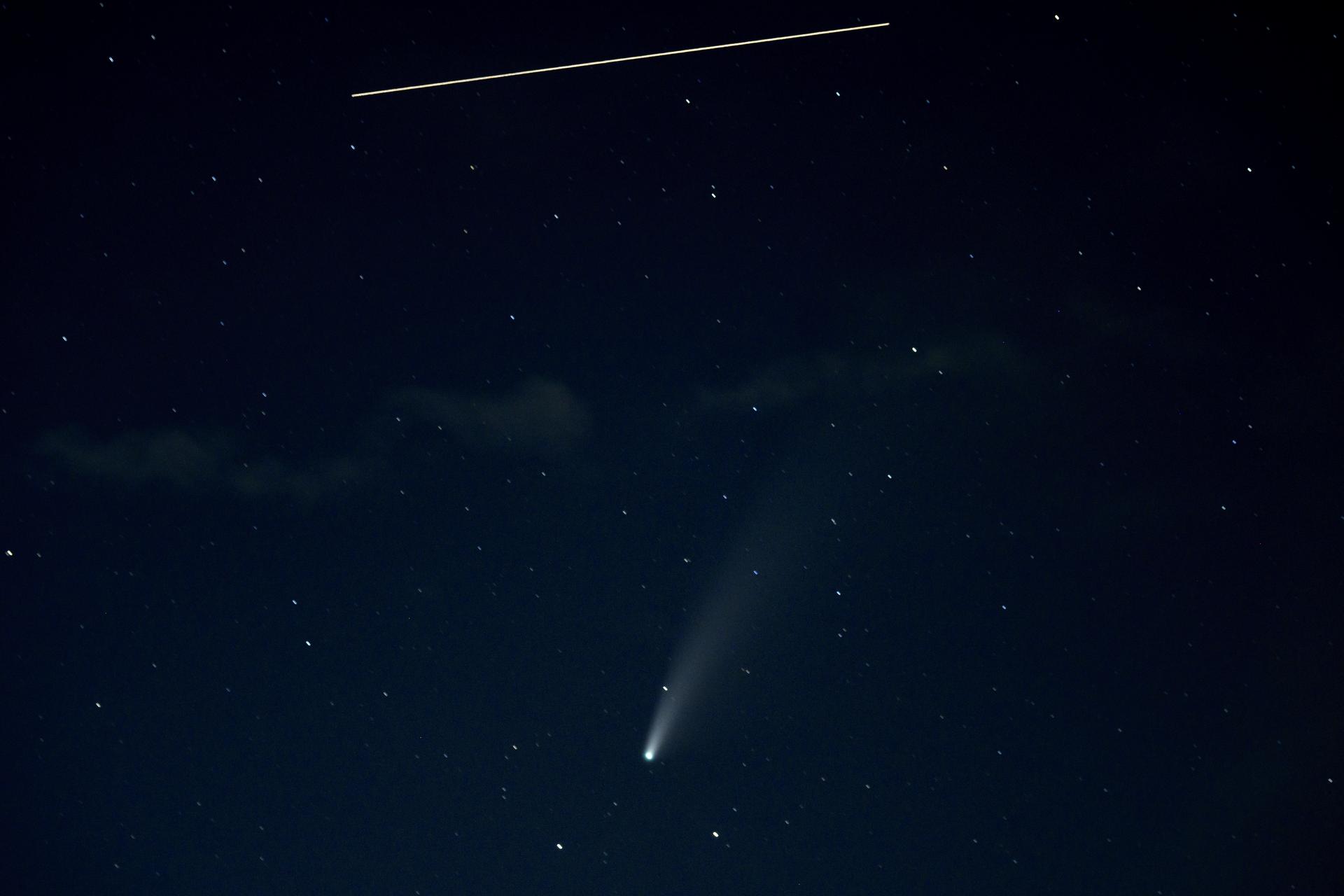
Few ideas in origins-of-life research have lasted as long as this one: comets, icy leftovers from the birth of the solar system, crashed into the young Earth and dropped off the chemical raw materials that later became biology. According to EarthSky, the theory has been favored in one form or another for about a century. A new study argues that it probably didn't happen that way.
The paper was published October 28 in Scientific Reports under the title "Cometary impacts an unlikely pathway towards the origins of life on Earth." It was led by Dr Richard Anslow of the University of Cambridge's Institute of Astronomy. Its conclusion is that comets successfully delivering prebiotic feedstock to Earth was "an exceedingly rare event." In Cambridge's announcement of the work, Anslow puts it more bluntly: "It would really have to be a one-in-a-million occurrence... at best, a one-off fluke."
The molecule in question
The study focuses on hydrogen cyanide, or HCN. Cambridge describes it as an important prebiotic molecule that is regularly found on Solar System comets. If comets were going to supply early Earth with something useful, HCN is a sensible molecule on which to test the idea.
The question the team asked was simple enough to state and hard to answer: could a comet carrying HCN hit Earth in a way that left a useful amount of the molecule intact on the surface? The answer, according to the Cambridge release, is that early Earth history offered at most a handful of chances for that to happen.
Three problems at once
The paper does not depend on one knockout argument. It combines three lines of recent work: improved simulations of comet impacts, models of how comets interact with a planet's atmosphere on the way in, and dynamical modelling of where short-period comets come from and how often they would have crossed Earth's path. Each one makes the delivery idea look worse.
Speed and angle. As EarthSky summarizes the findings, comets move too fast and come in at too sharp an angle. An impact like that releases a huge amount of energy at the impact site, which is the worst possible setting for delicate chemistry.
Destruction on arrival. Because of that energy, fragile organic molecules would most likely vaporize on impact. The paper describes the destruction of fragile organics as "efficient." Delivering a molecule doesn't help if it is destroyed in the act of delivery.
Timing. Earth's comet bombardment dropped off quickly. The study's summary puts the steep decline after roughly the first 500 million years of Earth's history. Since impacts were already scarce, and most of them would have destroyed their cargo, the number of plausible successes falls to almost none.
Put together, the result is not that comet delivery was physically impossible. It is that for it to be the answer, you need an unusually lucky impact on a planet where few chances were on offer.
A follow-up to "bouncing comets"
The new paper builds on a 2023 idea, which Cambridge's release calls the "bouncing comets" concept, about how a comet's material might reach a planet's surface under gentler conditions. Seen that way, the 2026 study is less a rejection out of nowhere than a quantitative test of how often those gentler conditions could actually have occurred around early Earth. The answer turns out to be rarely, if at all.
Why It Matters
Origins-of-life research depends on narrowing down which pathways are plausible. Nearly ruling out a long-favored delivery route shifts attention to the other candidates.
The Cambridge team points to a few alternatives. One is the synthesis of these molecules following asteroid impacts, since asteroids hit Earth far more frequently than comets. Another is that the needed chemistry happened on Earth itself, with no delivery from space required.
Mars is a third possibility. The release says Mars, which is smaller than Earth and has a much thinner atmosphere today, could be a better candidate for comet delivery, though still highly unlikely. That is a striking idea, but Anslow is careful about it. EarthSky reports him saying that delivery was unlikely on Earth and may not have happened on Mars either. Those differences improve the odds. It doesn't make the scenario likely.
There is also a wider lesson. A theory held for about a century did not fall to a new observation. It fell to better modelling of physics people already understood: how fast comets travel, how they pass through an atmosphere, and how the population of comets changes over time. Running those numbers carefully turned a reasonable-sounding story into an extreme long shot.
What it doesn't say
The study does not say comets contain no organic molecules, and it does not say space chemistry is irrelevant to the origin of life. Its claim is narrower: the specific route of comets impacting Earth and leaving prebiotic feedstock intact was, at best, extremely rare. Where life's starting materials actually came from is still an open question, and this result pushes researchers toward asteroids, Earth's own chemistry, or both.
