
For more than a decade, one of the tidier results in radiation-belt physics has been a wall. In 2014, NASA's Van Allen Probes found that ultra-relativistic electrons, the multi-MeV particles often called "killer electrons," seemed to stop at a sharp inner boundary about 11,500 km above Earth. Below it, in the inner radiation belt, the most energetic electrons simply did not show up. The boundary came to be called the "impenetrable barrier."
A new paper in Geophysical Research Letters says the barrier did not so much fail as get bypassed. Data from Japan's Arase satellite show that during the May 2024 superstorm, multi-MeV electrons were not pushed through the barrier from outside. They were made right at it.
A wall that held, until it didn't
Arase, which JAXA's Institute of Space and Astronautical Science also calls ERG (Exploration of energization and Radiation in Geospace), was built for this kind of question. According to JAXA/ISAS, the probe was designed to watch directly how high-energy electrons in the Van Allen belt are generated and how space storms develop. The belt is a region of electrons above 1 MeV that has been known since 1958, and Arase observes the energization process from inside it.
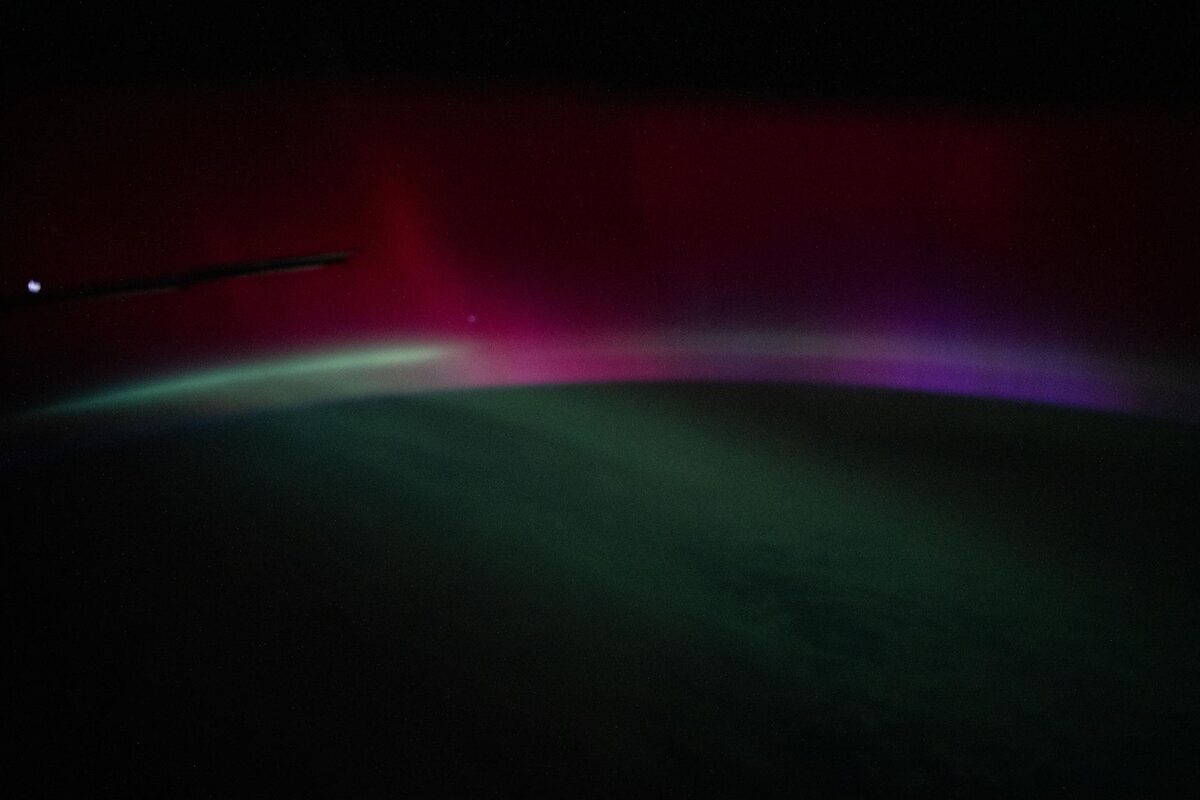
Arase has been flying through the magnetosphere since 2017. For most of that time, the barrier behaved as the Van Allen Probes had described it. Then came May 2024. Solar wind gusts of up to 1,200 km/s compressed Earth's magnetic field and set off the most intense geomagnetic disturbance since the Halloween storms of 2003.
During that storm, Arase counted ultra-relativistic electrons at about 5,000 times their typical background level, deep in a region that was supposed to keep them out.
Inside job or break-in?
Finding killer electrons where they shouldn't be is the easy part. The hard part is working out how they got there, and there are two broad options. Electrons energized farther out could have been carried inward across the barrier. Or electrons already sitting near the barrier could have been accelerated where they were.
The research team, led by Yoshizumi Miyoshi of Nagoya University, separated the two using electron phase space density, a measure of how particles are spread across position and momentum. The reasoning goes like this. If electrons were mostly being transported inward from a source farther out, you would expect phase space density to fall off steadily with distance from that outer source. A local bump in the profile, a peak with lower values on both sides, points to a source in the middle.
That is what Arase saw. The paper's abstract says the phase space density profiles "develop a local maximum at L* ~ 3." L* is a coordinate physicists use to label drift shells in Earth's magnetic field, and L* ~ 3 sits right at the old barrier. The inner radiation belt, at L* below 3, is the region long treated as impenetrable to ultra-relativistic electrons. The authors read the peak as evidence of in situ acceleration. The electrons were energized at the barrier first, then spread both inward and outward by radial diffusion.
Put plainly, the barrier was not breached from outside. The storm switched on an energy source inside the zone the barrier was supposed to protect.
The chorus behind it
What did the accelerating? The team points to chorus waves, a type of plasma wave in the magnetosphere. According to the abstract, Arase recorded intense chorus waves under a strongly depleted plasma region, a condition the authors link to enhanced convection and a negative ionospheric storm. They describe those observations as consistent with chorus-driven local acceleration.
The setting is the interesting part. The storm appears to have emptied out the cold plasma environment near the barrier, and in that depleted region chorus waves could pump energy into low-energy electrons and lift them to multi-MeV energies, in a region where that was not expected. The barrier, it seems, was never purely about geometry or distance. It also depended on the local conditions that control whether acceleration can happen at all. A big enough storm changed those conditions.
Continuous coverage helped. The abstract stresses that Arase's observations were continuous and near-equatorial, which allowed the team to follow the electron population as the storm developed rather than piece it together from snapshots.
Why It Matters
The impenetrable barrier is more than a neat finding. It shapes how scientists think about the inner magnetosphere as a fairly protected zone during most space weather. This result does not say the barrier is imaginary. Arase saw it hold for years before May 2024. What the result does show is that the barrier is conditional, and that a severe enough storm can create killer electrons inside the region it bounds.
That matters for any model that treats the inner belt as reliably free of ultra-relativistic electrons, because under extreme conditions that assumption breaks down. It also changes what forecasters and modelers need to watch. The question is not only whether energetic particles can be driven inward from the outer belt. It is also whether the inner magnetosphere's own plasma conditions can turn into an accelerator.
Physically, the paper adds strong evidence that wave-particle interactions, here chorus waves, can do a lot of work in places where transport was thought to dominate or where acceleration was thought impossible. The phase space density peak is the key piece. It turns "the electrons showed up" into "the electrons were made here."
It is also a case for long-lived missions. The barrier was first identified in 2014, and catching this breach took a spacecraft that had been watching since 2017, through the most intense geomagnetic disturbance since 2003.
The paper
The study, "Local Acceleration of Multi-MeV Electrons Inside Earth's Impenetrable Barrier During the May 2024 Superstorm," appears in issue 20 of Geophysical Research Letters, first published online on 26 October 2026 (print date 28 October), under DOI 10.1029/2026GL125879. It lists 20 authors, starting with Y. Miyoshi, S. Kurita and A. Shinbori, and was funded by the Japan Society for the Promotion of Science. Details here come from the Crossref record and abstract and from Universe Today's coverage.
Sources
- Earth's 'Impenetrable' Space Radiation Shield Was Just Breached From Within (Universe Today, 30 Oct 2026)
- Crossref record: Local Acceleration of Multi-MeV Electrons Inside Earth's Impenetrable Barrier During the May 2024 Superstorm (Geophysical Research Letters, DOI 10.1029/2026GL125879)
- Exploration of energization and Radiation in Geospace 'ARASE' (ERG) (JAXA/ISAS)
