
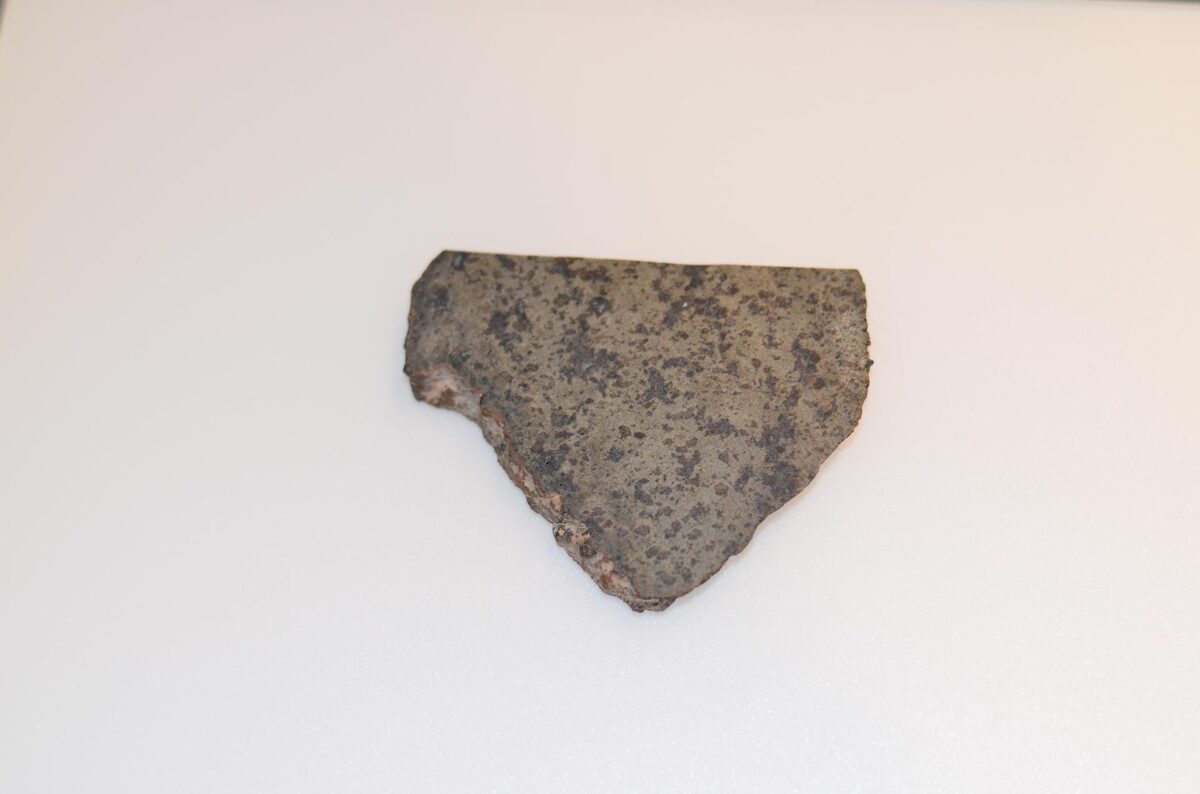
Most Martian meteorites are young by planetary standards. They are volcanic rocks that crystallized long after the planet's formative era and were later blasted off the surface by impacts. A stone found in the Sahara and recovered from Mali in 2022 is an exception. The nearly 2-pound (800-gram) rock now goes by the name Teghaza 001, and according to a paper published in Science, it formed more than 4.1 billion years ago.
That age puts Teghaza 001 among the three most ancient Martian meteorites known, alongside ALH84001 and NWA 7034, the breccia nicknamed "Black Beauty." The research team says the rock's composition, mineralogy and texture set it apart from other Martian meteorites. One of the paper's reviewers called it a "Rosetta Stone for Mars."
A sample from somewhere new
The paper, titled "A Martian meteorite that formed ≥4.1 billion years ago samples Mars' early crust and mantle," was led by Yang Liu of NASA's Jet Propulsion Laboratory. Collaborators came from Caltech, UCLA, the University of New Mexico and the University of Maine.
The novelty is not only the age but also where the rock appears to come from. Teghaza 001's mineralogy matches what NASA's Mars Reconnaissance Orbiter sees in the planet's cratered southern highlands. The team identified 13 locations on Mars that match the mineralogy and chemistry of the rock.
"Our first piece of Martian crust from a part of Mars we've never had a sample of," said Lee Saper, the paper's second author.
That matters because Martian meteorites carry no return address. Researchers have to infer where a stone came from by comparing its chemistry and mineralogy with data collected by Mars missions. A sample that plausibly ties to the southern highlands fills a real gap, and it means a piece of ancient crust is now in the laboratory.
How you date a rock this old
The age comes from zircon, a tough mineral that locks in uranium when it crystallizes and keeps a radiometric clock running for billions of years. The team made ten measurements of uranium and lead isotopes on six shocked zircon grains to determine their U-Pb and Pb-Pb ages. Caltech's Francois Tissot added a separate line of evidence by applying an in-situ rubidium-strontium dating method to a piece of the meteorite smaller than a fingernail.
The researchers state the result as a minimum: the rock formed at least 4.1 billion years ago. That places its origin in the Pre-Noachian, the earliest chapter of Martian history. Planetary scientists struggle to paint a clear picture of that period because it was so long ago and geological processes and weathering have erased much of the record.
Flagged by its oxygen
The meteorite got its first serious attention at the University of New Mexico's Institute of Meteoritics. There, director and curator Carl Agee and Karen Ziegler examined it with the university's electron microprobe and oxygen isotope analysis capabilities. Two things stood out. Its oxygen isotope values resembled those of Black Beauty, though not exactly, and it contained domains with high levels of manganese oxide, a compound rovers look for on Mars.
Agee doesn't hedge. "It's the oldest Martian igneous rock ever found by a huge margin," he said. He described it as "just one unadulterated rock type," unlike the conglomeration of rock types in Black Beauty, and said it points to an environment with fluids coursing over the surface.
The water story rests partly on a high delta-18O value, a measure of how much heavy oxygen-18 the rock holds relative to lighter oxygen. The authors write that this probably reflects assimilation of crustal material that had interacted with surface fluids, or direct reaction of the magma with high-delta-18O fluids. In other words, water was probably altering Mars' crust early enough for that altered material to end up in this rock more than 4.1 billion years ago.
Agee said the alteration indicates the rock has been in what he would call "an Earth-like environment," and that it probably came from a time when the Martian environment was different from the dry desert that produced most Martian meteorites.
Why It Matters
Martian meteorites give laboratory access to real rock, but most of them are young basalts that say little about the planet's infancy. Meteorites are launched by impacts, which favors younger, stronger rocks, while more ancient crust is weaker and more fractured. Teghaza 001 is a different kind of sample on several counts:
- It is igneous and coherent. Agee calls it a single rock type, so its chemistry reflects one magmatic history rather than a mix of fragments. That makes it easier to interpret as a record of the early crust and mantle.
- It can plausibly be tied to orbital data. Its match to the southern highlands, with 13 candidate locations, links lab measurements to terrain observed from orbit.
- It pushes evidence of water-rock interaction into the Pre-Noachian. The oxygen isotopes indicate that surface fluids had likely already altered crustal material by the time this rock formed. That bears on how early Mars may have offered environments that were wet and, in Agee's word, Earth-like.
There are limits. The source-region work produces candidates, not a confirmed launch site, and a single meteorite cannot stand for an entire hemisphere. Still, a rock of this age, with a chemical signal of interaction with surface fluids, gives researchers a fixed reference point for testing models of how Mars' crust formed and when water started reworking it.
The "Rosetta Stone" label is generous, but the comparison works in one specific way. Teghaza 001 gives scientists a rock in hand that they can read against what orbiters have been mapping from a distance for years.
