
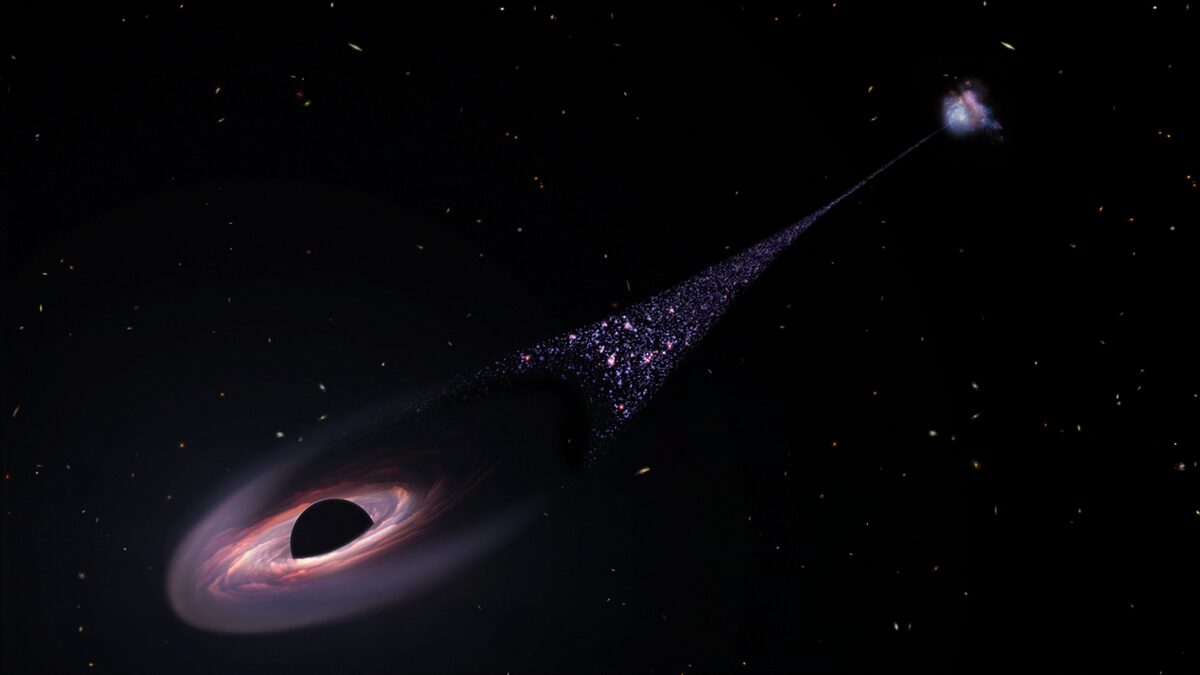
The textbook order of operations goes like this: galaxies form first, stars live and die within them, and over cosmic time a supermassive black hole grows in the center, feeding on gas and the corpses of stars until it weighs millions or billions of suns. The black hole's mass tracks its host galaxy's, a tight relationship astronomers have measured across the nearby universe. The James Webb Space Telescope keeps finding objects in the early universe that refuse to follow that script — and the latest is the most extreme yet.
An object that shouldn't fit
In a galaxy catalogued as Abell 2744-QSO1, seen as it was roughly a billion years after the Big Bang, JWST has identified a black hole of about 50 million solar masses sitting in a region nearly devoid of stars. By the usual yardstick — black hole mass relative to host galaxy — it is the most "overmassive" black hole ever found: a gravitational heavyweight with almost no stellar city built around it. In the conventional picture, that ordering is backwards. The black hole appears to have shown up before its galaxy did.
It is not an isolated anomaly. Webb has flagged other early systems where the central black hole is growing far faster than its host — black holes seen just 800 million years after the Big Bang already outsized relative to their galaxies — and a population of mysterious, compact, deeply red objects nicknamed "little red dots" that many astronomers suspect are early black holes shrouded in gas. The pattern across these finds is consistent and uncomfortable: in the first billion years, black holes seem to assemble too much mass, too quickly, for the slow stellar-remnant story to explain.
That a black hole's mass normally tracks its host galaxy is one of the more remarkable regularities in astrophysics: across the nearby universe, the central black hole tends to weigh about a thousandth as much as the galaxy's central bulge, as if the two grew in lockstep. Measuring that ratio in the early universe is how JWST tests whether the relationship held from the beginning — and it does so by catching the telltale glow of gas swirling into the black hole and reading its motion, which betrays the mass of the unseen object pulling on it. QSO1 breaks the ratio so badly that the usual co-evolution story simply cannot stretch to fit it.
Born big?
The favored resolution is that the universe made some black holes heavy from the start. Instead of beginning as the modest remnant of a single collapsed star and patiently accreting, a "heavy seed" could form directly — a massive cloud of primordial gas collapsing straight into a black hole of thousands or tens of thousands of solar masses, skipping the star stage entirely. Such an object would have a colossal head start, and could plausibly reach 50 million solar masses within a billion years. QSO1, growing in a near-empty patch of sky, is close to a clean test case: there simply weren't enough stars around to have built it the slow way.
Confirming heavy seeds would be a genuine shift in the story of cosmic dawn — it would mean black holes are not merely the end products of galaxy evolution but, in some cases, among its first ingredients, possibly shaping the galaxies that later grew around them. The case isn't closed; alternative explanations involving bursts of extremely efficient accretion remain on the table, and each new JWST detection is being scrutinized for selection effects. But the weight of evidence is bending toward a universe that built supermassive black holes earlier and faster than anyone planned for — one of the clearest examples yet of a powerful new telescope not answering old questions so much as overturning them.
