
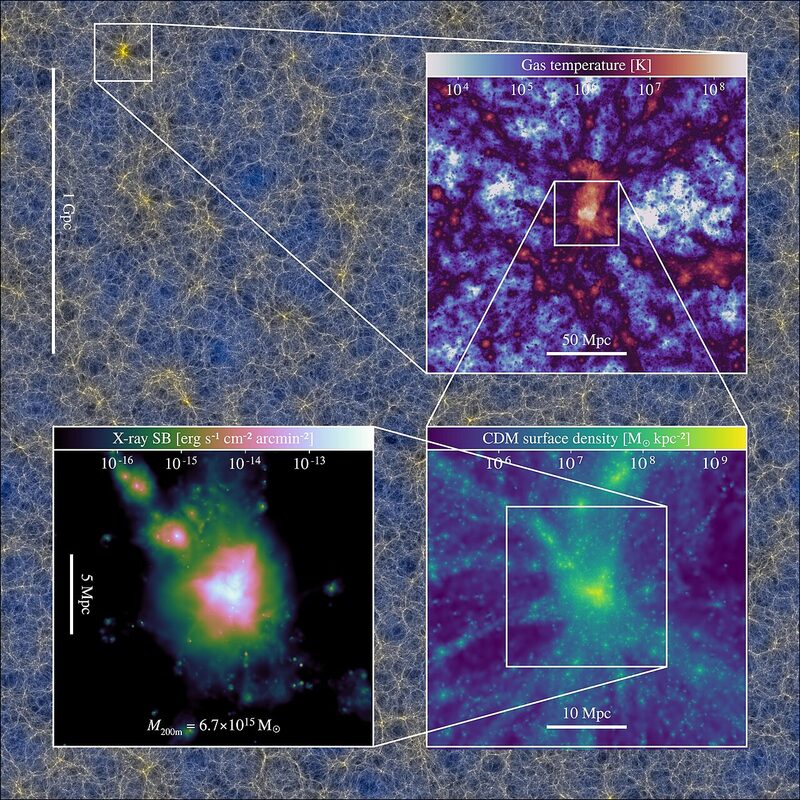
Galaxies are not scattered randomly through space. They hang along an immense, branching framework of filaments and sheets — strands of dark matter and gas, threaded with galaxies, wrapped around vast and nearly empty voids. Cosmologists call it the cosmic web, and it is the largest structure there is: the literal scaffolding of the universe. Now a team led by astronomers at the University of California, Riverside has charted it in more detail than ever before, tracing the web back to when the cosmos was just a billion years old.
How you map something made mostly of nothing visible
The map comes from COSMOS-Web, the largest survey the James Webb Space Telescope has carried out to date. Webb stared deep at a single patch of sky and, in that one field, pinned down the positions of about 164,000 galaxies — not just on the two-dimensional sky but in three dimensions, using their distances to place each one along the line of sight. With enough galaxies located in depth, the web they trace emerges: the filaments light up as chains of galaxies, the voids as the dark gaps between. The result, published in The Astrophysical Journal, resolves filamentary structures and clusters that earlier maps could only blur together.
The depth is what makes it powerful. Because looking far across space means looking far back in time, a single deep field captures the web at many cosmic epochs at once — strands as they were when the universe was young, and as they grew denser and more defined over billions of years. The survey effectively watches the scaffolding assemble itself across 13.7 billion years of history, compressed into one field of view.
Why the cosmic web is the test, not the backdrop
It is tempting to treat large-scale structure as mere stage dressing for the galaxies that occupy it. It is closer to the opposite. The shape of the cosmic web — how clumpy it is, how fast the filaments thickened, where the clusters sit — is one of the sharpest tests cosmologists have of what the universe is made of and how it evolved. Dark matter's gravity built the scaffolding; dark energy's push pulled the voids open. A precise map of the web at different epochs is, in effect, a measurement of that tug-of-war over time. Discrepancies between the observed web and the web that standard models predict are exactly where new physics, if it exists, would show up.
The web is not inert plumbing, either. Its filaments are the channels along which gas flows toward the densest knots, feeding the galaxies that form there; the clusters sit at the intersections like cities at the meeting of rivers. Mapping where galaxies fall on that structure — deep in a filament, at a node, or stranded near a void — connects a galaxy's environment to how it grew, one of the long-standing questions in the field. Webb's particular advantage here is depth: its infrared sensitivity reaches galaxies too faint and too distant for the optical surveys that mapped the nearby cosmic web, extending the chart back toward the era when the scaffolding was first taking shape. Earlier maps captured the web roughly as it is now; COSMOS-Web reaches toward the web as it was being built.
An unusually open dataset
There is a notable epilogue to the result: the team released its work to everyone. The processing pipeline, the full catalogue of 164,000 galaxies with their measured cosmic densities, and even a video of the web evolving across cosmic time were all made public. That matters because a map this rich is not a single answer but a resource — a dataset other groups will mine for years to test their own questions about galaxy formation, dark matter, and the growth of structure. Releasing the catalogue and the pipeline together also lets independent teams reproduce the map and probe its uncertainties rather than take a single group's word for it, the kind of openness that turns one survey into a shared foundation. The picture of the universe's skeleton just got sharper, and it was handed to the whole field at once.
