
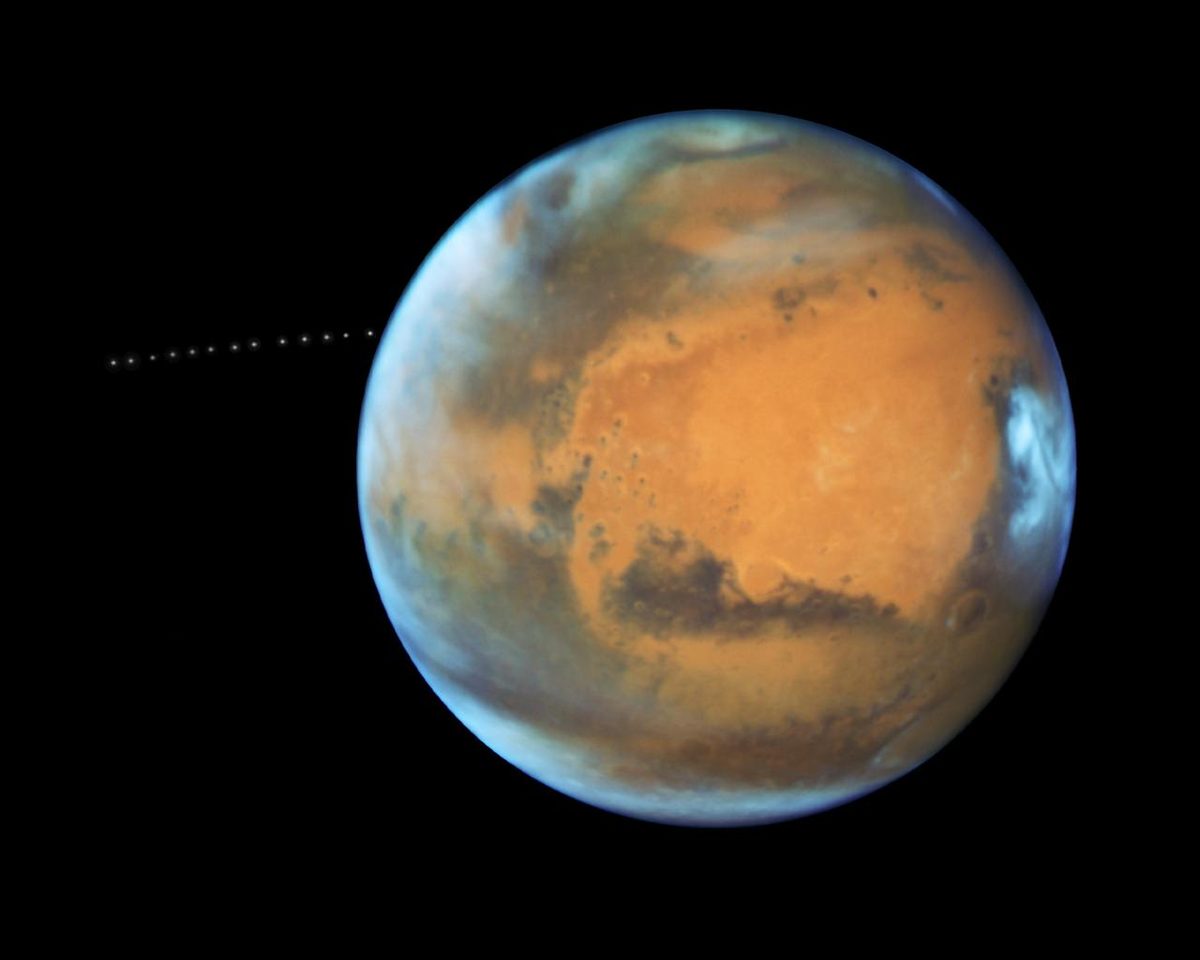
Asaph Hall discovered Phobos and Deimos in August 1877, working at the U.S. Naval Observatory with a powerful new refractor and the kind of stubborn persistence that characterizes great astronomical observing runs. He nearly gave up the night before he found them. In the 150 years since, humanity has flown past, orbited, photographed, and argued about these two small bodies orbiting Mars — and still cannot agree on where they came from. That is the essential embarrassment driving the Japan Aerospace Exploration Agency's Martian Moons eXploration mission, better known as MMX: after a century and a half, the origin of Mars's moons remains genuinely, stubbornly unknown.
MMX is designed to end that argument. Scheduled for launch in 2026 and a Phobos landing around 2027, the spacecraft will spend roughly three years in the Martian system before returning to Earth in 2031 with at least ten grams of material scooped from the Phobos surface. Ten grams sounds modest. But the Hayabusa2 team demonstrated with its asteroid Ryugu sample return — which yielded 5.4 grams of pristine carbonaceous material and upended models of organic chemistry in the early solar system — that sample mass is not the point. Provenance is. A confirmed sample from Phobos, analyzed in terrestrial laboratories with instruments that cannot be miniaturized onto a spacecraft, will either confirm or rule out the two leading origin hypotheses in ways that no remote observation can.
The Problem with Phobos
The two competing stories about Phobos and Deimos begin in very different places. The captured asteroid hypothesis holds that the moons are primitive, volatile-rich bodies from the outer solar system that were gravitationally captured by Mars billions of years ago — objects similar to the D-type and C-type asteroids found in the outer main belt, dark and carbon-rich and chemically primitive. The giant impact hypothesis proposes instead that a large impactor struck proto-Mars and threw debris into orbit, which subsequently accreted into the two moons — a scenario analogous to the leading model for Earth's Moon, but scaled down and possibly repeated.
Each hypothesis predicts a different composition, and both predictions are frustratingly consistent with what we have been able to measure remotely. Phobos is dark — albedo around 0.07, meaning it reflects only seven percent of the light that hits it, darker than charcoal. Its spectrum in the visible and near-infrared is featureless and red-sloped, resembling D-type asteroids or certain classes of primitive carbonaceous chondrites. But spectral similarity is not proof of origin. Mars ejecta that has spent billions of years in radiation-bathed space will also darken and redden through a process called space weathering. Distinguishing between a captured asteroid and a heavily weathered chunk of Mars requires knowing the actual mineralogy, the isotopic ratios, the presence or absence of hydrated minerals, the abundance of volatile elements — the kind of data that comes from laboratory instruments, not spacecraft spectrometers.
One specific measurement sits at the center of the scientific case for MMX: oxygen isotope ratios. Every rocky body in the solar system has a characteristic oxygen isotopic fingerprint, reflecting the composition of the disk from which it formed. Mars has a well-characterized oxygen isotope signature, as do various classes of chondritic meteorites. If Phobos is a captured asteroid, its oxygen isotopes will cluster near carbonaceous chondrite values. If it formed from Martian ejecta, they will cluster near the Martian signature. That single measurement — achievable in any decent geochemistry laboratory once a sample arrives — would resolve a question that has occupied planetary scientists for half a century.
What the Spacecraft Actually Does
The MMX spacecraft is not a simple sample-return probe. JAXA has designed it as a genuine science platform, carrying eleven instruments contributed by European, American, and Japanese teams. The instrument suite includes a near-infrared spectrometer (MIRS, provided by CNES) for surface composition mapping, a wide-angle multiband camera, a laser altimeter for topographic mapping, a dust monitor, a neutron and gamma-ray spectrometer for bulk elemental composition, and a Raman spectrometer for mineralogical analysis at the landing site. Two sampling mechanisms are planned: a pneumatic system that fires projectiles into the surface and collects the ejected material, and a coring device that can drill a few centimeters into the regolith. The goal of sampling at depth matters because the uppermost surface of Phobos has been processed by solar radiation and micrometeorite impacts for billions of years; a few centimeters down, the material is more chemically pristine.
Getting to Phobos is not straightforward. The moon orbits Mars at just 9,376 kilometers from the planet's center — closer to its primary than any other known moon in the solar system. Its orbital period is 7 hours and 39 minutes, meaning it completes nearly three orbits per Martian day and actually rises in the west and sets in the east from Mars's surface because it orbits faster than Mars rotates. The surface gravity is approximately 0.0057 m/s², which means a person standing on Phobos who jumps at normal walking speed could achieve escape velocity. Landing there is less like landing on a planet and more like rendezvousing with a very large, irregularly shaped object, requiring precise relative velocity matching and careful attention to the gravitational influence of Mars itself. JAXA's Hayabusa and Hayabusa2 programs gave the agency significant institutional expertise in exactly this kind of proximity operations at small bodies.
The mission will also deploy a small rover — contributed by CNES and DLR — onto the Phobos surface. The rover is designed to characterize the regolith texture, measure surface temperatures, and provide ground-truth data to correlate with orbital remote sensing. Surface conditions on Phobos include extreme temperature swings, from roughly 27°C in direct sunlight to -113°C in shadow, and a radiation environment unshielded by any significant atmosphere. The rover represents a secondary scientific investment that extends the return from a mission whose primary cost is the sample-return architecture itself.
Beyond Phobos: A Mars System Observatory
The three years MMX will spend in the Martian system before the return trip give the mission a secondary role that the science community has been explicit about wanting to exploit. The spacecraft will observe Deimos at close range, providing the first detailed characterization of the smaller and more distant of the two moons. It will also observe Mars itself from orbit — atmospheric phenomena, dust storm evolution, surface albedo changes — at spatial resolutions and cadences that complement dedicated Mars orbiters. A mission parked in the inner Martian system for three years with a capable multi-instrument payload is an opportunity that would be wasteful to squander on sample collection alone.
The return sample will arrive on Earth in 2031, packaged in a capsule that will enter the atmosphere and land in the Australian outback — the same general target area used for Hayabusa2's return in December 2020. Japanese curation facilities have been upgraded to handle Phobos material, with particular attention to contamination control and the possibility that samples may contain volatile compounds that require cold curation. The scientific community has already begun organizing sample analysis consortia, anticipating the allocation process that will distribute material to qualified laboratories worldwide.
Whether Phobos turns out to be a captured interloper or a child of Mars, the answer will force a revision somewhere in the current models of small body dynamics, planetary impact physics, or early solar system chemistry. One hundred and fifty years after Asaph Hall nearly went home early from the observatory, the question he inadvertently raised is finally going to get a definitive laboratory answer. The sample return window opens in 2031. The argument ends there.
